
Latest News
50 passengers dead in Taiwan train crash

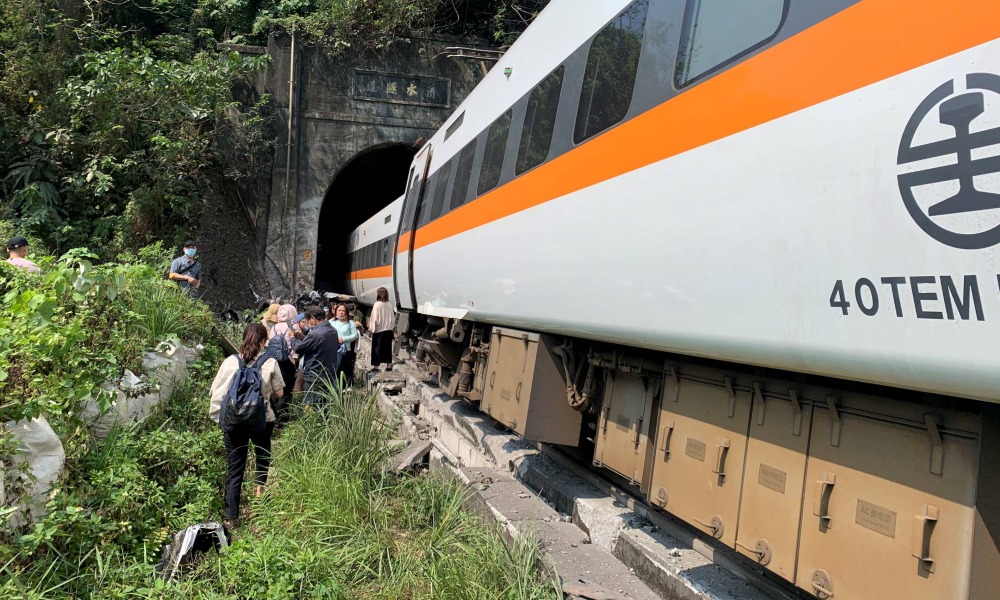
A Taiwan express train with almost 500 aboard derailed in a tunnel on Friday after hitting a truck that had slid down a bank onto the track, killing at least 50 passengers and injuring 146 in the island’s worst rail disaster in seven decades.
Images from the scene showed some carriages ripped apart by the impact, with others crumpled, hindering rescuers in their efforts to reach passengers.
By mid-afternoon no one was still trapped, though the fire department said it had found body parts, meaning the number of those killed, who included the driver, was likely to rise.
“People just fell all over each other, on top of one another,” a woman who survived the crash told domestic television. “It was terrifying. There were whole families there.”
Taiwan’s government said there were 496 people on the train, including 120 without seats. Many were tourists and people heading home at the start of a traditional long weekend holiday to tend to family graves. One French citizen was amongst the dead, officials said.
The train was traveling from Taipei, the capital, to the southeastern city of Taitung.
It came off the rails north of the eastern city of Hualien after hitting a truck that had slid off a road from a nearby construction site, Feng Hui-sheng, the Taiwan Railways Administration’s deputy director, told reporters.
Feng said the manager of the site, which was stabilizing the mountainside to prevent landslides, visited around 9 a.m. (0100 GMT) and stopped his truck in front of the site office.
“At present, it is suspected because the vehicle wasn’t braked properly, it slid for around 20 meters along the site access road and entered the eastern trunk line,” he added.
The official Central News Agency said police had taken in the manager for questioning.
The fire department showed a picture of what appeared to be the wreckage of the truck beside the derailed train, with an aerial image of one end of the train still on the track next to the construction site.
Survivors described their terror as the train slammed into the truck and ground to a halt.
“It suddenly came to a stop and then everything shook,” one told local television. “It was all so chaotic.”
Passengers in some carriages still in the tunnel had to be led to safety, the railway administration said.
Images showed an injured passenger carried away on a stretcher, with her head and neck in a brace, while others gathered suitcases and bags in a tilted, derailed carriage as some walked on the train’s roof to exit the tunnel.
The accident occurred at the beginning of a long weekend for the traditional Tomb Sweeping Day holiday.
Taiwan’s mountainous east coast is a tourist destination. The railway that snakes down from Taipei hugs the coast and is known for its tunnels, in one of which the crash took place. The link to Taipei opened in 1979.
Taiwan’s state-owned railways are generally reliable and efficient but have had a patchy safety record over the years.
The last major crash was in 2018 when 18 people died and 175 were injured when a train derailed in the island’s northeast.
In 1948, 64 people are estimated to have died when a train burst into flames in northern Taiwan.












Kazakhstan’s Foreign Minister Mukhtar Tileuberdi has called for pragmatic and coordinated international engagement with Afghanistan, saying the country’s long-term stability is closely linked to the security and sustainable development of Central Asia.
Speaking during the general debate of the 81st session of the United Nations General Assembly in New York on Friday, Tileuberdi said humanitarian assistance to Afghanistan remains essential but alone cannot break the cycle of poverty, displacement and dependency.
He said Kazakhstan supports a “pragmatic, coordinated and step-by-step” approach to international engagement with Afghanistan, with the United Nations playing a central role.
Tileuberdi also said Kazakhstan is working with the UN to operationalize the United Nations Regional Centre for the Sustainable Development Goals for Central Asia and Afghanistan in Almaty.
He said the success of the centre should be measured by the results and assistance it delivers to the region.


Abu Muslim Farah defeat Khurasan Faryab 2-0 in ACL season six

Saar: Concerns over Pakistan’s political crisis discussed

Afghanistan Champions League: Omar Zawak Herat beat Toofan Herat 1-0

Blast in Pakistan’s Dera Ismail Khan kills 11, injures 30

Ariana Afghan Airlines increases Kabul-Delhi cargo flights

Saudi energy group signs major Afghanistan deals covering gas exploration and pipeline plans

Trump floats idea of renaming Atlantic or Pacific Ocean

US hits Egyptian bank branches with Iran sanctions as war marks six months

Nepal flood rescue mission enters critical phase as thousands remain missing

Iranian clubs to face Gulf opponents at neutral venues in Asian Champions League Elite
Saar: Concerns over Pakistan’s political crisis discussed

Exclusive interview with Abdul Latif Mansoor, Minister of MRRD

Tawsia: Overview of Afghanistan’s iron mines

Tahawol: Discussion on fresh Pakistani airstrikes on Afghanistan

Saar: Calls for international support for Afghanistan discussed
-

 World5 days ago
CNN, MS NOW and Politico sue Trump, challenging White House ban
-

 Latest News3 days ago
Ariana Afghan Airlines ranks seventh among 45 Central Asian airlines
-

 Latest News5 days ago
UN reiterates call for respect for international law after Kunar airstrikes
-

 Regional4 days ago
US and Iran hold first talks since June after Trump’s ‘annihilation’ threat
-

 Latest News3 days ago
Silk Road highway in Wakhan corridor now reaches the China border
-

 Latest News5 days ago
Afghan Official: Pakistan’s airstrikes will not go unanswered
-

 Regional3 days ago
Iran airlines cancel flights as US sanctions hit
-

 Sport4 days ago
Afghan boxing referee heads to China for international festival