
Latest News
SCO foreign ministers issue joint statement on Afghanistan

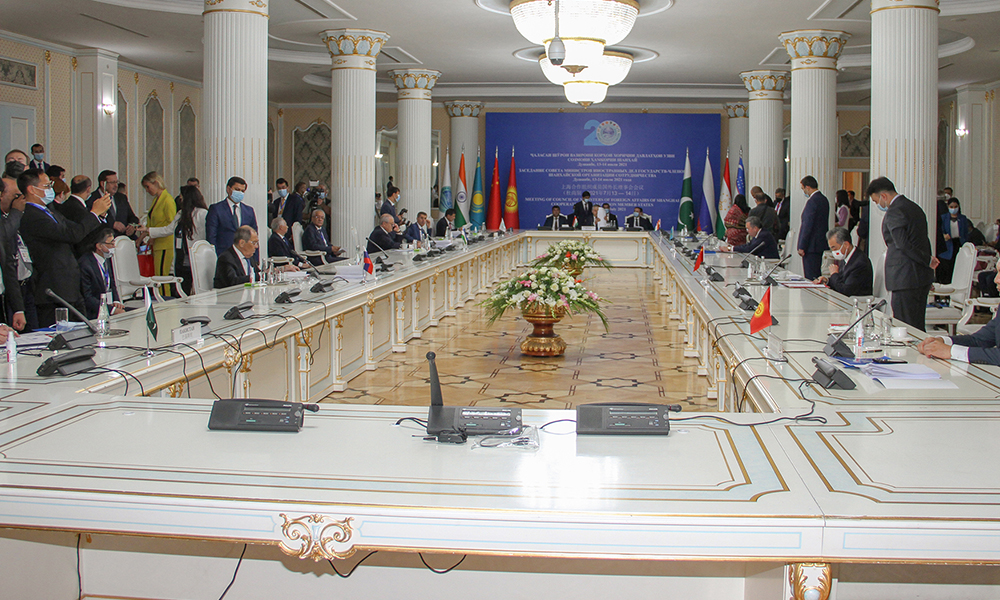
Foreign ministers of the Shanghai Cooperation Organization (SCO) member countries issued a joint statement following a meeting in the format of the SCO-Afghanistan Contact Group on Wednesday.
The foreign ministers stand for the development of Afghanistan as an independent, neutral, united, peaceful, democratic and prosperous state, according to the statement.
They realize that peace and stability in that country is one of the main factors in ensuring security in the SCO region, the statement said, adding that the ministers are convinced of the need to continue helping the Afghan people in their efforts to restore the country and return to the road of peace and national accord.
The foreign ministers declared in the statement the following:
“As friendly neighbors and important partners of Afghanistan, the SCO member states are interested in its development as a peaceful, stable and prosperous country, and confirm their respect for the traditions and culture of all peoples living in Afghanistan.
In accordance with universally accepted principles and norms of international law, primarily the UN Charter, the SCO countries reaffirm their respect for the sovereignty, independence and territorial integrity of Afghanistan. They intend to facilitate the development of Afghanistan as a country free from terrorism, war and drugs.
“We condemn the violence and terror attacks that continue in Afghanistan, killing civilians and representatives of government bodies and call for their cessation as soon as possible. We note that the activities of international terrorist organizations remain one of the key factors of instability in that country. We express our deep concern over the escalation of tensions in the northern provinces of Afghanistan as a result of a sharp increase in the concentration of various terrorist, separatist and extremist groups. We consider it important for the SCO member states to enhance their joint efforts in order to counteract terrorism, separatism and extremism.
“We urge all parties involved in the conflict in Afghanistan to refrain from the use of force and actions that may lead to destabilization and unpredictable consequences near the Afghan borders with the SCO states.”
The SCO member states reaffirm their willingness to continue developing cooperation with Afghanistan on countering security threats in the region, in particular, all forms and manifestations of terrorism and drug trafficking, and to jointly oppose double standards in resolving these tasks.
Emphasizing the importance of long-term hospitality and effective aid for Afghan refugees, the SCO members consider it important for the international community to take active joint efforts to facilitate their proper, safe and sustainable return home.
“We believe that reaching an early settlement in Afghanistan is a major factor in maintaining and strengthening security and stability in the SCO space. In this context, we emphasize the need for the government and people of the Islamic Republic of Afghanistan to intensify their efforts to restore peace, promote national economic development and counter terrorism, extremism and drug-related crime. We confirm the position of the SCO members that the conflict in Afghanistan can only be settled by political dialogue and an inclusive peace process conducted and led by the Afghans themselves.
“We urge all interested states and international organizations to strengthen their cooperation, with the UN playing a central coordinating role, in order to stabilize and develop the country. In this context, we note the activities of the UN Assistance Mission in Afghanistan, the Special Envoy of the UN Secretary-General and the UN Regional Centre for Preventive Diplomacy.
“We welcome the diplomatic support for the peace process in Afghanistan by the international public, including the inter-Afghan peace talks in Doha, the extended Troika, the Moscow consultations format and the Tashkent venue. We note the outcome of the ministerial meeting of the Heart of Asia – Istanbul process in Dushanbe on March 29-30, 2021.
Respecting the Afghan people’s independent choice of their own path of development, we are convinced that the inter-Afghan negotiations must consider the interests of all ethnic groups living in the country.
“We attach much importance to our cooperation in the SCO-Afghanistan Contact Group. We consider it necessary to consistently implement the roadmap for further action by the Contact Group, which was adopted in Bishkek on June 14, 2019, with a view to strengthening regional stability and developing relations between the SCO states and Afghanistan.
“We reaffirm the willingness of our countries to continue deepening cooperation with Afghanistan in politics and security, as well as in the economic and humanitarian spheres, including by maximizing the potential of Afghanistan‘s participation as an observer state in the SCO’s activities.”












Kazakhstan’s Foreign Minister Mukhtar Tileuberdi has called for pragmatic and coordinated international engagement with Afghanistan, saying the country’s long-term stability is closely linked to the security and sustainable development of Central Asia.
Speaking during the general debate of the 81st session of the United Nations General Assembly in New York on Friday, Tileuberdi said humanitarian assistance to Afghanistan remains essential but alone cannot break the cycle of poverty, displacement and dependency.
He said Kazakhstan supports a “pragmatic, coordinated and step-by-step” approach to international engagement with Afghanistan, with the United Nations playing a central role.
Tileuberdi also said Kazakhstan is working with the UN to operationalize the United Nations Regional Centre for the Sustainable Development Goals for Central Asia and Afghanistan in Almaty.
He said the success of the centre should be measured by the results and assistance it delivers to the region.


Abu Muslim Farah defeat Khurasan Faryab 2-0 in ACL season six

Saar: Concerns over Pakistan’s political crisis discussed

Afghanistan Champions League: Omar Zawak Herat beat Toofan Herat 1-0

Blast in Pakistan’s Dera Ismail Khan kills 11, injures 30

Ariana Afghan Airlines increases Kabul-Delhi cargo flights

Saudi energy group signs major Afghanistan deals covering gas exploration and pipeline plans

Trump floats idea of renaming Atlantic or Pacific Ocean

US hits Egyptian bank branches with Iran sanctions as war marks six months

Nepal flood rescue mission enters critical phase as thousands remain missing

Iranian clubs to face Gulf opponents at neutral venues in Asian Champions League Elite
Saar: Concerns over Pakistan’s political crisis discussed

Exclusive interview with Abdul Latif Mansoor, Minister of MRRD

Tawsia: Overview of Afghanistan’s iron mines

Tahawol: Discussion on fresh Pakistani airstrikes on Afghanistan

Saar: Calls for international support for Afghanistan discussed
-

 World5 days ago
CNN, MS NOW and Politico sue Trump, challenging White House ban
-

 Latest News3 days ago
Ariana Afghan Airlines ranks seventh among 45 Central Asian airlines
-

 Latest News5 days ago
UN reiterates call for respect for international law after Kunar airstrikes
-

 Regional4 days ago
US and Iran hold first talks since June after Trump’s ‘annihilation’ threat
-

 Latest News3 days ago
Silk Road highway in Wakhan corridor now reaches the China border
-

 Regional3 days ago
Iran airlines cancel flights as US sanctions hit
-

 Latest News5 days ago
Afghan Official: Pakistan’s airstrikes will not go unanswered
-

 Regional5 days ago
G7 foreign ministers call on Iran to stop arming Houthis