
Latest News
Six killed in suicide attack on Chinese engineers in Pakistan

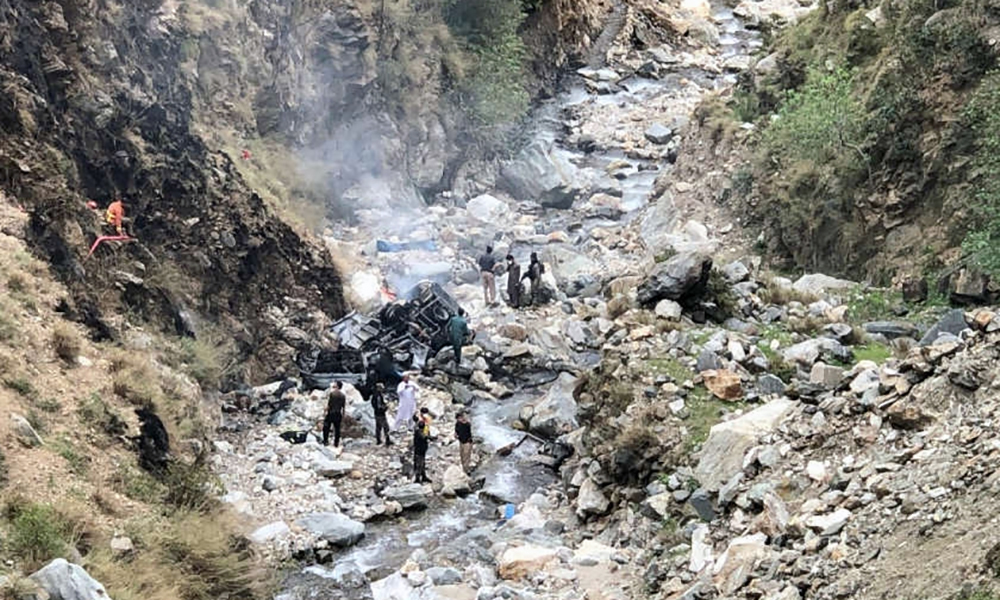
A suicide bomber rammed a vehicle into a convoy of Chinese engineers working on a dam project in northwest Pakistan on Tuesday, killing six people, police said, the third major attack on Chinese interests in the South Asian country in a week, Reuters reported.
The first two attacks hit an airbase and a strategic port in the southwest province of Balochistan where China is investing billions in infrastructure projects.
The engineers were on their way from Islamabad to their camp at the dam construction site in Dasu in the Khyber Pakhtunkhwa province, Mohammad Ali Gandapur, the regional police chief, told Reuters.
“Five Chinese nationals and their Pakistani driver were killed in the attack,” Gandapur said.
Dasu is the site of a major dam and the area has been attacked in the past. A blast on a bus killed 13 people, including nine Chinese nationals, in 2021.
Chinese engineers have been working on a number of projects Pakistan with Beijing investing over $65 billion in infrastructure projects as part of the China Pakistan Economic Corridor (CPEC) under its wider Belt and Road initiative.
No one claimed responsibility for Tuesday’s attack, nor was there a claim for the 2021 attack. Pakistan is home to twin insurgencies – one by Islamists and the other ethnic militants seeking secession, read the report.
While Chinese interests are primarily targeted by the ethnic militants seeking to push Beijing out of mineral-rich Balochistan, they generally operate in the country’s south and southwest – far from the site of Tuesday’s attack.
Islamists mostly operate in the country’s northwest in the area the convoy was attacked.
The Khyber Pakhtunkhwa police had reached the spot and started relief operations, Reuters reported.
A separate police source told Reuters the convoy was carrying staff of the construction firm China Gezhouba Group Company (CGGC) working on the Dasu hydropower project – the same company targeted in 2021.
Construction work ceased for months after that attack.
China’s embassy in Islamabad did not immediately respond to an emailed request for comment.
The attacks come a week before Prime Minister Shehbaz Sharif is expected to fly to Beijing, according to a source in the Prime Minister’s Office. It will be Sharif’s first visit since taking office following February elections.
Pakistani Foreign Minister Ishaq Dar condemned the attack, and said the country would continue to fight back against militants.












Kazakhstan’s Foreign Minister Mukhtar Tileuberdi has called for pragmatic and coordinated international engagement with Afghanistan, saying the country’s long-term stability is closely linked to the security and sustainable development of Central Asia.
Speaking during the general debate of the 81st session of the United Nations General Assembly in New York on Friday, Tileuberdi said humanitarian assistance to Afghanistan remains essential but alone cannot break the cycle of poverty, displacement and dependency.
He said Kazakhstan supports a “pragmatic, coordinated and step-by-step” approach to international engagement with Afghanistan, with the United Nations playing a central role.
Tileuberdi also said Kazakhstan is working with the UN to operationalize the United Nations Regional Centre for the Sustainable Development Goals for Central Asia and Afghanistan in Almaty.
He said the success of the centre should be measured by the results and assistance it delivers to the region.


Abu Muslim Farah defeat Khurasan Faryab 2-0 in ACL season six

Saar: Concerns over Pakistan’s political crisis discussed

Afghanistan Champions League: Omar Zawak Herat beat Toofan Herat 1-0

Blast in Pakistan’s Dera Ismail Khan kills 11, injures 30

Ariana Afghan Airlines increases Kabul-Delhi cargo flights

Saudi energy group signs major Afghanistan deals covering gas exploration and pipeline plans

Trump floats idea of renaming Atlantic or Pacific Ocean

US hits Egyptian bank branches with Iran sanctions as war marks six months

Nepal flood rescue mission enters critical phase as thousands remain missing

Iranian clubs to face Gulf opponents at neutral venues in Asian Champions League Elite
Saar: Concerns over Pakistan’s political crisis discussed

Exclusive interview with Abdul Latif Mansoor, Minister of MRRD

Tawsia: Overview of Afghanistan’s iron mines

Tahawol: Discussion on fresh Pakistani airstrikes on Afghanistan

Saar: Calls for international support for Afghanistan discussed
-

 World5 days ago
CNN, MS NOW and Politico sue Trump, challenging White House ban
-

 Latest News3 days ago
Ariana Afghan Airlines ranks seventh among 45 Central Asian airlines
-

 Latest News4 days ago
UN reiterates call for respect for international law after Kunar airstrikes
-

 Regional3 days ago
US and Iran hold first talks since June after Trump’s ‘annihilation’ threat
-

 Latest News3 days ago
Silk Road highway in Wakhan corridor now reaches the China border
-

 Latest News4 days ago
Afghan Official: Pakistan’s airstrikes will not go unanswered
-

 Sport4 days ago
Afghan boxing referee heads to China for international festival
-

 Regional5 days ago
G7 foreign ministers call on Iran to stop arming Houthis