
Latest News
Afghan government releases 900 Taliban prisoners

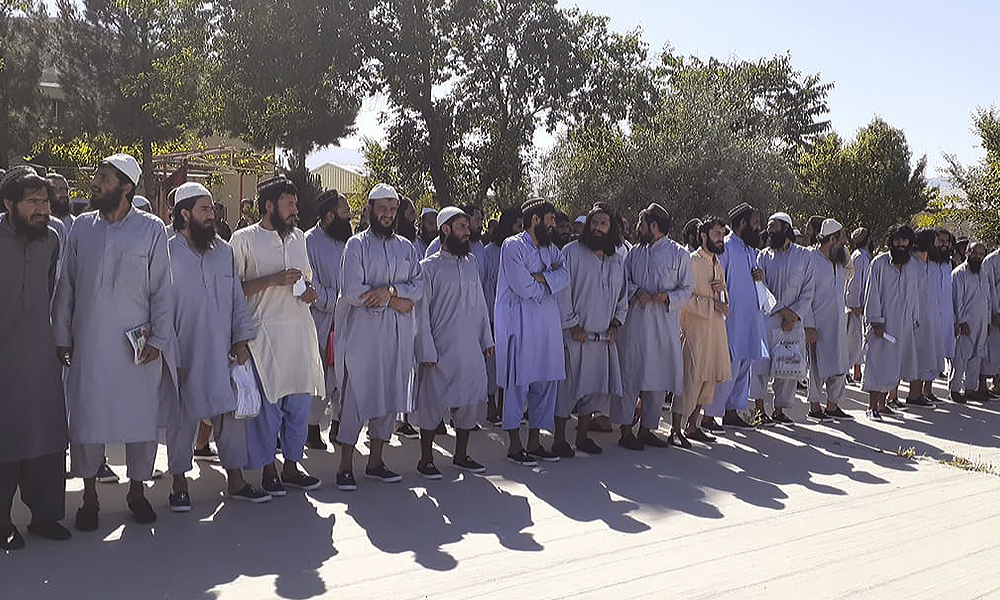
The Afghan government has released another 900 Taliban prisoners from jails on Tuesday, the government confirmed.
The Office of the National Security Council said that the step was taken “to advance the cause of peace, including the continuation of the bilateral ceasefire and the immediate start of direct negotiations.”
The Government is releasing up to 900 Taliban prisoners from across Afghanistan today to advance the cause of peace, including the continuation of the bilateral ceasefire and the immediate start of direct negotiations.
— Office of the National Security Council (@NSCAfghan) May 26, 2020
Ariana News’ correspondent Shahpoor Farahmand reported from Parwan province that 581 inmates were released from Bagram jail while the rest were released from Kabul and other provinces.
According to him, the released prisoners have taken an oath never to return to the battlefield.
Many released inmates have told that they would follow their leader’s directions while some others said they would continue fighting until foreign troops leave Afghanistan.
Mohammadullah, a prisoner who spent 16 years of his life in jail, says that he would pick up weapons again unless the American forces withdraw Afghanistan.
“I will go for my previous job and continue Jihad (Holy war),” Mohammadullah added.
The Afghan government released a batch of 100 Taliban prisoners on Monday from Parwan jail, so far, 2000 Taliban inmates have been released, while the Taliban has released 200 government inmates only.
Meanwhile, the Taliban militant group has welcome the government’s move and call it as a gesture of goodwill.
“Release of 2000 prisoners by the other side is a good step. The stipulation in the Doha Agreement for the release of 5000 prisoners was to create a conducive atmosphere of confidence. This process should be completed in order to remove hurdles in the way of commencement of intra-Afghan negotiations and to pave the way for further progress which is to follow,” the group’s political spokesman, Suhail Shaheen said in a tweet on Tuesday.
He added that the Taliban is committed to the “release of prisoners on its own part.”
It comes as the two sides declared a 3-day ceasefire during the Eid Ul-Fitr.












Kazakhstan’s Foreign Minister Mukhtar Tileuberdi has called for pragmatic and coordinated international engagement with Afghanistan, saying the country’s long-term stability is closely linked to the security and sustainable development of Central Asia.
Speaking during the general debate of the 81st session of the United Nations General Assembly in New York on Friday, Tileuberdi said humanitarian assistance to Afghanistan remains essential but alone cannot break the cycle of poverty, displacement and dependency.
He said Kazakhstan supports a “pragmatic, coordinated and step-by-step” approach to international engagement with Afghanistan, with the United Nations playing a central role.
Tileuberdi also said Kazakhstan is working with the UN to operationalize the United Nations Regional Centre for the Sustainable Development Goals for Central Asia and Afghanistan in Almaty.
He said the success of the centre should be measured by the results and assistance it delivers to the region.


Abu Muslim Farah defeat Khurasan Faryab 2-0 in ACL season six

Saar: Concerns over Pakistan’s political crisis discussed

Afghanistan Champions League: Omar Zawak Herat beat Toofan Herat 1-0

Blast in Pakistan’s Dera Ismail Khan kills 11, injures 30

Ariana Afghan Airlines increases Kabul-Delhi cargo flights

Saudi energy group signs major Afghanistan deals covering gas exploration and pipeline plans

Trump floats idea of renaming Atlantic or Pacific Ocean

US hits Egyptian bank branches with Iran sanctions as war marks six months

Nepal flood rescue mission enters critical phase as thousands remain missing

Iranian clubs to face Gulf opponents at neutral venues in Asian Champions League Elite
Saar: Concerns over Pakistan’s political crisis discussed

Exclusive interview with Abdul Latif Mansoor, Minister of MRRD

Tawsia: Overview of Afghanistan’s iron mines

Tahawol: Discussion on fresh Pakistani airstrikes on Afghanistan

Saar: Calls for international support for Afghanistan discussed
-

 World5 days ago
CNN, MS NOW and Politico sue Trump, challenging White House ban
-

 Latest News3 days ago
Ariana Afghan Airlines ranks seventh among 45 Central Asian airlines
-

 Latest News5 days ago
UN reiterates call for respect for international law after Kunar airstrikes
-

 Regional4 days ago
US and Iran hold first talks since June after Trump’s ‘annihilation’ threat
-

 Latest News4 days ago
Silk Road highway in Wakhan corridor now reaches the China border
-

 Regional3 days ago
Iran airlines cancel flights as US sanctions hit
-

 Latest News5 days ago
Afghan Official: Pakistan’s airstrikes will not go unanswered
-

 Sport5 days ago
Afghan boxing referee heads to China for international festival