/var/www/vhosts/ariananews.af/httpdocs/wp-content/themes/ariana-news/parts/post-single.php on line 153
">
Warning: Undefined array key 0 in /var/www/vhosts/ariananews.af/httpdocs/wp-content/themes/ariana-news/parts/post-single.php on line 153
Warning: Attempt to read property "cat_name" on null in /var/www/vhosts/ariananews.af/httpdocs/wp-content/themes/ariana-news/parts/post-single.php on line 153
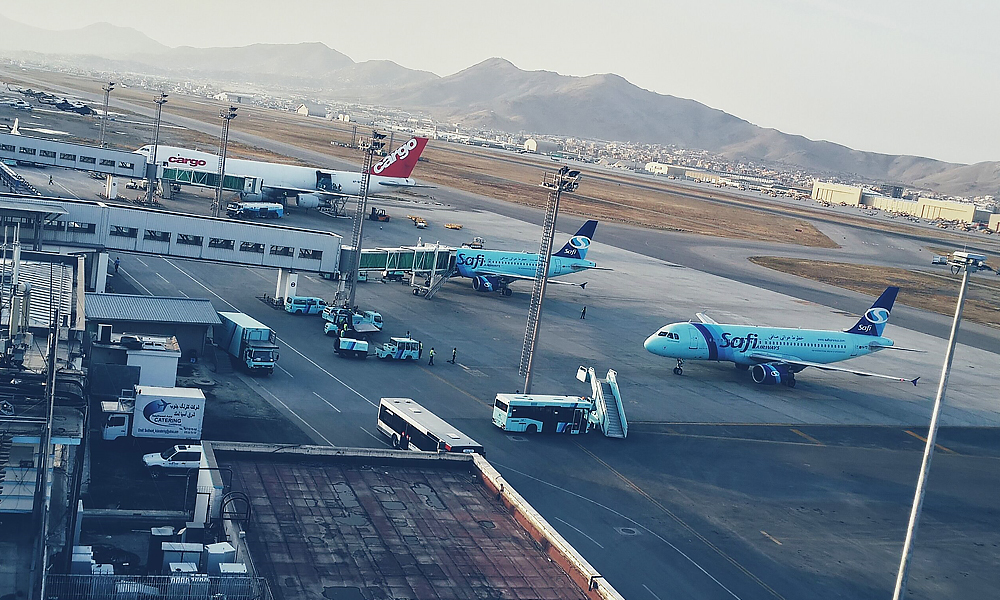
Afghanistan resumes Intl flights after three months of Coronavirus halt
Afghanistan has allowed some international airlines to operate flights to and from the country from today with special precautions after a gap of three months due to the COVID-19 outbreak.
Afghanistan Civil Aviation Authority said in a statement that the Turkish Airlines will resume flights on Wednesday, 24th of June.
According to the statement, Emirates Airlines will resume flights to Kabul’s Hamid Karzai International Airports by tomorrow, 25th of June.
“All passengers holding visas and residents permit for Turkey, UAE, European countries and the US can take international flights from tomorrow (today),” the Civil Aviation Authority said Tuesday.
Meanwhile, domestic airlines – Ariana and Kam Air – have also resumed international flights, the organization added.
It comes as flights to/from most of the countries around the globe including Afghanistan were halted due to the rapid spread of the COVID-19.
Recently, with a decline in the spread of the virus, some countries have gradually resumed their flights.

Warning: Undefined array key 0 in /var/www/vhosts/ariananews.af/httpdocs/wp-content/themes/ariana-news/parts/post-single.php on line 573
Warning: Attempt to read property "cat_ID" on null in /var/www/vhosts/ariananews.af/httpdocs/wp-content/themes/ariana-news/parts/post-single.php on line 573
Latest News
FAO warns water shortages and heat put Afghanistan’s agriculture under pressure
FAO assessed current conditions and prospects using climate forecasts, remote-sensing data and consultations with farming communities across all 34 provinces.
The Food and Agriculture Organization of the United Nations (FAO) has warned that water shortages and above-average temperatures are placing increasing pressure on summer crops and grazing across Afghanistan.
In its August 2026 outlook for Afghanistan’s 2026/27 agricultural season, FAO assessed current conditions and prospects using climate forecasts, remote-sensing data and consultations with farming communities across all 34 provinces.
The agency said persistent water shortages, combined with high temperatures, are affecting agricultural conditions during the summer season and increasing pressure on crops and livestock.
FAO also warned that persistently high fertilizer prices could limit farmers’ ability to invest in the upcoming winter wheat season, potentially affecting production prospects.
Looking ahead, the report says a strengthening El Niño and the possible development of a positive Indian Ocean Dipole could bring above-average precipitation during winter and spring.
Such conditions could improve water availability and boost prospects for agricultural production, but FAO cautioned that heavier rainfall could also increase the risk of floods, landslides, crop damage and livestock losses.
The agency said the latest outlook highlights the need for continued monitoring, anticipatory action and timely, practical climate and agricultural advisories to help farmers and livestock owners prepare for changing conditions.
World
US military operations killed 153 civilians in 2025, Pentagon assessment shows
A Pentagon report submitted to the U.S. Congress and published by U.S. media said all civilian deaths and injuries recorded in 2025 resulted from three U.S. strikes in Yemen.
U.S. military operations killed 153 civilians and wounded 243 others in 2025, a U.S. official said on Tuesday, citing Pentagon assessments.
According to Reuters, the figures represent a sharp increase from 2024, when Pentagon assessments recorded two civilian deaths and two injuries linked to U.S. military operations.
A Pentagon report submitted to the U.S. Congress and published by U.S. media said all civilian deaths and injuries recorded in 2025 resulted from three U.S. strikes in Yemen.
The report said the U.S. Central Command assessed that the three strikes carried out in April 2025 in Yemen “more likely than not” resulted in civilian harm.
As of February 2026, the report said, 15 other incidents in Yemen were still being assessed by U.S. Central Command following reports received through non-governmental organizations.
The U.S. military says its operations in Yemen aim to degrade the capabilities of Iran-backed Houthi militants.
The Pentagon report did not include casualties from U.S. strikes in the Caribbean and Eastern Pacific. It said that as of February 1, 2026, the U.S. Southern Command had assessed that no incidents in its area of responsibility in 2025 “more likely than not” resulted in civilian casualties.
The Trump administration has also carried out strikes on vessels it accuses of transporting narcotics in the Eastern Pacific, describing the targets as “narco-terrorists.” According to a Reuters tally based on death tolls published after each strike, more than 200 people have been killed in such operations since September 2025.
Human Rights Watch and Amnesty International have described the strikes as unlawful extrajudicial killings, while the American Civil Liberties Union has called the Trump administration’s claims about those targeted “unsubstantiated, fear-mongering claims.”
Latest News
Hana raises concerns over Afghan women and children amid Iran’s expulsion policy
It said the risks are particularly serious for children born in Iran or those who have spent much of their lives there.
The Hana Human Rights Organization has raised serious concerns over the situation of Afghan women and children in Iran, saying the country’s plan to regulate and expel undocumented Afghan nationals remains in effect.
According to Hana, Iran’s Ministry of Interior has confirmed that the “Plan for the Regulation and Expulsion of Unauthorized Afghan Nationals” has not been suspended.
The organization said the policy is continuing amid the consequences of armed conflict and an increasingly securitized environment in Iran, which it said has heightened the vulnerability of Afghan migrants and asylum seekers.
Hana said it has previously documented cases involving the arrest and mistreatment of Afghan nationals, deportations, family separation and difficulties obtaining civil documentation and accessing essential services.
The organization warned that continued implementation of the expulsion policy could worsen these problems.
Hana expressed particular concern for Afghan children under 18, stressing that children’s rights are independent of their parents’ migration status.
It said irregular residence should not, by itself, justify a child’s detention, separation from family or removal without an individualized assessment. Any decision affecting a child, it added, should prioritize the child’s best interests, preserve family unity and provide additional safeguards for unaccompanied and separated children.
The organization warned that large-scale expulsions without clear procedures to identify and protect children at risk could result in family separation, disruption to education, lack of legal protection, difficulties establishing legal identity, exploitation and return to unsafe conditions.
It said the risks are particularly serious for children born in Iran or those who have spent much of their lives there.
Hana also highlighted gender-specific risks facing Afghan women and girls. It warned that deportation to Afghanistan without assessing risks linked to gender, previous political or social activities, family circumstances and access to support networks could expose them to serious human rights violations.
The organization said being classified as an “unauthorized foreign national” should not replace an individual assessment of a person’s protection needs and the risks they may face upon return.
Hana stressed that while states have the authority to regulate the entry and residence of foreign nationals, migration enforcement must comply with international human rights principles, including non-refoulement, the prohibition of collective expulsion, access to individualized procedures and respect for family unity.
It called for heightened protection for women and children, warning that continuing the expulsion plan without effective legal and protection safeguards could lead to further human rights violations against Afghan migrants and asylum seekers in Iran.
-
Sport3 days agoAfghanistan secure direct qualification for 2027 Men’s ODI World Cup
-
Regional4 days agoGoods transporters to go on strike from Saturday after talks with Pakistan govt fail
-
Latest News3 days agoPakistan-backed armed groups in Balochistan using former Afghan government forces: report
-
Sport4 days agoRashid Khan takes six as Afghanistan thrash Ireland by 92 runs
-
World4 days agoUS Senate passes Russia sanctions championed by Graham; US House next
-
Sport2 days agoAbasin Defenders stun Kabul Zalmi in Kabul Premier League
-
Latest News4 days agoMoldova president criticizes visa approval for IEA delegation
-
Regional3 days agoTurkey, Pakistan, Saudi Arabia defence pact technically same as NATO’s Article 5, Turkish minister says