
Latest News
Explosion at Samangan school sparks widespread condemnation


The deadly explosion on Wednesday at the Al-Jihadi school in the city of Aybak, the center of Samangan province, which killed and injured a number of children and teenagers, has sparked widespread condemnation both locally and internationally.
According to an announcement by the Ministry of Interior, 10 children died and a number of others were injured in the explosion.
US Special Representative for Afghanistan Thomas West, in a series of tweets called the attack terrible.
“All Afghan children have the right to go to school without fear,” he tweeted, adding that the United States condemns this senseless attack against innocent civilians.
Amnesty International called the blast “disturbing”, and stated it was “yet another reminder to the world that the sufferings of Afghan people are far from over.”
Amnesty International has said that Afghanistan demands the attention of the world and that determined efforts must be made to protect the people of this country and that those responsible for such reprehensible attacks face justice in fair trials.
The United Nations Children’s Fund (UNICEF) has also said in its response that it is horrified by the explosion.
UNICEF added that at least 288 children were killed or injured in Afghanistan in the first half of this year, including in attacks on schools and educational environments. According to the organization, it is believed that the real figure of Wednesday’s explosion is much higher.
The United Nations Children’s Fund has said that children should never be the target of violence.
The Norwegian Ministry of Foreign Affairs also condemned the blast.
“Appalled by today’s horrendous bomb attack on a school in Samangan, Afghanistan, killing and wounding innocent people and students. These atrocities only add to the multitude of crises in Afghanistan. My thoughts go out to the victims’ families and their loved ones,” Anniken Huitfeldt, Minister of Foreign Affairs of Norway tweeted.
Germany also condemned the explosion, adding that children should be able to go to school without fear and harm.
“We are shocked and saddened by the reports of an attack on a school in Aybak in northern Afghanistan with many dead and injured, including children & young people. Children should be able to go to school without fear and harm. Our thoughts are with those who grieve for a loved one,” German Foreign Office tweeted.
Imdadullah Mahajer, head of the cultural information department in Samangan province, says that an explosion occurred on Wednesday at a religious school called Al-Jihadi in the vicinity of Aybak city, the center of Samangan province.
Mahajer said that students were praying at the time of the explosion.
According to him, 15 students were killed and a number of others were wounded. However, the IEA has put the death toll at 10.
The attack was also widely condemned by IEA officials in the country.
Mawlawi Abdul Kabir, the political deputy of the current government, has strongly condemned the explosion and said that it is against all Islamic and humanitarian principles and an “unforgivable crime”.
“The enemies of Afghanistan and Islam revealed their enmity with Islam with this attack that targeted the students of Quran and Sunnah. I assure that the perpetrators of this crime will not remain unanswered,” Kabir tweeted.
Hamid Karzai, the former president of Afghanistan, has also strongly condemned this explosion and called it against all human and Islamic values.
Abdullah Abdullah, the head of the High Council of National Reconciliation under the previous government, also condemned the incident in a Facebook message.
Abdullah wrote that attacking worshipers, students, religious schools, mosques and places of worship is against Islamic and human values.
The ministry of interior meanwhile stated that the explosion targeted a religious seminary in Samangan’s capital Aybak, killing 10 students and wounding several others.
However, reports on social media indicate that the casualty toll was much higher.
So far no group claimed responsibility for the blast.







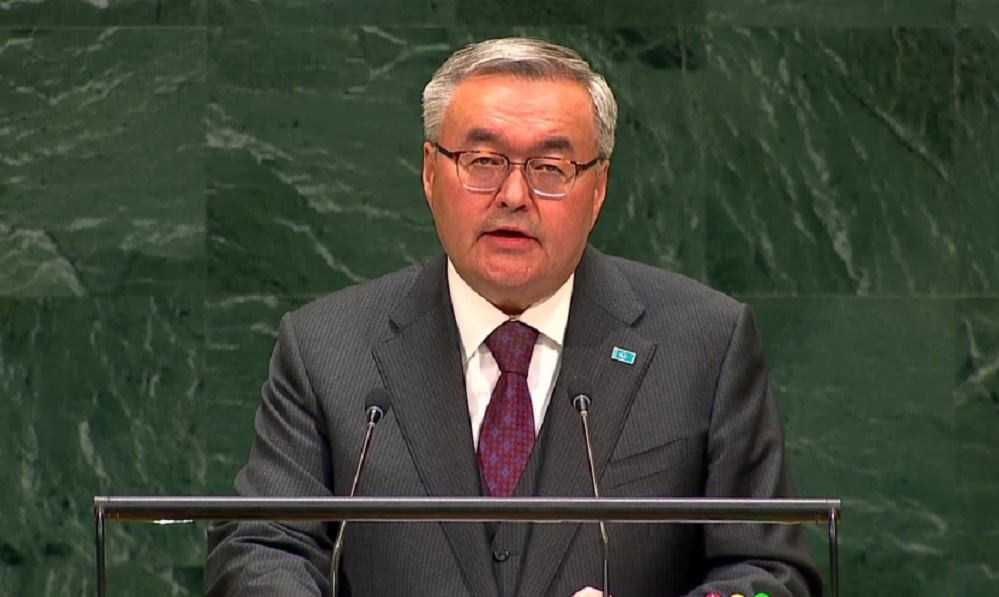
Kazakhstan’s Foreign Minister Mukhtar Tileuberdi has called for pragmatic and coordinated international engagement with Afghanistan, saying the country’s long-term stability is closely linked to the security and sustainable development of Central Asia.
Speaking during the general debate of the 81st session of the United Nations General Assembly in New York on Friday, Tileuberdi said humanitarian assistance to Afghanistan remains essential but alone cannot break the cycle of poverty, displacement and dependency.
He said Kazakhstan supports a “pragmatic, coordinated and step-by-step” approach to international engagement with Afghanistan, with the United Nations playing a central role.
Tileuberdi also said Kazakhstan is working with the UN to operationalize the United Nations Regional Centre for the Sustainable Development Goals for Central Asia and Afghanistan in Almaty.
He said the success of the centre should be measured by the results and assistance it delivers to the region.


Abu Muslim Farah defeat Khurasan Faryab 2-0 in ACL season six

Saar: Concerns over Pakistan’s political crisis discussed

Afghanistan Champions League: Omar Zawak Herat beat Toofan Herat 1-0

Blast in Pakistan’s Dera Ismail Khan kills 11, injures 30

Ariana Afghan Airlines increases Kabul-Delhi cargo flights

Saudi energy group signs major Afghanistan deals covering gas exploration and pipeline plans

Trump floats idea of renaming Atlantic or Pacific Ocean

US hits Egyptian bank branches with Iran sanctions as war marks six months

Nepal flood rescue mission enters critical phase as thousands remain missing

Iranian clubs to face Gulf opponents at neutral venues in Asian Champions League Elite
Saar: Concerns over Pakistan’s political crisis discussed

Exclusive interview with Abdul Latif Mansoor, Minister of MRRD

Tawsia: Overview of Afghanistan’s iron mines

Tahawol: Discussion on fresh Pakistani airstrikes on Afghanistan

Saar: Calls for international support for Afghanistan discussed
-

 World5 days ago
CNN, MS NOW and Politico sue Trump, challenging White House ban
-

 Latest News4 days ago
Ariana Afghan Airlines ranks seventh among 45 Central Asian airlines
-

 Latest News5 days ago
UN reiterates call for respect for international law after Kunar airstrikes
-

 Regional4 days ago
US and Iran hold first talks since June after Trump’s ‘annihilation’ threat
-

 Latest News4 days ago
Silk Road highway in Wakhan corridor now reaches the China border
-

 Regional3 days ago
Iran airlines cancel flights as US sanctions hit
-

 Latest News5 days ago
Afghan Official: Pakistan’s airstrikes will not go unanswered
-
 Regional5 days ago
G7 foreign ministers call on Iran to stop arming Houthis