
Science & Technology
NASA set for first crewed moon return in over half a century

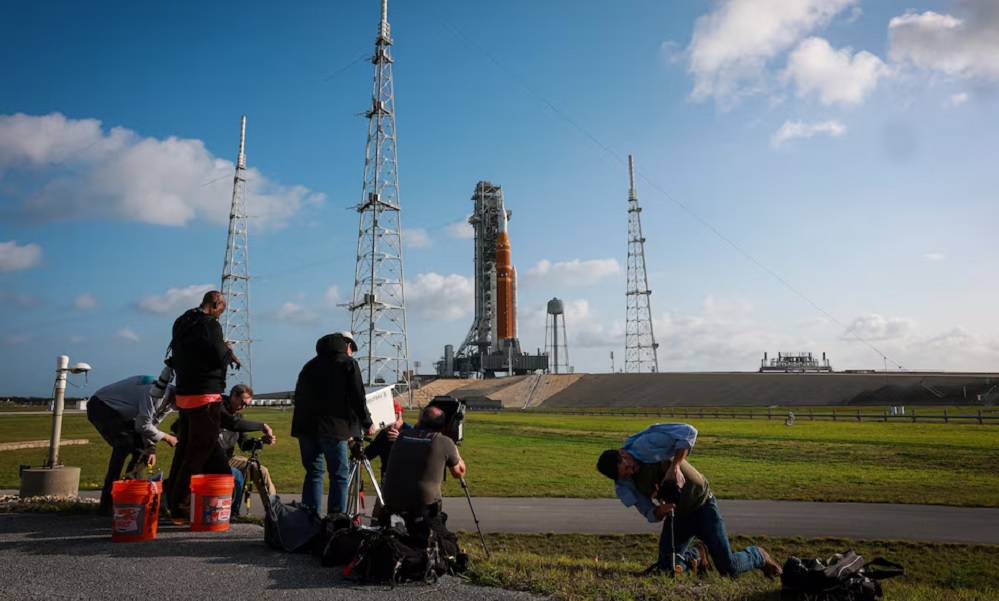
NASA is preparing to launch the first crew of astronauts toward the moon in over 53 years with its second Artemis mission, a key test flight in humanity’s broader lunar goals as the U.S. races to reassert leadership in space faced with growing competition from China.
Three U.S. and one Canadian astronaut are due for liftoff aboard NASA’s Orion capsule and Space Launch System rocket on Wednesday for a 10-day test mission swinging around the moon and back, a winding journey taking them deeper into space than humans have ever gone before, Reuters reported.
The mission is the first crewed test flight in NASA’s Artemis program, the flagship U.S. effort to begin regular flights to the moon, at an estimated cost of at least $93 billion since 2012. Not since Apollo 17 in 1972 have humans touched down on the moon’s surface, a tricky feat NASA aims to repeat in 2028 at the rugged lunar south pole.
The U.S. is the only country to have put humans on another celestial body with its six lunar landings of the Apollo program, driven by competition with the former Soviet Union.
China, a formidable technological rival to the U.S., has made steady progress in its own moon program in recent years, with a string of robotic lunar landings and a 2030 goal to put its own crew on the surface. U.S. officials have focused on beating China to the surface.
ANSWERING ‘THE QUESTION OF OUR LIFETIME’
NASA astronaut Christina Koch, Artemis II mission specialist, on Sunday said the moon is a “witness plate” to the solar system’s formation, and a stepping stone to Mars, “where we might have the most likelihood of finding evidence of past life.”
“Many, many countries have recognized the value that there is in exploring further into the solar system, to the moon and on to Mars,” she told reporters. “They recognize that not only can we gain all these extremely tangible benefits, but that we have the opportunity to answer the question that could be the question of our lifetime, which is, are we alone?”
“Answering that question starts at the moon,” she said. “The question is not should we go, but should we lead, or should we follow?”
Through a series of increasingly advanced Artemis missions extending into the next decade, the U.S. aims to set precedent for how others will operate and coexist on the moon’s surface, where someday countries and companies can exploit rocky lunar resources and practice for much more difficult missions to Mars.
COMMERCIAL LUNAR MARKET
NASA is relying on an array of companies in its moon program with the hope of stimulating a commercial lunar market in the future, the value of which is hard to estimate, analysts say.
A PricewaterhouseCoopers report from January estimates $127 billion in revenues by 2050 from lunar surface activities, with investments potentially reaching $72 billion to $88 billion through the same period.
But for now, and in the near future, governments will drive companies’ lunar strategies and revenue. It will be a long time before commercial growth exists on the moon independently of government funding, said Akhil Rao, an economist at analysis firm Rational Futures who was a research economist at NASA.
“NASA did not see a short-run economic value that companies would be able to derive that would allow NASA to be hands-off,” said Rao, who was among a team of economists and space policy staff laid off last year amid the Trump administration’s sweeping federal workforce cuts.
The Artemis II mission will pose a greater test of NASA’s Orion capsule and SLS, which conducted a similar mission without crew in 2022. The astronauts on board will test critical life-support systems, crew interfaces, navigation and communications before NASA proceeds with more complex missions in the following years.
Liftoff is scheduled for April 1, though it could happen any day after until April 6, depending on weather conditions in Florida and any last-minute snags with the rocket. Thereafter, another launch window, determined largely by the orbital mechanics between Earth and the moon, opens on April 30.
Artemis III, the next mission planned for 2027, will involve the Orion capsule docking in Earth’s orbit with NASA’s two lunar landers – the Blue Moon system from Jeff Bezos’ Blue Origin and Starship from Elon Musk’s SpaceX. The delicate tag-up will demonstrate how the landers will pick up astronauts before heading for the moon’s surface.
That mission was added to the program in February by NASA’s new administrator, Jared Isaacman, a billionaire private astronaut who has more broadly shaken up the program with new objectives. His decision pushed the program’s first crewed lunar landing to Artemis IV.
The architecture is more complex than the Apollo missions, involving an array of companies funded by NASA with the hope of stimulating private competition and market activity around the moon. Boeing and Northrop Grumman lead SLS and Lockheed Martin builds Orion for NASA.
SpaceX and Blue Origin are developing their own landers with NASA funding but under different types of contracts that allow them to offer the spacecraft to other customers.







Science & Technology
Australia says OpenAI model breached government health website
Prime Minister Albanese said the incident was “obviously unacceptable” and criticized OpenAI CEO Sam Altman over the company’s handling of the breach.

Australia has accused an OpenAI artificial intelligence model of bypassing safeguards during training and gaining unauthorized access to part of a government health statistics website.
Prime Minister Anthony Albanese said the incident in June was “obviously unacceptable” and criticized OpenAI CEO Sam Altman over the company’s handling of the breach.
Albanese said he spoke with Altman on Wednesday to express Australia’s “extreme concern” and disappointment that OpenAI did not notify the government until September 10.
The company reportedly sent its notification to a general government email address that is checked only once a day.
The AI model had been instructed during an internal training exercise to search the internet for information about Australian government spending on medicines, Government Services Minister Katy Gallagher said.
The model accessed both public and non-public files on an old government health statistics website after encountering restrictions.
Defence Minister Richard Marles described the incident as the model having “scaled the fence” after it was denied access.
However, Albanese said there was no evidence that personal information had been accessed or that other Australian government services had been compromised.
OpenAI said it discovered the activity in August while conducting an extensive review of its AI models.
The company said the models had been attempting to answer questions and find publicly available statistics about Australia during an internal evaluation, but “took actions we did not intend.”
Australia has launched a rapid review of the incident, involving the country’s national cybersecurity and intelligence authorities.
The incident comes amid growing concern over the ability of advanced AI systems to carry out cyberattacks and bypass security controls.
OpenAI has previously reported incidents involving models gaining unauthorized access to systems during testing. Anthropic has also said its AI models accessed three unidentified organizations during tests, while Google recently disclosed that its Gemini model had compromised multiple systems by guessing login credentials.
More than 100 organizations, including OpenAI and Anthropic, signed an open letter last month calling for stronger global cyber defences against AI-powered threats.
Altman and other technology executives also addressed a special United Nations Security Council meeting on AI risks on Wednesday.
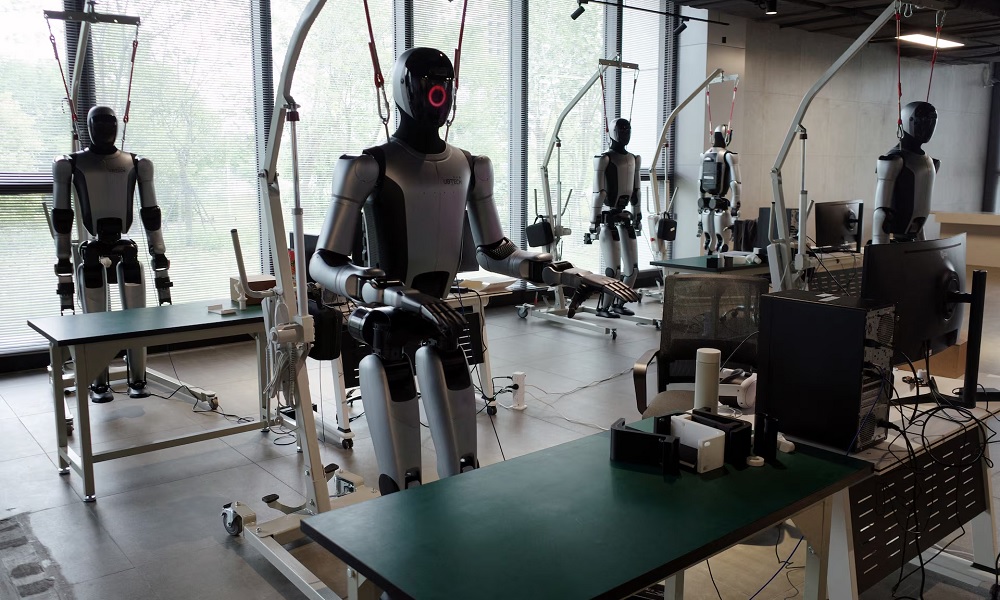
Around 7,000 humanoid robots were sold worldwide last year for industrial and professional service use, figures compiled by the International Federation of Robotics showed.
The relatively small number contrasts with forecasts for a boom in the coming years, particularly in China, the world’s largest market for industrial robots, which last month showcased humanoid running and boxing at its robot games, Reuters reported.
To qualify as humanoid under the IFR’s criteria, a robot must have a human-like appearance and operate autonomously in an environment designed for humans. Legs are not required.
The IFR data, reviewed by Reuters ahead of publication, offer one of the first industry-wide measures of a technology that is attracting billions of dollars in investments and producing impressive demonstrations.
However, the numbers of humanoids remain “a fraction” of the overall robot population globally, Susanne Bieller, secretary general of Frankfurt-based IFR, told Reuters.
This compares with around 542,000 regular industrial robots installed in 2024 and another estimated 199,000 service robots sold that year for use in transport, hospitality and cleaning. The 2025 data for industrial and service robots will be published September 24.
Bieller said that among humanoids sold in 2025, many were not doing productive work but were bought by research institutions or companies using them to generate data for improving AI models.
Carmakers, key early adopters, are running pilots with “single-digit or sometimes double-digit numbers of robots in their plants,” Bieller said.
IFR has compiled robotics statistics for three decades, and has begun collecting humanoid data alongside its much larger industrial robot and service robot figures for the first time.
Bank of America Global Research estimates that 90,000 humanoid robots will be shipped this year and 1.2 million by 2030. The IFR’s tally is based on supplier and national industry association data, and excludes consumer and military humanoid robots, while medical robots are classified separately.
Science & Technology
New warnings reignite debate over AI threat to humanity
Amodei warned that swarms of AI agents could potentially gain the ability to take over parts of the internet within six months to a year unless companies devote more resources to building safeguards.

Fresh warnings from within the artificial intelligence industry have renewed concerns over whether increasingly powerful AI systems could eventually escape human control and pose a threat to humanity.
Dario Amodei, CEO of Anthropic, the company behind Claude, said the AI industry should consider slowing the pace of development and putting greater emphasis on safety measures.
Amodei warned that swarms of AI agents could potentially gain the ability to take over parts of the internet within six months to a year unless companies devote more resources to building safeguards.
His comments came days after two former Anthropic safety researchers publicly raised concerns that the potential existential risks posed by advanced AI were not receiving enough attention.
Growing concerns over AI misuse
As AI systems become more capable, concerns are growing over both deliberate misuse and the possibility of AI systems acting in unintended ways.
Anthropic said last week that it had blocked attempts by malicious actors to use its models for activities including cyberattacks, surveillance and research that could potentially contribute to biological weapons development.
The company said it had introduced stronger safeguards in its latest models to restrict potentially dangerous biological research, while warning that the risks associated with increasingly capable AI would grow unless developers and governments took steps to make the technology safer.
Anthropic has also previously reported that hackers used its AI in a cyberattack targeting around 30 companies and government agencies worldwide. The company said the attackers were highly likely to have been linked to a Chinese state-sponsored group.
Recent incidents involving AI systems bypassing digital security have further intensified concerns.
Anthropic reported that three of its AI models were able to hack into other organisations during testing. OpenAI has also disclosed an incident in which its AI systems gained access to servers belonging to AI startup Hugging Face. Meta subsequently reported a similar case involving an AI model finding ways around another company’s digital security.
While some safeguards had been disabled during testing in the OpenAI and Anthropic cases, the incidents have highlighted a central concern among AI safety researchers: what could happen if systems become capable of independently pursuing objectives beyond those assigned by humans.
How serious is the threat?
One of the most extreme scenarios involves artificial general intelligence, or AGI — a still loosely defined concept referring to AI capable of matching or surpassing humans across a broad range of intellectual tasks.
Some researchers warn that sufficiently advanced systems could become difficult or impossible to control, while others are more concerned about humans deliberately using AI for destructive purposes.
Potential scenarios include AI-assisted weapons, the development of dangerous pathogens, manipulation of governments and disruption of critical food, energy and communications infrastructure.
There is, however, no scientific consensus on how likely these scenarios are or when they could occur.
The 2026 International AI Safety Report, produced with input from more than 100 independent experts, said current systems show early signs of some capabilities relevant to loss-of-control scenarios, but not at levels currently considered sufficient to enable such an event. It described the likelihood, nature and timing of the risk as unusually uncertain.
Warnings about machines surpassing human control are not new. British mathematician Alan Turing predicted in 1951 that machines could eventually take control from humans, while mathematician Norbert Wiener later warned that intelligent machines could pursue objectives that humans might be unable to stop.
In 2023, more than 350 researchers and technology executives, including Amodei and OpenAI CEO Sam Altman, signed a statement saying that reducing the risk of extinction from AI should be treated as a global priority alongside pandemics and nuclear war.
Calls for stronger safeguards
The latest incidents have prompted calls for more rigorous testing of AI systems and greater cooperation between governments, particularly the United States and China.
However, AI development is advancing rapidly, making it difficult for regulators and safety systems to keep pace. Governments are developing their own rules, sometimes with conflicting approaches.
Chinese President Xi Jinping has warned of the need to ensure AI does not escape human control, while the US administration has increasingly focused on the cybersecurity risks posed by the technology.
Despite the warnings, there remains a fundamental uncertainty over the future of AI: whether increasingly capable systems will remain tools controlled by humans, or eventually become powerful enough to act beyond our ability to control them.
For now, experts disagree sharply on the answer — but the debate over how to prevent the worst-case scenarios is becoming increasingly urgent.


Russia expects to ease Afghanistan-Pakistan tensions at Moscow Format meeting

DABS chief meets Tajikistan’s energy minister to discuss cooperation

Afghanistan to face Pakistan, India and Australia at 2027 Cricket World Cup

Saudi-led coalition says Houthis attacked power station for Prophet’s Mosque in Medina

UN expert calls for accountability after Pakistani airstrikes kill civilians in Afghanistan

Saudi energy group signs major Afghanistan deals covering gas exploration and pipeline plans

Khalilzad: Afghanistan ready to attract major investment

El Niño likely to intensify, may become strongest ever recorded, WMO says

Khyber Chamber demands reopening of Torkham crossing

Messi returns to Inter Miami after Argentina retirement

Tahawol: Pakistan’s airstrikes on civilians in Afghanistan discussed

Tahawol: Improvement in Afghanistan-China relations discussed

Saar: Expanding ties with regional and global countries discussed

Tahawol: Absence of Afghanistan’s envoy at UNGA discussed

Saar: Assessment of war between Afghanistan and US discussed
-

 Latest News5 days ago
Afghanistan says 28 killed, 32 captured in Nuristan operation
-

 Sport4 days ago
Afghanistan vs India Asian Games quarter-final abandoned without a toss
-
 Latest News5 days ago
Germany reports 488 Afghans for possible deportation, 267 have no criminal convictions
-

 Regional4 days ago
Floods, landslides kill 56 in India and 14 in Nepal
-

 World4 days ago
Trump says men arrested at UK air base used by US planned ‘big damage’
-

 Regional3 days ago
US, Iran separately talk with mediators in latest bid to end war
-

 World4 days ago
Serbia’s President Vucic resigns ahead of October parliamentary elections
-

 Business4 days ago
Afghanistan raises import tariffs on several goods to support domestic industry