
Latest News
Petraeus downbeat about Afghanistan’s future post pullout

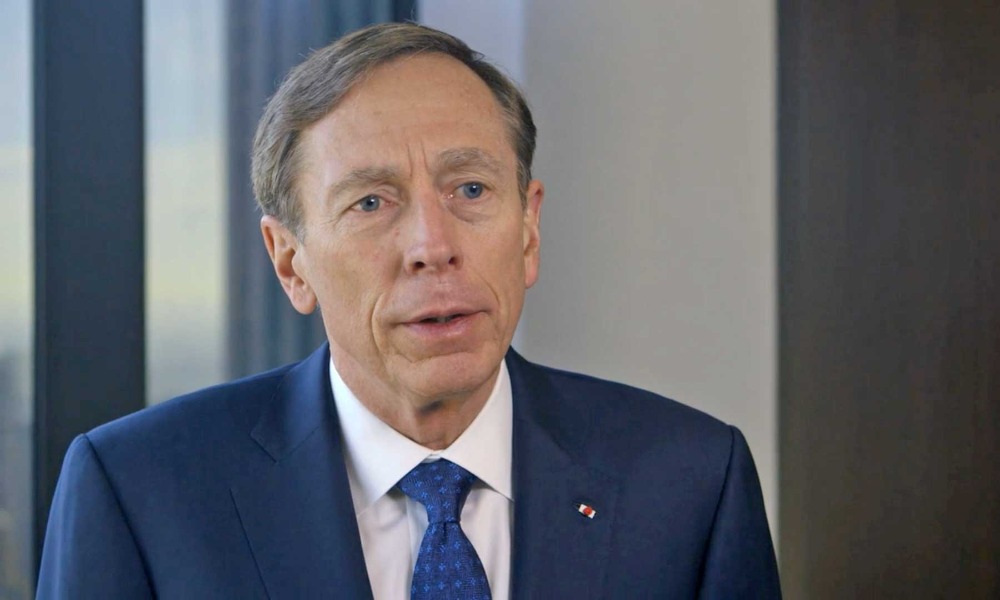
General David H. Petraeus, retired US Army general and former director of the CIA said on Saturday he fears the United States will come to regret their decision to withdraw all troops and warned of a possible civil war.
In an interview with VOA, Petraeus said despite measures being taken to mitigate risks by extremists from re-establishing safe havens in Afghanistan, he fears “that we will come to regret this because there could very well be the return of a sense of civil war, a reality of civil war.”
He said he sees “no willingness” on the Taliban’s part to commit to meaningful, verifiable and sustainable agreements “that would be necessary to enable some kind of sharing of power; some kind of again, diplomatic resolution of the issues and instead I see a Taliban who has gotten everything that they wanted from the negotiations.”
He stated the Taliban has gotten its leaders and fighters out of prison, under the Doha agreement signed between the United States and the Taliban in February last year.
“Now they are getting the U.S. to leave which then also means that our coalition partners leave,” and the foreign contractors who do the maintenance on military helicopters and fixed-wing aircraft for the Afghan defense force will also leave, he said.
He said based on this alone, one will see an erosion of security and the people will “fall back on their tribe, their ethnic group, their sectarian affiliation, their political party”.
“You may see again the kind of civil war that characterized the situation in Afghanistan after the collapse of the post-Soviet regime in Kabul which took place two or three years after the departure of Soviet forces and when the Soviet funding eventually ran out.”
But he said he had enormous admiration for the Afghan security forces who he said were fighting and dying for their country and for a democratically elected government.
“They’re fighting for a country that is very different from the one that the Taliban will establish if they are able to regain control of the country.”
He stated that should this happen, the Taliban would return Afghanistan to a “theoretic medieval government structure”.
But he said he hopes his fears are misplaced and that “this does not come to pass”.
Petraeus said he was concerned that foreign contractors might feel that once troops have withdrawn that security will not be adequate enough for them to remain, adding that he does “not see any willingness” on the Taliban’s part to “negotiate in good faith”.
He said he is aware that U.S. military commanders and American intelligence officers among other are working hard to identify ways to mitigate the risks of al-Qaeda or ISIS (Daesh) or other extremist group from establishing sanctuaries in Afghanistan,
He questioned however whether the U.S. would in fact get a base in a neighboring country stating that Pakistan has refused the request and so has Uzbekistan.
He pointed out that any flights out of bases in the Gulf states is a long commute – particularly for drones which he said had been the “unblinking eyes that were able to establish over so many areas in Afghanistan to identify when you see what could be extremist activity and the establishment of sanctuaries and
perhaps training bases and ranges and a variety of other facilities that might be the hub.”
He also said that the U.S. had destroyed on a number of occasions over the past 20 years attempts by al-Qaeda to re-establish bases in eastern Afghanistan and “more recently one down in southern Afghanistan, in Helmand province.”
This Petraeus said was “a bit of a surprise”.
However, he blamed the Taliban, the Haqqani network and the Islamic Movement of Uzbekistan for providing the grounds for terrorist organizations to establish themselves in Afghanistan.
Petraeus said it is these groups that are “eroding the security posture of Afghanistan, who are creating ungoverned spaces or spaces governed by the Taliban such as they are, and it is a fact that Islamist extremists will exploit ungoverned spaces anywhere in the Muslim world and that certainly includes Afghanistan.
He also said the U.S. has a “moral obligation” to Afghans who worked alongside American soldiers on the battlefield as interpreters, as well as those who played other roles, and said these people “and in many cases that of their family members” should be granted visas to live in the U.S.
He said while this is a long process, various options are being examined including some kind of real airlift of these individuals – even to a third Country where they could be processed.
“There is a recognition very much on Capitol Hill, certainly at the State Department in the Pentagon and increasingly in the White House that there is this moral obligation that we need to take care of those who did risk their lives as a result of what they did together with our forces.”
He said he thinks there will be some solution that will be forthcoming. “I just hope it is developed quickly enough so that we don’t end up leaving many of them behind and not meeting that very important obligation that we have incurred.”
He said he hopes however that his worst fears are not realized and that his assessment is inaccurate and that the Afghan security forces continue to receive solid assistance from the U.S. and NATO allies, from diplomats and aid workers and other international organizations.
He also said he hopes the Afghan security forces show they can stand up to the Taliban on their own and that contractors stay on in Afghanistan to maintain the equipment and weapons systems.
Petraeus also stated he hopes the Taliban will eventually engage in “true negotiations” and be willing to compromise on some issues.
He said however he does not see “enormous leverage” for U.S. special envoy Zalmay Khalilzad’s continued diplomatic efforts “given that we have told the Taliban that we are leaving.”











Kazakhstan’s Foreign Minister Mukhtar Tileuberdi has called for pragmatic and coordinated international engagement with Afghanistan, saying the country’s long-term stability is closely linked to the security and sustainable development of Central Asia.
Speaking during the general debate of the 81st session of the United Nations General Assembly in New York on Friday, Tileuberdi said humanitarian assistance to Afghanistan remains essential but alone cannot break the cycle of poverty, displacement and dependency.
He said Kazakhstan supports a “pragmatic, coordinated and step-by-step” approach to international engagement with Afghanistan, with the United Nations playing a central role.
Tileuberdi also said Kazakhstan is working with the UN to operationalize the United Nations Regional Centre for the Sustainable Development Goals for Central Asia and Afghanistan in Almaty.
He said the success of the centre should be measured by the results and assistance it delivers to the region.


Abu Muslim Farah defeat Khurasan Faryab 2-0 in ACL season six

Saar: Concerns over Pakistan’s political crisis discussed

Afghanistan Champions League: Omar Zawak Herat beat Toofan Herat 1-0

Blast in Pakistan’s Dera Ismail Khan kills 11, injures 30

Ariana Afghan Airlines increases Kabul-Delhi cargo flights

Saudi energy group signs major Afghanistan deals covering gas exploration and pipeline plans

Trump floats idea of renaming Atlantic or Pacific Ocean

US hits Egyptian bank branches with Iran sanctions as war marks six months

Nepal flood rescue mission enters critical phase as thousands remain missing

Iranian clubs to face Gulf opponents at neutral venues in Asian Champions League Elite
Saar: Concerns over Pakistan’s political crisis discussed

Exclusive interview with Abdul Latif Mansoor, Minister of MRRD

Tawsia: Overview of Afghanistan’s iron mines

Tahawol: Discussion on fresh Pakistani airstrikes on Afghanistan

Saar: Calls for international support for Afghanistan discussed
-

 World5 days ago
CNN, MS NOW and Politico sue Trump, challenging White House ban
-

 Latest News3 days ago
Ariana Afghan Airlines ranks seventh among 45 Central Asian airlines
-

 Latest News5 days ago
UN reiterates call for respect for international law after Kunar airstrikes
-

 Regional4 days ago
US and Iran hold first talks since June after Trump’s ‘annihilation’ threat
-

 Latest News4 days ago
Silk Road highway in Wakhan corridor now reaches the China border
-

 Regional3 days ago
Iran airlines cancel flights as US sanctions hit
-

 Latest News5 days ago
Afghan Official: Pakistan’s airstrikes will not go unanswered
-

 Sport5 days ago
Afghan boxing referee heads to China for international festival