
Climate Change
Thousands on alert in Indonesia’s Java after volcano erupts

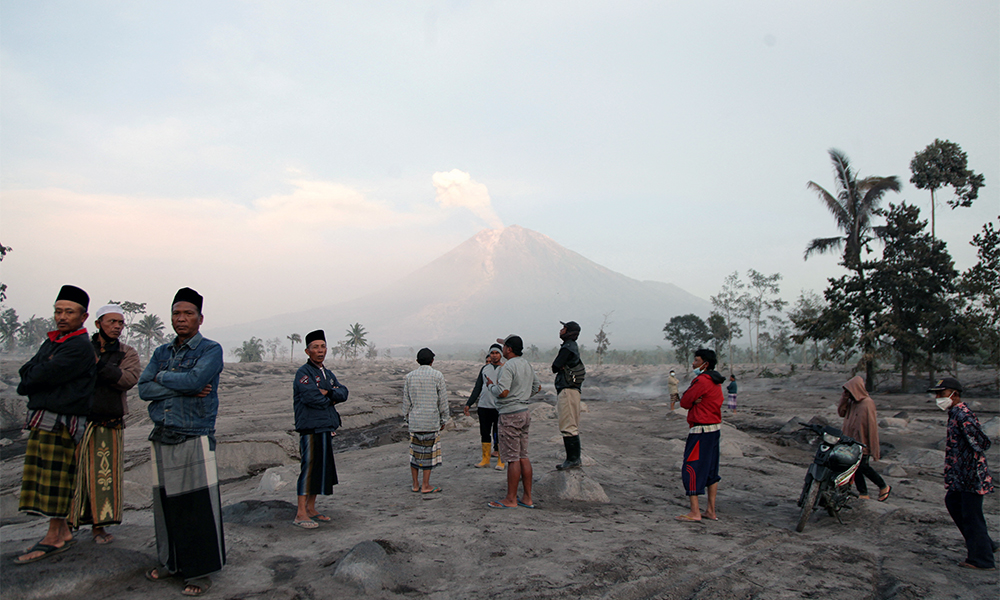
Thousands of residents in Indonesia’s East Java were on high alert on Monday after a violent eruption at the island’s tallest volcano prompted authorities to impose an 8-kilometer no-go zone and forced evacuations of entire villages.
The provincial search and rescue agency deployed teams to the worst-affected areas near Mount Semeru to assess damage, with low rainfall giving some reprieve, Tholib Vatelehan, a Basarnas spokesperson, told Reuters.
“Yesterday, the rainfall level was high, causing all the material from the top of the mountain to come down. But today, so far, there’s no rain, so it’s relatively safe,” he said.
No casualties have been reported and there has not been any immediate disruption to air travel.
The 3,676-meter volcano erupted at 2.46pm local time on Sunday. Footage shot by local residents showed Mt. Semeru spewing a giant cloud of gray ash high above its crater, which later engulfed the mountain and surrounding rice paddy fields, roads and bridges, and turned the sky black. A video shared by the Environment Ministry on Twitter showed a pyroclastic flow of lava, rocks and hot gasses gushing down the mountainside.
People fled the eruption on motorcycles, with almost 2,500 people forced to evacuate, authorities said.
Semeru erupted last year killing more than 50 people and displacing thousands more.
The eruption, some 640 km east of the capital, Jakarta, follows a series of earthquakes in the west of Java, including one last month that killed more than 300 people.
An archipelago of 270 million that sits along the Pacific Ring of Fire, Indonesia is one of the most disaster-prone nations on earth.
With 142 volcanoes, Indonesia has the largest population globally living in close range to a volcano, including 8.6 million within 10km , Reuters reported.








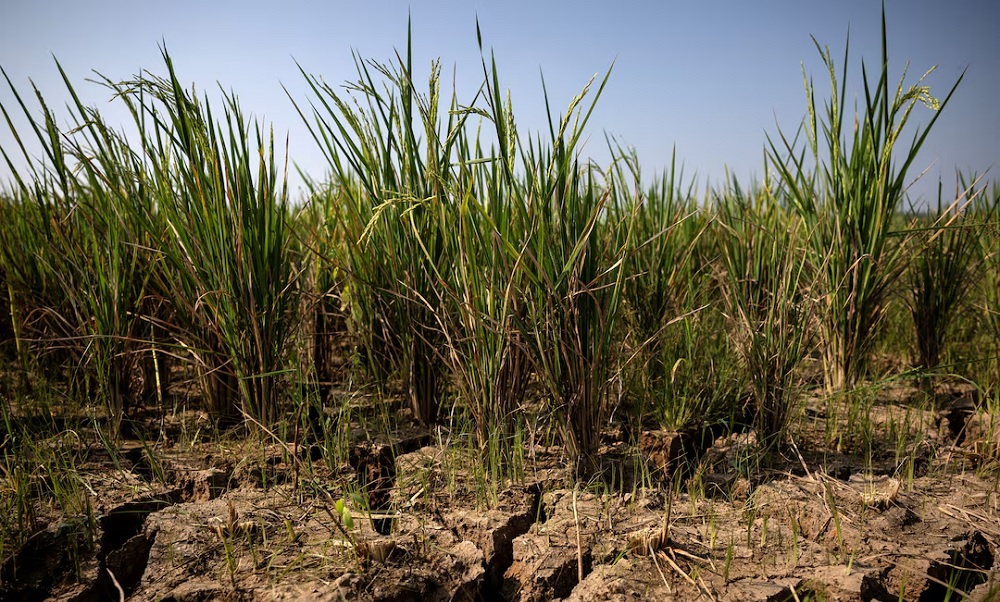
A powerful El Niño weather event could push an additional nearly 49 million people into acute food insecurity across some of the world’s most vulnerable regions by the end of next year, the World Food Programme said on Wednesday.
The U.N. agency said in a report that there was an 81% chance of a very strong El Niño event, with sea surface temperatures at their warmest levels since at least 1982 and potentially making it the strongest such event since 1950, Reuters reported.
El Niño, a periodic warming of ocean surface temperatures in the Pacific, alters global weather patterns and is often associated with drought in Southern Africa, delayed monsoons in parts of Asia and erratic rainfall elsewhere.
“These are events that in the past have triggered large-scale hunger,” Jean-Martin Bauer, director of WFP’s Food Security and Nutrition Analysis Service, told reporters.
Based on an analysis of 45 countries deemed vulnerable to the adverse effects of El Niño, WFP estimates that the number of people facing acute food insecurity could rise by almost 49 million to a total of 274 million people, an increase of 22%, relative to the baseline population already experiencing crisis-level food insecurity or worse.
Central America and Southern Africa are expected to be among the hardest-hit regions, with the number of food-insecure people set to increase by 83% in Central America and nearly 75% in Southern Africa, the WFP report said.
Southern Africa as well as South America and the Caribbean could each see more than 12 million additional people fall into acute food insecurity.
Bauer said global food markets entered the El Niño period in a relatively strong position following good harvests in 2025, but warned that conflict in the Middle East and potential weather-related crop losses could put further upward pressure on prices.
While past El Niño events have not typically triggered major global food price spikes, regional shortages and higher prices could worsen food access for vulnerable households, he said.
Funding cuts from U.S. and European donors in 2025 were also hampering efforts to monitor the developing crisis, with Bauer describing a growing drought of food-security data used to assess the impact of El Niño.
WFP conducted about 1.1 million household surveys in 2024, compared with about 800,000 in 2025, while data collection has fallen further this year due to funding restrictions.
“At a time when you have a risk like an El Niño, it is important to have high-frequency data collection,” Bauer said, warning that reduced monitoring could make it harder to identify emerging food crises quickly.
EARLY ACTION REQUIRED
WFP said current forecasts point to rainfall deficits in parts of East Africa, the Sahel, Central America and the Caribbean, while flood risks could rise in Somalia and neighbouring areas.
Significant impacts are also projected across South and Southeast Asia, where drought risks, uneven monsoons and localized flooding could disrupt agricultural production, the report stated.
The agency stressed that the forecasts remain uncertain and that impacts will vary across regions, but warned that governments and aid agencies needed to prepare.
Richard Choularton, director of WFP’s Climate and Resilience Service, said the agency had scaled up anticipatory action programmes in 18 countries, reaching more than 1.3 million people so far this year with cash and other assistance to help in the event of extreme weather.
Climate Change
Heavy monsoon rains claim lives across India as flooding and landslides continue
Further northeast, flood conditions in Assam have shown slight improvement, although nearly 179,000 people remain affected across seven districts.
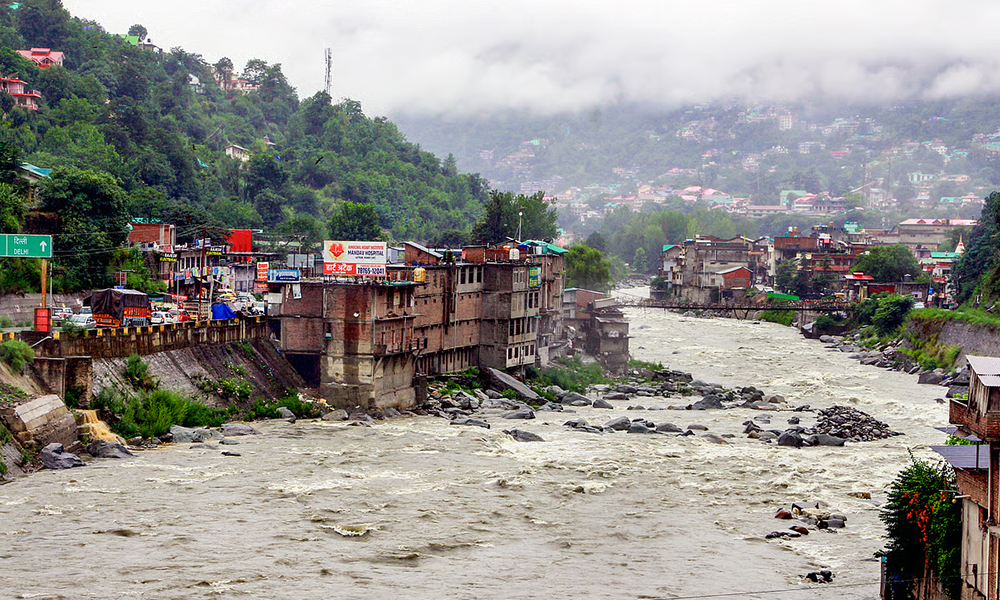
Heavy monsoon rains continue to batter large parts of India, triggering deadly landslides, flash floods and widespread disruption across several states.
In the southern state of Karnataka, three members of the same family were killed early Sunday after a rain-triggered landslide caused a hill to collapse onto their home in Shivamogga district. The state has experienced moderate to heavy rainfall over the past two days, with schools closed in several districts, including Karwar, Udupi, Chikkamagaluru and Dakshina Kannada.
Rivers in parts of Karnataka remain above danger levels, while flooded roads and waterlogged homes have prompted authorities to issue a high alert and urge residents to avoid rivers and low-lying areas.
In neighbouring Kerala, at least eight people have died in rain-related incidents after torrential downpours triggered landslides, flash floods and extensive damage, particularly in the state’s hilly regions. Several rivers burst their banks overnight, inundating towns across central districts. Authorities have opened 65 relief camps, providing shelter to more than 1,400 displaced residents.
Further northeast, flood conditions in Assam have shown slight improvement, although nearly 179,000 people remain affected across seven districts. The death toll from the state’s floods stands at 82, with thousands still living in relief camps. Several rivers, including the Dikhow and Dhansiri, continue to flow above danger levels, while more than 15,000 hectares of farmland remain submerged.
The Indian government has approved the early release of more than 21 billion rupees from the State Disaster Response Fund to support seven flood-affected states.
The India Meteorological Department has forecast heavy to very heavy rainfall across several regions, including Karnataka, Kerala, Rajasthan, Assam, Nagaland, Manipur, Mizoram, Tripura, West Bengal and Sikkim. Thunderstorms, lightning and strong winds are also expected in many parts of the country, with authorities urging residents in vulnerable areas to remain alert.
Climate Change
Hundreds of thousands flee as devastating wildfires rage across France and Spain
Firefighters, military personnel and emergency responders have been deployed across the affected regions, while thousands of residents remain displaced.
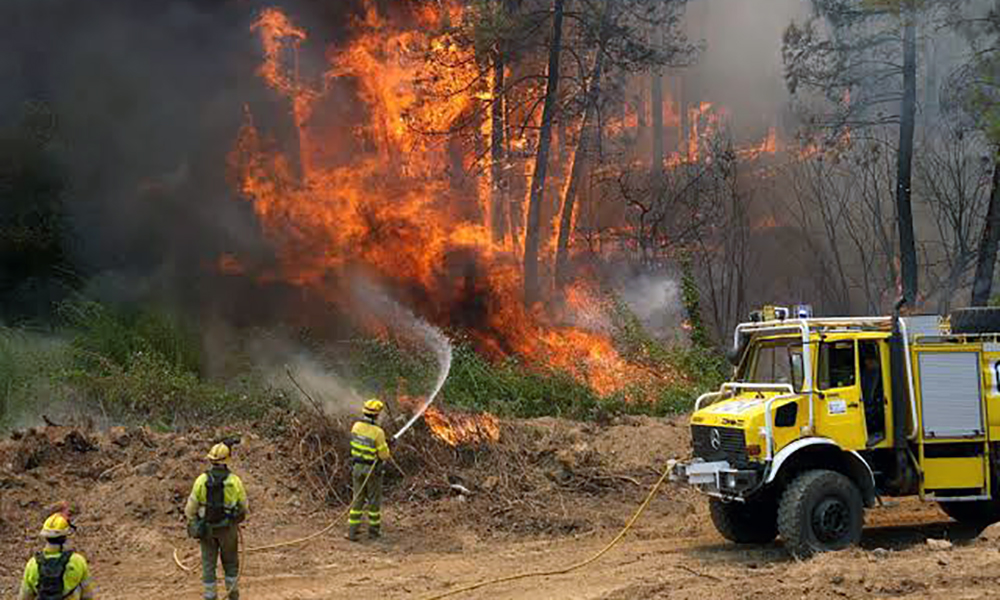
Hundreds of thousands of people have been forced to evacuate their homes as massive wildfires continue to sweep across parts of France and Spain, prompting emergency declarations and international assistance.
Authorities say more than 267,000 people have been evacuated as the fast-moving blazes, fueled by high temperatures, strong winds and dry conditions, continue to spread across large areas of both countries.
In France, officials ordered the complete evacuation of the Cap Ferret peninsula on the Atlantic coast as wildfires burned through more than 10,000 hectares of forest. Thousands of residents and tourists were instructed to leave the area by road and boat as flames advanced despite extensive firefighting efforts.
French President Emmanuel Macron described the situation as “very intense,” while the government activated the European Union’s Civil Protection Mechanism, bringing in additional firefighting aircraft from other EU member states to help battle the blazes.
In neighboring Spain, the government declared a national emergency after multiple wildfires threatened communities west of Madrid and in the province of Ávila. Authorities warned that several fires risked merging into larger fronts, complicating efforts to contain them.
Firefighters, military personnel and emergency responders have been deployed across the affected regions, while thousands of residents remain displaced.
Scientists have repeatedly warned that climate change is increasing the frequency and intensity of extreme heatwaves and wildfire conditions across southern Europe, with prolonged drought and soaring temperatures creating ideal conditions for rapidly spreading fires.
No final estimate of the damage has yet been released, and officials cautioned that dangerous weather conditions are expected to persist, raising concerns that the fires could continue to spread in the coming days.
Emergency services remain on high alert as authorities urge residents in affected areas to follow evacuation orders and avoid travel near active fire zones.


Afghanistan’s future depends on inclusive progress and sustained international engagement: UNAMA

UN: Two staff members detained in Afghanistan’s Herat

Khalilzad says Qatar’s approach to women is smarter than IEA policy

Total darkness, then sunset as full eclipse wows spectators in Spain

Afghan envoy invites Fazlur Rehman to Kabul amid push for better Pak-Afghan ties

Pakistan’s governance system has ‘collapsed’: Mohsin Naqvi

Spain sweep FIFA World Cup player awards after historic triumph

Iran, Afghanistan and Tajikistan discuss expanding regional transit cooperation

Afghanistan temporarily eases fuel import standards to help curb rising prices

Afghan health minister, Gavi discuss expanding routine immunization

Tahawol: Afghanistan’s future in the global press discussed

Saar: The Islamic Emirate’s five-year rule discussed

Tahawol: Hamid Karzai’s call for Afghan reconciliation discussed

Saar: Preparations for IEA’s fifth anniversary discussed

Tahawol: Iran’s acknowledgment of Afghanistan’s cooperation discussed
-

 Sport4 days ago
Afghanistan secure direct qualification for 2027 Men’s ODI World Cup
-

 Latest News4 days ago
Pakistan-backed armed groups in Balochistan using former Afghan government forces: report
-

 Sport3 days ago
Abasin Defenders stun Kabul Zalmi in Kabul Premier League
-

 Regional4 days ago
Turkey, Pakistan, Saudi Arabia defence pact technically same as NATO’s Article 5, Turkish minister says
-

 Sport3 days ago
Kabul Premier League gets underway with high-scoring opener
-

 Latest News4 days ago
Russia eyes railway route via Afghanistan as alternative to Strait of Hormuz
-

 Latest News4 days ago
Ariana Airlines brings $2.3 million Boeing 737 engine from US to Kabul
-

 Latest News4 days ago
Afghanistan issues more than 650,000 passports in one year