
Latest News
Trump’s NSA says thousands of US forces will remain in Afghanistan beyond Christmas

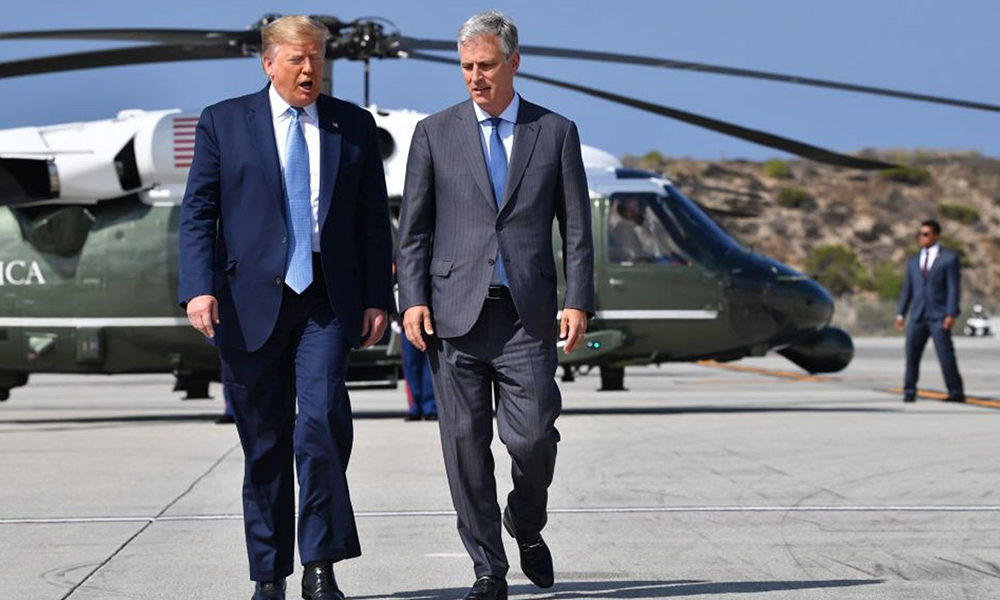
US National Security Advisor Robert O’Brien said Friday that 2,500 American soldiers will remain in Afghanistan beyond Christmas, dismissing US President Donald Trump’s tweet stating that all American troops in Afghanistan should be home by Christmas.
O’Brien also took a swipe at US Chairman of the Joint Chiefs of Staff General Mark Milley, who in an interview with NPR on Sunday suggested that US National Security Advisor’s announcement about the withdrawal plan from Afghanistan was ‘speculation.’
Milley said anyone “can speculate as they see fit. I am not going to engage in speculation. I’m going to engage in the rigorous analysis of the situation based on the conditions and the plans that I am aware of and my conversations with the president. And then when we get to the point where we have further discussions and further decisions, those will be appropriately made public.”
About Milley’s remarks, O’Brien said: “It has been suggested by some that that’s speculation. I can guarantee you that’s the plan of the president of the United States.”
“That’s the order of the commander-in-chief, that’s not speculation,” he noted.
O’Brien stated that It is not his practice to speculate, “Other people can interpret what I say as speculation, but…When I’m speaking, I’m speaking for the president and I think that’s what the Pentagon is moving out and doing.”
Referring to Trump’s tweet saying that US troops should be home by Christmas, the US NSA said that Trump was “expressing the same desire” of every wartime president—to get troops home by Christmas.
In February, the US-brokered a deal with the Taliban in Doha that was conditions based and included the full withdrawal of troops from Afghanistan. Since then troop levels have reduced from 13,000 to 8,600 with a further reduction to 4,500 expected by November.






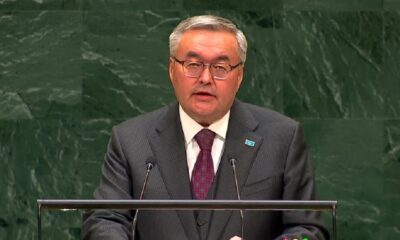




Kazakhstan’s Foreign Minister Mukhtar Tileuberdi has called for pragmatic and coordinated international engagement with Afghanistan, saying the country’s long-term stability is closely linked to the security and sustainable development of Central Asia.
Speaking during the general debate of the 81st session of the United Nations General Assembly in New York on Friday, Tileuberdi said humanitarian assistance to Afghanistan remains essential but alone cannot break the cycle of poverty, displacement and dependency.
He said Kazakhstan supports a “pragmatic, coordinated and step-by-step” approach to international engagement with Afghanistan, with the United Nations playing a central role.
Tileuberdi also said Kazakhstan is working with the UN to operationalize the United Nations Regional Centre for the Sustainable Development Goals for Central Asia and Afghanistan in Almaty.
He said the success of the centre should be measured by the results and assistance it delivers to the region.


Afghanistan Champions League: Omar Zawak Herat beat Toofan Herat 1-0

Blast in Pakistan’s Dera Ismail Khan kills 11, injures 30

Ariana Afghan Airlines increases Kabul-Delhi cargo flights

Khalilzad questions Pakistan’s commitment to Afghan welfare

India, UN envoy discuss Afghanistan’s humanitarian needs

Saudi energy group signs major Afghanistan deals covering gas exploration and pipeline plans

Trump floats idea of renaming Atlantic or Pacific Ocean

US hits Egyptian bank branches with Iran sanctions as war marks six months

Nepal flood rescue mission enters critical phase as thousands remain missing

Iranian clubs to face Gulf opponents at neutral venues in Asian Champions League Elite

Exclusive interview with Abdul Latif Mansoor, Minister of MRRD

Tawsia: Overview of Afghanistan’s iron mines

Tahawol: Discussion on fresh Pakistani airstrikes on Afghanistan

Saar: Calls for international support for Afghanistan discussed

Tahawol: Opening of the 81st UN General Assembly Session
-

 World5 days ago
CNN, MS NOW and Politico sue Trump, challenging White House ban
-

 Latest News3 days ago
Ariana Afghan Airlines ranks seventh among 45 Central Asian airlines
-

 Latest News4 days ago
UN reiterates call for respect for international law after Kunar airstrikes
-
 Latest News5 days ago
Khalilzad condemns Pakistan airstrikes, says current strategy is not working
-

 Regional3 days ago
US and Iran hold first talks since June after Trump’s ‘annihilation’ threat
-

 Latest News3 days ago
Silk Road highway in Wakhan corridor now reaches the China border
-

 Latest News4 days ago
Afghan Official: Pakistan’s airstrikes will not go unanswered
-
 Regional4 days ago
G7 foreign ministers call on Iran to stop arming Houthis