
Latest News
US may increase troop numbers before full withdrawal: Pentagon

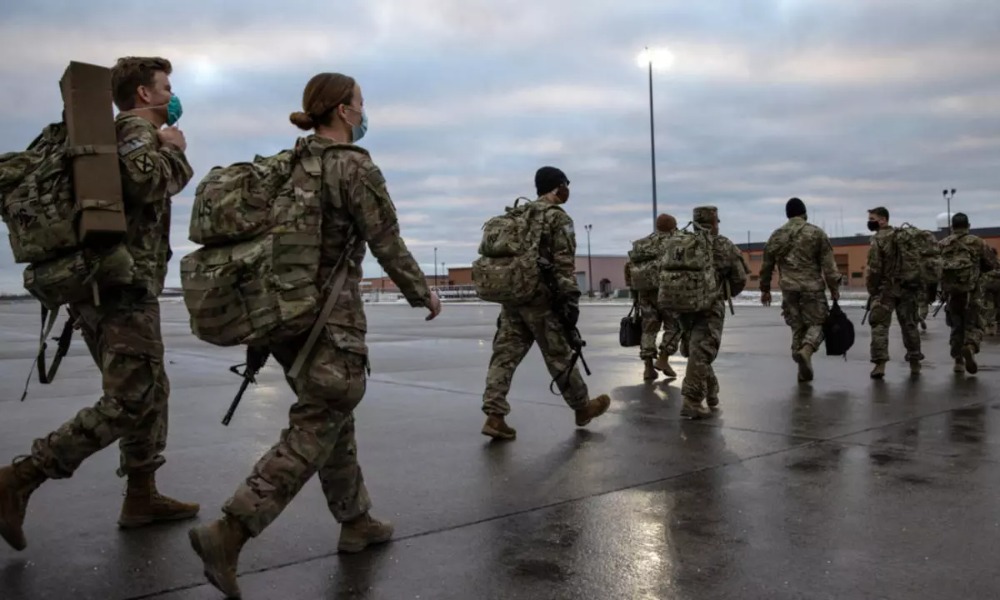
Pentagon spokesman John Kirby said on Friday there could be an increase in the number of troops in Afghanistan in order to complete a safe withdrawal of all foreign forces by September 11.
Addressing a press conference Friday, Kirby said: “It is not out of the realm the possibility that for a short period of time, there will have to be some additional enabling capabilities added to Afghanistan, to help effect a safe, orderly, and deliberately planned drawdown of everybody by the president’s deadline, early September.”
Kirby did not however elaborate on the nature of the increase in US troops. “I can’t speak today with exactly what that would look like, how many, when they would be going in. But as we transitioned out of Iraq, of course, it’s logical to assume that you may need some logistics help, maybe some engineering help.”
“You may have to add some force protection capabilities, temporarily, just to make sure that the drawdown goes in a safe, orderly, and effective way. Again, we’ll know more as we get closer, but that would not be out of the realm of possibility,” Kirby said.
Responding to a question, Kirby said that the Department of Defense is still working out what the future bilateral security relationship is going to be with Afghanistan.
“We’re going to transition to a bilateral relationship, a military relationship that’s more akin to the kinds of relationships we have with other countries,” he said.
“It will not include a US military footprint on the ground in Afghanistan with the exception of what’s going to be required to support the diplomatic mission there. All that’s still being worked out. So, I can’t speak with specificity today about what contract support the Afghan security forces are going to need going forward,” he said.
The United States, he said, will maintain counterterrorism capabilities to continue to prevent Afghanistan from becoming a launching pad for terrorist attacks on the US.
“We have a vast range of capabilities available to us and we’re not going to speak to the details of exactly how we’re going to maintain those capabilities and utilise those capabilities,” he said.
On Wednesday US President Joe Biden and NATO Secretary General Jens Stoltenberg announced that a full withdrawal of troops would start from May 1 and end by September 11 – the 20th anniversary of the 9/11 attack on the United States.
The Taliban did not however welcome the decision and said on Thursday the US was in breach of its agreement with the group, signed in February last year that called for full withdrawal by May 1.
Responding to the announcement, Taliban spokesperson Zabihullah Mujahid threatened retaliation and said on Twitter: “If the agreement is breached and foreign forces fail to exit our country on the specified date, problems will certainly be compounded and those (who) failed to comply with the agreement will be held liable.”
Kirby meanwhile acknowledged the danger and responded with a warning.
“We’ve seen their threats, and it would be imprudent for us not to take those threats seriously,” Kirby said.
“It would also be imprudent for the Taliban to not take seriously what the president and what (Defense) Secretary (Lloyd) Austin both made clear, that any attack on our drawdown, on our forces or our allies and partners as they draw down, will be met very forcefully.”
Kirby also insisted that even though American forces will be leaving, “it doesn’t mean that we’re walking away from our Afghan partners.”
U.S. officials have promised to continue paying the salaries of Afghan security force members and to financially support the Afghan Air Force.
Kirby said that going forward, the U.S. will continue to support the Afghan military.












Kazakhstan’s Foreign Minister Mukhtar Tileuberdi has called for pragmatic and coordinated international engagement with Afghanistan, saying the country’s long-term stability is closely linked to the security and sustainable development of Central Asia.
Speaking during the general debate of the 81st session of the United Nations General Assembly in New York on Friday, Tileuberdi said humanitarian assistance to Afghanistan remains essential but alone cannot break the cycle of poverty, displacement and dependency.
He said Kazakhstan supports a “pragmatic, coordinated and step-by-step” approach to international engagement with Afghanistan, with the United Nations playing a central role.
Tileuberdi also said Kazakhstan is working with the UN to operationalize the United Nations Regional Centre for the Sustainable Development Goals for Central Asia and Afghanistan in Almaty.
He said the success of the centre should be measured by the results and assistance it delivers to the region.


Abu Muslim Farah defeat Khurasan Faryab 2-0 in ACL season six

Saar: Concerns over Pakistan’s political crisis discussed

Afghanistan Champions League: Omar Zawak Herat beat Toofan Herat 1-0

Blast in Pakistan’s Dera Ismail Khan kills 11, injures 30

Ariana Afghan Airlines increases Kabul-Delhi cargo flights

Saudi energy group signs major Afghanistan deals covering gas exploration and pipeline plans

Trump floats idea of renaming Atlantic or Pacific Ocean

US hits Egyptian bank branches with Iran sanctions as war marks six months

Nepal flood rescue mission enters critical phase as thousands remain missing

Iranian clubs to face Gulf opponents at neutral venues in Asian Champions League Elite
Saar: Concerns over Pakistan’s political crisis discussed

Exclusive interview with Abdul Latif Mansoor, Minister of MRRD

Tawsia: Overview of Afghanistan’s iron mines

Tahawol: Discussion on fresh Pakistani airstrikes on Afghanistan

Saar: Calls for international support for Afghanistan discussed
-

 World5 days ago
CNN, MS NOW and Politico sue Trump, challenging White House ban
-

 Latest News3 days ago
Ariana Afghan Airlines ranks seventh among 45 Central Asian airlines
-

 Latest News5 days ago
UN reiterates call for respect for international law after Kunar airstrikes
-

 Regional4 days ago
US and Iran hold first talks since June after Trump’s ‘annihilation’ threat
-

 Latest News4 days ago
Silk Road highway in Wakhan corridor now reaches the China border
-

 Regional3 days ago
Iran airlines cancel flights as US sanctions hit
-

 Latest News5 days ago
Afghan Official: Pakistan’s airstrikes will not go unanswered
-

 Sport5 days ago
Afghan boxing referee heads to China for international festival