
Science & Technology
Italy’s drought exposes ancient imperial bridge over Tiber River


Italy’s worst drought in 70 years has exposed the piers of an ancient bridge over the Tiber River once used by Roman emperors but which fell into disrepair by the third century.
Two piers of Nero’s Bridge have been visible much of the summer near the Vittorio Emanuele bridge that traverses the river near the Vatican, a pile of moss-covered rocks where seagulls now sun themselves, The Associated Press (AP)
reported.
The bridge was built in the first century for Emperor Nero to reach his gardens near the Janiculum Hill near what is present-day St. Peter’s Square, said historian Anthony Majanlahti.
The bridge was already falling apart by the third century, traffic was diverted to the nearby Sant’Angelo Bridge, which funneled pilgrims past the Castel Sant’Angelo to the Vatican.
Nero’s Bridge originally is believed to have had four piers, but Majanlahti says two were dismantled in the 19th century to allow for a better flow of river traffic.
“Because the water level of the river is so low now due to widespread drought across Italy, we’re able to see a lot more of the piers of the bridge that we usually could,” Majanlahti said.
In normal water level years, one of the bridge’s piers can often be seen in the driest season, but this year two are visible, AP reported.
The Italian government has declared a state of emergency in several regions because of the prolonged drought and accompanying heat wave. The drought has also exposed a World War II tank in Italy’s largest river, the Po, as well as 20th century ordinance in lakes.







Science & Technology
Total darkness, then sunset as full eclipse wows spectators in Spain
Millions of people gathered in Iceland and northern Spain to witness Western Europe’s first total solar eclipse in 27 years.
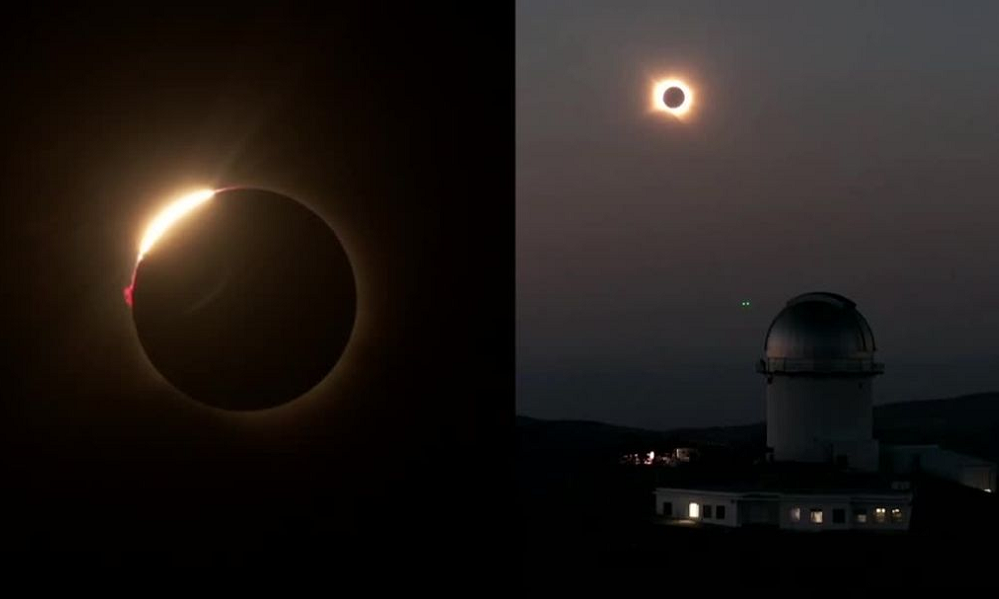
Spectators across Spain watched in wonder, some whipping off their protective glasses and rising to their feet in unison, as a rare total solar eclipse swept across the north of the country on Wednesday evening, plunging it into darkness.
Spain deployed a massive police contingent and set up special viewing spots across rural areas that offered the best views of the spectacle, Reuters reported.
Viewers in Buitrago de Lozoya, a rural district north of Madrid, clapped and cheered as the sky dimmed and Baily’s beads – bright points of sunlight that shine around the edge of the moon during a total eclipse – glistened on the horizon just after 8:30 p.m. (1830 GMT), lasting barely a minute.
“It’s impressive how the colours return little by little after totality – first the reds, then the blues – just like at dawn and sunset, totally deceiving your brain,” said economist Diego Fernandez, 32.
Rafael Jiménez, 50, a resident of Madrid, said the event felt like science fiction. “It was an absurd scene; we even got soaked when the garden sprinklers kicked in,” he said. “And then, just like that, we were watching the sunset again.”
Spain’s turn with the eclipse followed shortly after a less remarkable spectacle over much of overcast Iceland, although a break in the clouds in the far west of the Nordic country allowed holidaymakers and locals a glimpse of the celestial phenomenon. The eclipse was hidden behind clouds in central Reykjavik although the darkness of the totality was still evident.
“It was like a whole day just came at once and I felt goosebumps because it just made us think about … the shortness of life, how time can be different and it depends on your perspective,” lawyer Eduarda Ortiz, 33, told Reuters in the Icelandic capital.
Millions of people gathered in Iceland and northern Spain to witness Western Europe’s first total solar eclipse in 27 years.
Brian May, former guitarist for the rock band Queen, was among them. He travelled to an observatory in Spain’s Teruel province and chronicled the experience on his Instagram page.
“Here we go, the sun is disappearing. It’s amazing,” he said as the eclipse reached its climax and bystanders burst into cheers and applause after a countdown.
In Spain, authorities were expecting up to 6 million visitors in mostly rural areas under the eclipse’s path across the north of Spain and the Balearic Islands.
POLICE, PLANES AND HELICOPTERS ON STANDBY
The Iberian Peninsula last witnessed a total solar eclipse in 1912, but another is due on August 2, 2027, and an annular eclipse will follow in January 2028, completing the so-called “Iberian Eclipse Trio”.
The uncanny sensation when day briefly turns to twilight and some animals fall quiet, while the moon passes directly between Earth and the sun, has often been seen through history as an omen of cosmic struggle or a sign of divine power.
For Spain, the event has been a chance to showcase its less-travelled regions and draw tourists from its overcrowded beach resorts. Some seized the opportunity to get married, according to local press reports.
The eclipse took place in one of the country’s highest-risk periods for wildfires, with emergency crews fighting various fires on Wednesday, including a large one in the southern Andalucia region.
Authorities rolled out a large-scale police operation and public safety campaign to make sure the crowds did not set off wildfires.
A small fire erupted near an eclipse viewing point in the town of Peñíscola, in the Valencia region, local authorities said. The fire began in a vehicle and spread to 33 more before firefighters brought it under control, they said. Emergency crews, including aircraft, were dispatched to the area.
The authorities dispatched 25,000 police officers to guarantee security around the eclipse observation sites and deployed nearly 100 planes and helicopters.
As of late Wednesday, no wildfire incident tied to eclipse chasers was reported.
ECLIPSE FEVER IN THE LAND OF SAGAS
In Reykjavik, glasses that allow spectators to view the phenomenon without damaging their eyes have been sold out for days, as the country of roughly 400,000 people welcomed up to 80,000 visitors.
Totality reached Iceland’s westernmost coast at about 5:44 p.m. (1744 GMT), casting the far west of the island nation into total darkness for up to 2 minutes and 13 seconds.
The event has drawn both casual observers and “eclipse chasers”, enthusiasts who crisscross the globe to be in the path of totality whenever and wherever an eclipse occurs.
In Spain, 43-year old Gema, who did not give her last name, said as she left the Buitrago de Lozoya viewing point: “Everybody tells you about it, but it is more beautiful than you imagine.”
Science & Technology
Swirling, vortex-like patterns observed on the sun’s surface
The researchers said the observations may provide insight into underlying physical processes that impact the dynamics of the sun and other stars, including eruptions from the solar surface that can interfere with the operation of satellites, GPS navigation, power grids and global communications on Earth.
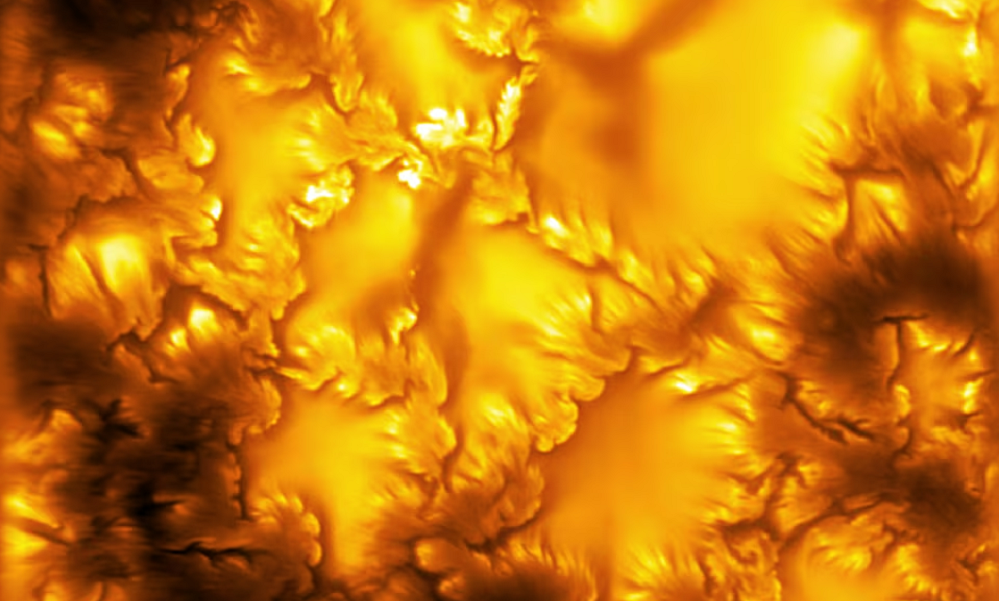
Astronomers have obtained the highest-resolution images to date of our sun’s visible surface, observing swirling, vortex-like patterns in superheated solar gases reminiscent of the shapes depicted in the nocturnal sky in Vincent van Gogh’s 1889 painting “The Starry Night.”
The researchers made the observations of a portion of the sun’s photosphere, a relatively thin layer — about 60 miles (100 km) in depth compared to the overall solar diameter of roughly 865,000 miles (1.4 million km) — using the U.S. National Science Foundation’s Hawaii-based Daniel K. Inouye Solar Telescope, Reuters reported.
The still images and time-lapse video reveal continuously growing whirls of hot plasma, gas heated to temperatures so high that subatomic particles called electrons break free from atoms and form a broth of charged particles. The observed whirls are large on a human scale but small on the scale of a stellar surface, with diameters ranging from about 12 miles (19 km) — the minimum scale detectable by the world’s most powerful solar telescope — up to roughly 100 miles (170 km).
The researchers said the observations may provide insight into underlying physical processes that impact the dynamics of the sun and other stars, including eruptions from the solar surface that can interfere with the operation of satellites, GPS navigation, power grids and global communications on Earth.
The curly, circular patterns do not represent random shapes, but rather are the first detection of a phenomenon called Kelvin-Helmholtz instability, or KHI, on the surface of a star. KHI, first described in the 19th century, refers to a dynamic process that happens when two parallel streams of fluids or gases interact while moving at different velocities.
“The interface can become unstable and develop wave-like vortices that grow in size until they break apart, not unlike waves out on a lake or out on the ocean in windy conditions,” said astronomer Friedrich Wöger, a senior scientist at the National Science Foundation’s National Solar Observatory in Colorado, the Inouye telescope’s instrument program scientist, and co-lead author of the study published on Wednesday in the journal Nature.
Swirling clouds caused by KHI are a well-known, albeit rare, meteorological occurrence on Earth, and also have been observed in the atmospheres of the giant gas planets Jupiter and Saturn, Wöger said.
“The difference from the waves and clouds we know here on Earth is that the two interacting fluids are hot plasma — about 6,000 degrees Kelvin and 10,000 degrees Fahrenheit (5,540 degrees Celsius) — moving within a magnetic field that helps create the conditions for the instability to develop,” Wöger said.
By twisting the solar magnetic field, KHI creates energy that can suddenly unleash an explosion.
‘A TRUE GAME-CHANGER’
Wöger called the discovery of solar KHI “a true game-changer,” saying it opens up a new framework for understanding how the sun energizes its atmosphere.
“The sun and sun-like stars are extremely dynamic systems, characterized by a whole spectrum of rapid, explosive events within their magnetic elements. How these explosions are triggered is one of the main frontiers in modern solar physics,” National Solar Observatory astronomer and study co-lead author David Kuridze said.
The KHI manifestation might help explain why the sun’s outer atmosphere becomes as hot as it does and why magnetic energy accumulates and moves around on the solar surface.
The constant twisting motions generated by KHI can gradually build the energy required to trigger coronal mass ejections and solar flares, Kuridze said. Coronal mass ejections are huge bubbles of gas threaded with magnetic field lines that are expelled from the sun’s surface. Solar flares are gigantic explosions on the sun that propel light, energy and high-speed particles into space.
Aside from the science, the researchers admired the beauty of the new close-up views of the sun.
“Maybe ‘magnificent’ comes closest to describing the aesthetics in the images for us,” Wöger said.
“Interestingly, artists have long captured this fluid dynamic intuition in their work. A famous example is Van Gogh’s ‘The Starry Night,’ where the sky’s vortex structures closely resemble turbulent KHI structures,” Kuridze said. “A similar parallel appears in Hokusai’s famous woodblock print, ‘The Great Wave off Kanagawa,’ where the curling crests of the wave echo the iconic shape of KHI billows. It shows how the fundamental geometry of nature deeply resonates with human art.”
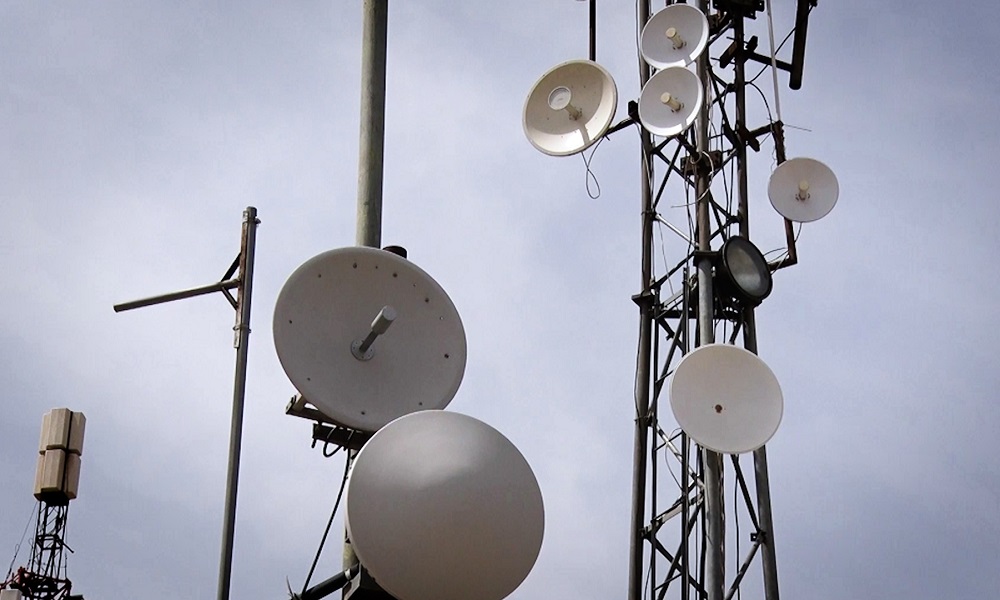
Afghanistan is currently serving as a transit route for internet traffic between South Asia and Central Asia, the Ministry of Communications and Information Technology (MCIT) said, highlighting the country’s growing role in regional digital connectivity.
The ministry said fiber-optic traffic from several South Asian countries is routed through Afghanistan to Central Asian nations via the country’s fiber-optic network.
According to the ministry, nearly $3 billion has been invested in Afghanistan’s fiber-optic and telecommunications sector so far, with expansion efforts continuing.
Officials said Afghanistan offers significant investment opportunities in telecommunications and fiber-optic infrastructure. They added that, alongside expanding domestic communications services, the ministry is working to enhance the country’s capacity to provide transit services for regional countries.
The ministry said Afghanistan is already facilitating the transit of internet traffic from parts of South Asia to Central Asia and stressed that the country’s strategic geographic location positions it as an important digital corridor between the two regions.
“We are currently transiting internet traffic through Afghanistan to South Asian and Central Asian countries,” said Enayatullah Alokozai, spokesperson for the Ministry of Communications and Information Technology. “Afghanistan is a suitable geographical corridor for data transmission.”
Economic analysts say Afghanistan has the potential to become a key hub for regional connectivity. They noted that, in addition to serving as a corridor for energy transmission from Central Asia, the country could also facilitate the large-scale transit of fiber-optic connectivity, internet traffic, and commercial goods.
Representatives of the private sector also said Afghanistan has strong potential to attract further investment in telecommunications and fiber-optic infrastructure. They noted that numerous domestic and international companies are active in the sector, creating direct employment opportunities for thousands of Afghans.


Total darkness, then sunset as full eclipse wows spectators in Spain

Afghan envoy invites Fazlur Rehman to Kabul amid push for better Pak-Afghan ties

Afghanistan clinch Ireland series with record ODI score

Iran says no progress on reviving interim peace deal with US

Tahawol: Afghanistan’s future in the global press discussed

Pakistan’s governance system has ‘collapsed’: Mohsin Naqvi

Spain sweep FIFA World Cup player awards after historic triumph

Iran, Afghanistan and Tajikistan discuss expanding regional transit cooperation

Afghan health minister, Gavi discuss expanding routine immunization

Afghanistan temporarily eases fuel import standards to help curb rising prices
Tahawol: Afghanistan’s future in the global press discussed

Saar: The Islamic Emirate’s five-year rule discussed

Tahawol: Hamid Karzai’s call for Afghan reconciliation discussed

Saar: Preparations for IEA’s fifth anniversary discussed

Tahawol: Iran’s acknowledgment of Afghanistan’s cooperation discussed
-

 Sport4 days ago
Afghanistan secure direct qualification for 2027 Men’s ODI World Cup
-

 Regional5 days ago
Goods transporters to go on strike from Saturday after talks with Pakistan govt fail
-
 Latest News4 days ago
Pakistan-backed armed groups in Balochistan using former Afghan government forces: report
-

 Sport3 days ago
Abasin Defenders stun Kabul Zalmi in Kabul Premier League
-
 Regional4 days ago
Turkey, Pakistan, Saudi Arabia defence pact technically same as NATO’s Article 5, Turkish minister says
-

 Sport3 days ago
Kabul Premier League gets underway with high-scoring opener
-

 Latest News4 days ago
Russia eyes railway route via Afghanistan as alternative to Strait of Hormuz
-

 Latest News4 days ago
Ariana Airlines brings $2.3 million Boeing 737 engine from US to Kabul