
Opinion
Did the US just get lured into war with the Houthis?

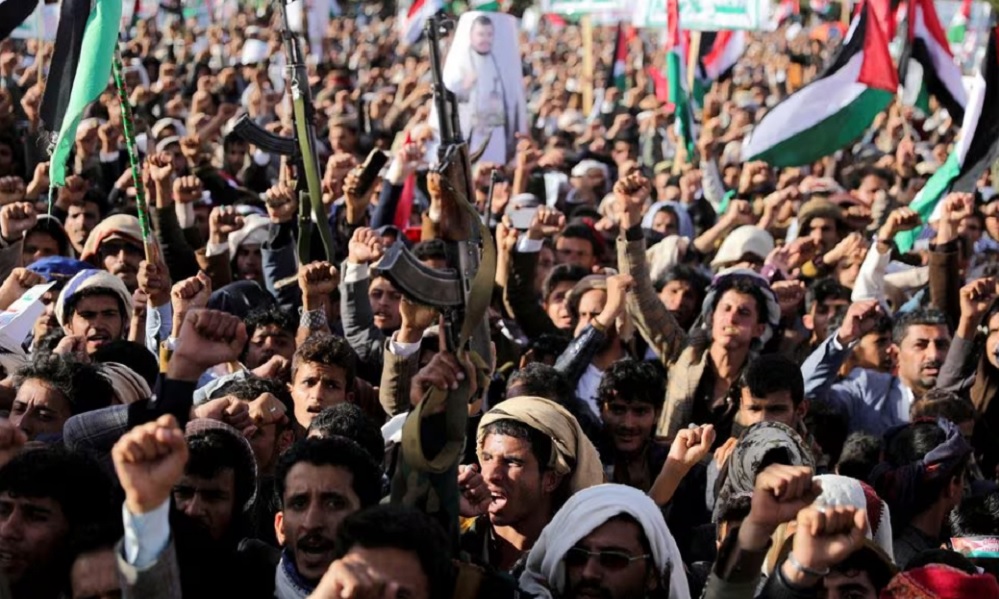
U.S. President Joe Biden’s blistering strikes on Yemen followed weeks of warnings to the Houthis to stop attacking Red Sea shipping – or else.
Yet the Houthis continued firing drones and missiles, seemingly goading the United States to follow through on its threats. That has raised a question for some experts: Did the Houthis want a war with America? And if so, why?
Gerald Feierstein, a former U.S. ambassador to Yemen, is among those who think the United States has given the Houthis exactly what they wanted: a fight.
“Absolutely they have been trying to provoke U.S. retaliation,” Feierstein told Reuters.
“They’ve been confident that they could withstand whatever we were going to do. They have seen they win popular support.”
The Houthis, who have controlled most of Yemen for nearly a decade, said five fighters had been killed in a total of 73 air strikes. They vowed to retaliate and continue their attacks on shipping, which they say are intended to support Palestinians against Israel, a popular cause in Yemen.
The U.S. military said late on Friday it had launched another strike targeting a radar site.
After the initial U.S. and British strikes, drone footage on the Houthis’ al-Masirah TV showed hundreds of thousands of people in Sanaa chanting slogans denouncing Israel and the United States. Crowds gathered in other Yemeni cities as well.
Experts say much of the Houthi confidence comes from having resisted years of attacks from Saudi Arabia. But a U.S.-led campaign against the group could be very different.
U.S. Lieutenant General Douglas Sims, the director of the Joint Staff, told reporters on Thursday that the strikes hit 28 locations with more than 150 munitions. Reviewing the damage, he said he hoped the Houthis would not invite that kind of destruction.
“My guess is if you were operating a ballistic missile launcher last night, you certainly didn’t want the strike. But, no, I would hope they didn’t want us to strike,” Sims said.
MOUNTAIN FIGHTERS
In pre-recorded speeches and sermons, Abdul Malik al-Houthi, the enigmatic leader of Yemen’s Houthi fighters, asserts that his movement is under siege because of its religion.
Al-Houthi established a reputation as a fierce battlefield commander before emerging as head of the Houthi movement, mountain fighters who have been battling a Saudi-led military coalition since 2015 in a conflict that has killed tens of thousands, devastated Yemen’s economy and left millions hungry.
Under the direction of al-Houthi, who is in his 40s, the group has acquired tens of thousands of fighters and a huge arsenal of armed drones and ballistic missiles, largely supplied by Iran.
Following the strikes, Sims and other U.S. officials acknowledged that the Houthis would probably make good on their threats to retaliate.
On Friday, the Houthis fired an anti-ship ballistic missile into the Red Sea, the Pentagon said.
A U.S. official, speaking on the condition of anonymity, said far from being deterred, the Houthis might see the likely low death toll among their fighters in the strikes as a success for the group, even if their capabilities have been degraded.
“Someone’s definition of success really depends on their perspective,” the official said.
With tensions soaring, the price of Brent crude oil rose 1% on Friday on concern that supplies could be disrupted. Commercial ship tracking data showed at least nine oil tankers stopping or diverting from the Red Sea.
MORE STRIKES?
Michael Mulroy, a former deputy assistant secretary of defense for the Middle East under the Trump administration, said the Pentagon should prepare for additional military action.
“The U.S. should start planning to increase our response to further attacks in the Red Sea or Syria and Iraq,” he said.
“And Iran’s IRGC should be included in those targets,” he added, using an acronym for Iran’s Revolutionary Guard Corps.
Iran champions the Houthis as part of its regional “axis of resistance” – a collection of Iran-backed groups that includes Palestinian militant group Hamas and militia in Iraq and Syria.
The United States accuses Iran of enabling the Houthi Red Sea attacks, providing the military capabilities and intelligence to carry them out.
The Houthis deny being puppets of Tehran and say they are fighting a corrupt system and regional aggression.
Still, Feierstein cautions that the Houthi defiance of the United States and its allies helps burnish their brand in the Middle East, a concern shared by some current U.S. officials.
“Regionally, it raises the Houthi profile. It puts them in the first rank of Iranian affiliates in the ‘Axis of Resistance,'” Feierstein said.
“We shouldn’t give the Houthis what they want, which is exactly what we did.”
Analysis by Reuters staff Phil Stewart and Idrees Ali





Opinion
Rising from Hardships to Glory
The following article was written by Zhao Xing, China’s ambassador to Kabul.

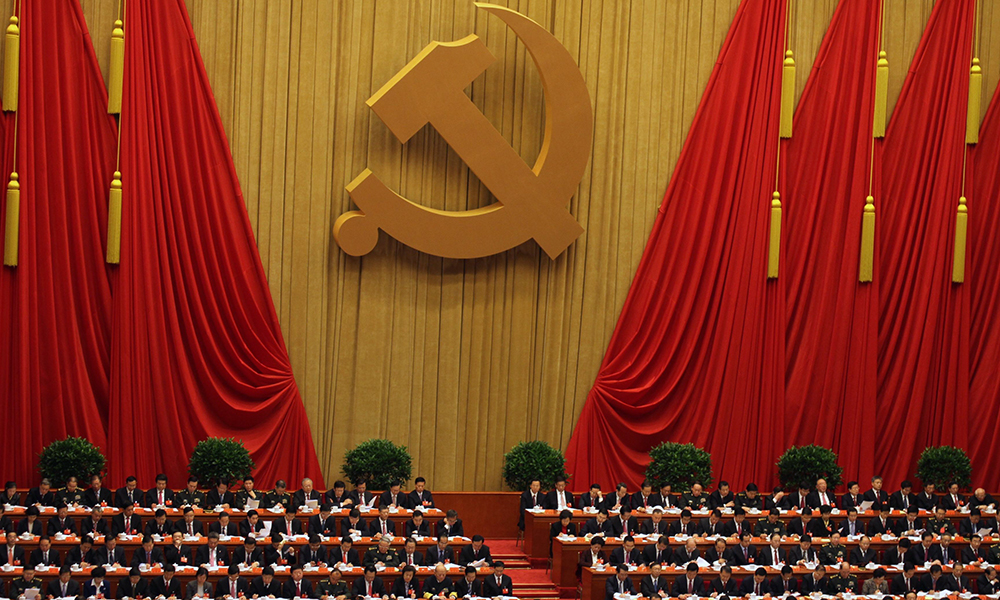
A Story of Success for a Century-old Party
1 July 2026 marked the 105th founding anniversary of the Communist Party of China (CPC). For the Chinese people, this memorable moment is not only in retrospect of the past, but also for new prospects in the future.
On the day, H.E. Xi Jinping, General Secretary of the CPC Central Committee, President of the People’s Republic of China (PRC) and Chairman of the PRC Central Military Commission, said in his address to the commemorative gathering, “Over the past 105 years, our Party has remained committed to its original aspiration and founding mission of seeking happiness for the Chinese people and rejuvenation for the Chinese nation. With a profound understanding of the evolving global landscape and an accurate grasp of the changing principal contradictions facing Chinese society in different historical periods, the Party has united and led the Chinese people of all ethnic groups in unremitting struggle, achieved great accomplishments in the New-Democratic Revolution, socialist revolution and construction, reform and opening up and socialist modernization, and socialism with Chinese characteristics for a new era.”
This important statement summarizes the CPC’s endeavors in more than a century and decodes the CPC’s success in achieving sustained development and progress for China.
More than a century ago, China was way different from what the world beholds today. Starting from the mid-19th century, China had been gradually reduced to a semi-colonial, semi-feudal society, a poor and weak nation ridden with foreign aggression, national disunity and social upheaval, where wars and poverty wreaked havoc on its people. At this make-or-break juncture for the Chinese nation, many patriots with lofty ideals dedicated themselves to seeking a path which may secure an independent nation, a rich and strong country and a happy people.
Against this historical backdrop, the CPC was founded in 1921, when there were but a few dozen members.
Today, the CPC has attracted more than 100 million members joining its grand cause, which always connects the future of China with the destiny of the Chinese people.
Through long and arduous struggles, the CPC united and guided the Chinese people to realize the hard-won national independence, which earned the CPC not only the trust and support from the Chinese people, but also a historic mission to advance China’s rejuvenation.
Upon the founding of the PRC in 1949, the Chinese people, under the industrious leadership of the CPC, embarked on a self-motivated and self-reliant journey to transform an extremely weak economy into independent and relatively complete industrial system and national economic structure, representing a face-lifting change to China.
Upon the launch of reform and opening up in the late 1970s, China entered into a period of rapid growth, when its economic power, sci-tech capabilities and overall national strength reached new heights, the people’s living standards were greatly improved, the influence of the Chinese culture expanded and China’s soft power grew by margins. 2021 should be remembered as year with historic significance because China succeeded in eradicating absolute poverty, which not only stands out as a milestone in the history of the Chinese nation, but also a remarkable achievement in the global campaign of poverty alleviation.
Today, the CPC’s mission still goes on, through setting off a refreshed and steadfast journey to advance the Chinese modernization, pursue high-quality development and fulfill its people’s aspiration for a better life.
Throughout its persevering enterprise, the CPC always persists in applying scientific theories to understanding the world, while implementing theoretical innovation to keep the guiding theory abreast with the times and China’s actual conditions.
The CPC always persists in going all out to serve its people, taking the people’s aspiration for a better life as its ultimate goal and drawing strength from the wisdom and creativity of its people as a driving force to grow the nation.
The CPC always persists in balancing immediate priorities with long-term national development, addressing pressing challenges while maintaining strategic continuity and policy consistency.
The CPC always persists in firmly staying true to China’s national conditions while learning in an open-minded manner from the outstanding achievements of human civilizations, and pursuing common development through mutually beneficial cooperation with the international community.
The CPC always persists in pressing ahead with its mission in the face of adversity, and turning risks and challenges into opportunities to strive for broader prospects of progress.
And the CPC always persists in strengthening its own building through self-renewal, self-improvement, self-reform and self-evolution, so as to ensure that the Party, as the leading core, always stay at the helm charting the course of advancing socialism with Chinese characteristics.
These are exactly the rewarding experience and inspiring wisdom acquired in its long-haul struggle that enable the CPC to unite and guide the Chinese people in creating newer and greater historic cause, and steel into the firm bedrock for the advancement of the Chinese modernization.
As President Xi Jinping once observed, “History looks kindly on those with resolve, with drive and ambition, and with plenty of guts. History won’t wait for the hesitant, the apathetic, or those shy of a challenge.”
The CPC’s 105-year journey has well proved that there is no universally applicable model for national development. Each country should make an independent choice of it path for development suited to its own national conditions, and should count on the unity and hard work of its own people, hence opening up vista for an even brighter future.
Although China and Afghanistan differ in our national conditions, both countries have endured foreign aggression, sustained turmoil of wars, and experienced difficult times of poverty and weakness. Our two peoples do share a common aspiration for independence, peace, stability and national rejuvenation.
China has been maintaining a policy toward Afghanistan based on respecting independence, sovereignty and territorial integrity of Afghanistan, respecting the independent choices made by the Afghan people, and respecting the religious beliefs and national customs of Afghanistan. China has also been adhering to the principles of never interfering in Afghanistan’s internal affairs, never seeking selfish interests in Afghanistan, and never pursuing so-called spheres of influence.
Guided by the principles of fostering an amicable, secure and prosperous neighborhood, the spirit of amity, sincerity, mutual benefit and inclusiveness, and the vision of building a community with a shared future, China and Afghanistan have been deepening our cooperation in such areas as trade and economic cooperation, infrastructure development and people-to-people exchanges. As Afghanistan ushers in a crucial stage of post-war reconstruction and economic recovery, China has every confidence that a stable, growing and prosperous Afghanistan serves not only the fundamental interests of the Afghan people, but also the lasting regional peace and stability. China has been, is and will always be ready to work with our Afghan friends in seeking paths of development suited to our own national conditions and bringing forth greater benefits for the two peoples.
Opinion
Afghanistan ‘cracking down’ on militants; ‘resetting’ relations with Pakistan
Things started to change in March, when a high-level Pakistani delegation led by Special Envoy for Afghanistan, Muhammad Sadiq Khan, visited Kabul
In what is seen as a possible policy shift, Afghanistan’s Islamic Emirate government has been taking action against elements facilitating cross-border attacks into Pakistan — marking a breakthrough that has led to renewed diplomatic momentum between Kabul and Islamabad.
According to Pakistan’s Express Tribune, while public discourse over the past month focused on rising tensions between Pakistan and India, behind the scenes, Pakistan and Afghanistan made significant strides in repairing a strained relationship long marred by security concerns.
At the core of Islamabad’s frustration has been the banned Tehreek-e-Taliban Pakistan (TTP) and other militant groups, which they say operate from inside Afghanistan.
Things however started to change in March, when a high-level Pakistani delegation led by Special Envoy for Afghanistan, Muhammad Sadiq Khan, visited Kabul, the Express Tribune reported.
According to sources familiar with the closed-door meetings, Pakistani officials were, for the first time, convinced that the Islamic Emirate of Afghanistan (IEA) leadership was taking Pakistan’s concerns seriously.
As part of this shift, the IEA reportedly began targeting Afghan nationals who had either joined the TTP or were recruiting others to do so. Several individuals were arrested and prosecuted, according to security sources.
The IEA’s response is believed to have led to a notable reduction in suicide attacks, particularly in Khyber Pakhtunkhwa province, and helped ease tensions between the two neighbors.
The Express Tribune reported that these developments set the stage for a landmark visit by Pakistan’s Deputy Prime Minister Ishaq Dar to Kabul on April 19 — the first by a Pakistani foreign minister in three years.
During the visit, both sides agreed on a renewed commitment: Afghanistan pledged not to allow its territory to be used for attacks against Pakistan, and in return, Pakistan eased trade restrictions, including lifting the requirement of bank guarantees for Afghan importers.
The IEA government further won Islamabad’s confidence by reportedly apprehending Afghan nationals who had facilitated the infiltration of over 70 terrorists into Pakistan following the Pahalgam attack.
All infiltrators were neutralized near the North Waziristan border in what officials described as the largest single-day anti-terror operation since Pakistan’s post-9/11 campaign, Express Tribune reported.
Despite the progress, Pakistani officials caution that more needs to be done. “It’s a positive start, but we expect the Taliban (IEA) government to take irreversible steps,” one official said on condition of anonymity.
China is believed to have played a key behind-the-scenes role in encouraging dialogue between the two countries.
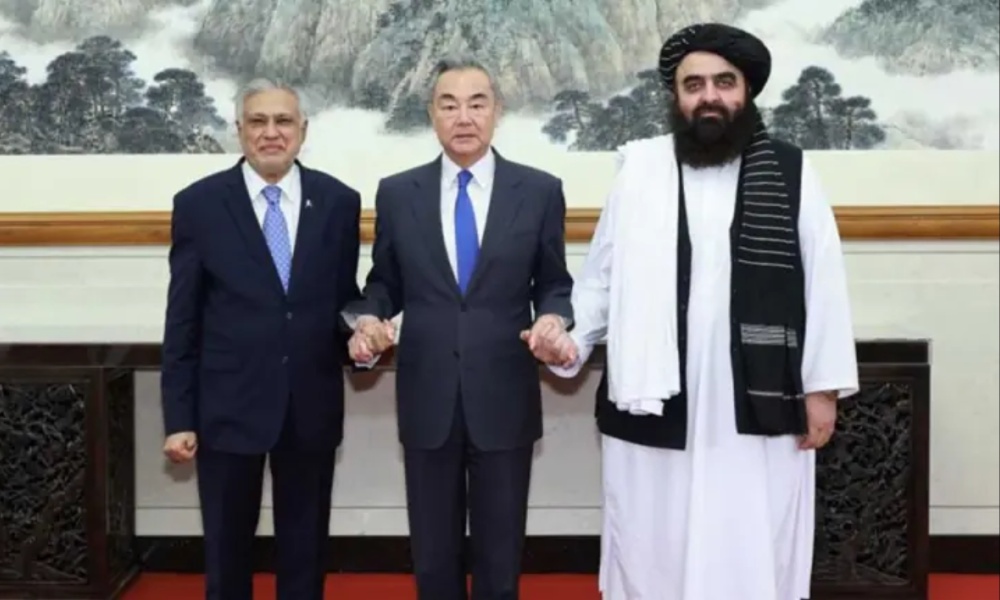
On May 21, Chinese Foreign Minister Wang Yi hosted an unannounced trilateral meeting in Beijing with the foreign ministers of Pakistan and Afghanistan.
Following the talks, both countries expressed their intent to upgrade diplomatic ties, including plans to exchange ambassadors—a move confirmed by Pakistani officials, although formalities remain.
China was the first to appoint a full-time ambassador to Kabul under IEA rule and accept an IEA envoy in Beijing. Russia and Turkey are reportedly considering similar moves.
Pakistani officials say that, despite ongoing concerns, the evolving regional landscape demands a pragmatic approach and that the recent spike in military tensions with India has only reinforced Islamabad’s interest in stabilizing its western frontier.
Meanwhile, India has also started re-engaging with the Islamic Emirate.
Indian External Affairs Minister S. Jaishankar recently held talks with his Afghan counterpart, breaking a 20-year policy of diplomatic non-engagement with the Islamic Emirate.
Analysts suggest the Beijing meeting was a strategic message from China—not only to support regional stability but also to signal to India that Kabul’s future may lie in alignment with Beijing and Islamabad.
Islamic Emirate’s response to Islamabad’s accusations
Leading up to this thaw between the two countries, Pakistan continued to accuse Afghanistan of not standing against militants in the country. The IEA however repeatedly denied these allegations and said on numerous occasions that it will not allow any individual or group to pose a threat to another country from Afghanistan.
Just last month, the IEA’s deputy spokesperson Hamdullah Fitrat dismissed allegations that armed groups are using Afghan territory to launch attacks into Pakistan.
He described the claims as “false” and accused Pakistan of deflecting blame for its own failures.
“Pakistan’s security problems are its internal matter,” Fitrat said. “Blaming Afghanistan is a way for Islamabad to avoid accountability for its own shortcomings.”
These remarks were made in response to comments by Prime Minister Shehbaz Sharif, who, speaking in London in April, stated that terrorist groups were operating from Afghan soil.
Just five days later, however, the high-level Pakistani delegation, led by Ishaq Dar, visited Kabul for talks with senior IEA officials, including Prime Minister Mullah Hassan Akhund.
The one-day visit was on the back of an official invitation extended by Islamic Emirate Foreign Minister Amir Khan Muttaqi.
Opinion
Afghan war crimes victims still awaiting justice: HRW Asia director
Patricia Gossman compares how differently Australia and Britain are handling the issue of war crimes committed by their troops in Afghanistan
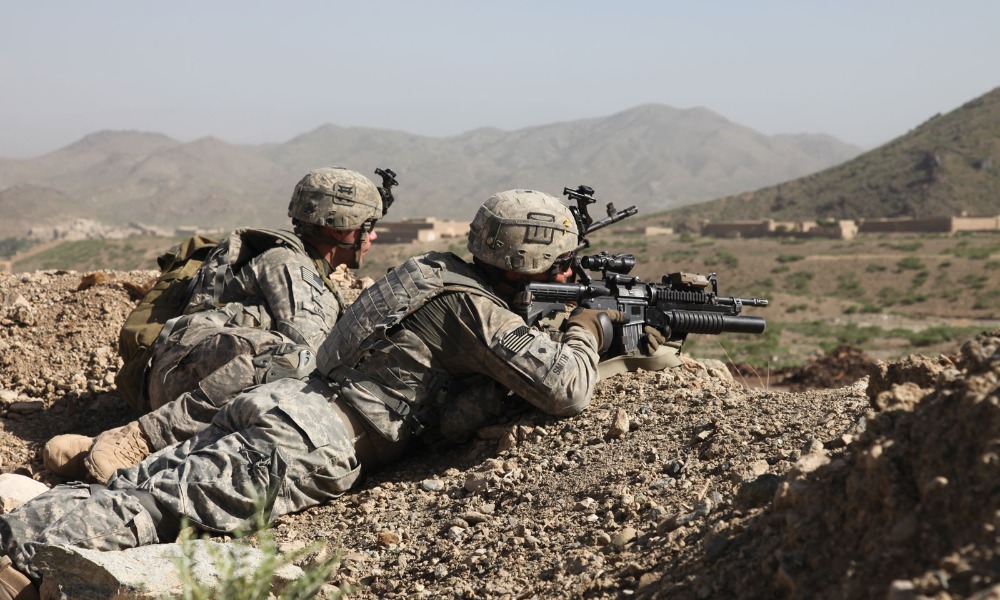
Human Rights Watch Associate Asia Director Patricia Gossman on Monday published an article on the situation of war crimes in Afghanistan over 20 years of foreign occupation and how differently two countries are tackling the issue.
Here’s what she wrote.
Family members of Afghans unlawfully killed by foreign military forces during the 20-year war in Afghanistan have been waiting a long time for justice. Last week revealed two quite different approaches by countries that should provide it.
Australia, which has gone the furthest in investigating alleged war crimes by its forces in Afghanistan, has established a website for family members to file complaints.
The site, managed by Australia’s Defense Ministry, includes an online form in the Dari and Pashto languages to request compensation.
While this progress is commendable, it comes five years after a governmental inquiry first disclosed the extent of probable crimes, including summary executions of captured combatants and civilians. Only one soldier has been charged in connection with the allegations.
The long delays led United Nations special mandate holders in August 2024 to raise concerns about Australia’s approach to compensation “as a form of charity at the discretion of its military, not as a legal right of victims under international law,” and the lack of clarity concerning consultation with victims and their families.
Those concerns remain.
Afghan human rights activists are hosting online panels to draw attention to the website. The Australian government needs to ensure Afghans know about the website and how to file a complaint.
The United Kingdom, meanwhile, which also has an obligation to provide justice for war crimes, has made much slower progress.
Last week, BBC Panorama presented new evidence of war crimes by British special forces in Iraq and Afghanistan, including interviews with former soldiers about summary executions of wounded detainees and civilians, including children.
“They handcuffed a young boy and shot him,” said a former soldier who had served in Afghanistan. “He was clearly a child, not even close to fighting age.”
The UK government has tried its best to prevent such crimes from ever being prosecuted, with successive governments alleged to have covered up crimes and shut down criminal inquiries.
While the government established an independent inquiry into the Afghanistan allegations in December 2022, it has taken years to get going and is limited in scope to the three years 2010-2013.
Richard Bennett, the UN special rapporteur on human rights in Afghanistan, said the new allegations highlighted “the need for comprehensive accountability.”
That is the only way victims and their families will find justice.
Article written by Patricia Gossman


Tahawol: Russian economic delegation’s visit to Kabul

Afghan Red Crescent, Austrian and Danish counterparts discuss humanitarian cooperation

Saar: Discussion on harsh criticism of Pakistan at Moscow meeting

Afghanistan railways chief attends ECO regional meeting in Kazakhstan

Iranian envoy warns Western interventions threaten regional security

Cricket Bonanza: Afghanistan set for packed international schedule

Afghanistan says 28 killed, 32 captured in Nuristan operation

Silk Road highway in Wakhan corridor now reaches the China border

CNN, MS NOW and Politico sue Trump, challenging White House ban

Dogharoun handles 60% of Iran’s exports to Afghanistan
Tahawol: Russian economic delegation’s visit to Kabul
Saar: Discussion on harsh criticism of Pakistan at Moscow meeting

Tawsia: Efforts to increase energy production capacity in Afghanistan

Saar: Review of state officials’ visits to Kabul over past month discussed

Tahawol: Kyrgyzstan’s rejection of Afghan refugees discussed
-

 Sport4 days ago
Afghan futsal coach: Brazil tournament is first step towards new goals and World Cup
-
 Latest News4 days ago
Afghan official says Durand Line crossings to remain closed until Islamabad accepts demands
-

 Latest News3 days ago
India, Russia hold security talks on Afghanistan and Pakistan amid regional tensions
-

 Sport4 days ago
Afghanistan hold Bangladesh to dramatic draw in Abu Dhabi Test
-
 Latest News4 days ago
Afghan farmers adopt climate-resilient innovations to improve food security
-
 Latest News4 days ago
Guterres proposes 60 job cuts at UNAMA
-

 Latest News5 days ago
Russia warns against return of US military infrastructure to Afghanistan
-
 Latest News3 days ago
Uzbekistan gains ground in Afghanistan’s flour market as Kazakhstan loses exports