
Latest News
Senior Afghan leaders to travel to Doha for talks with Taliban

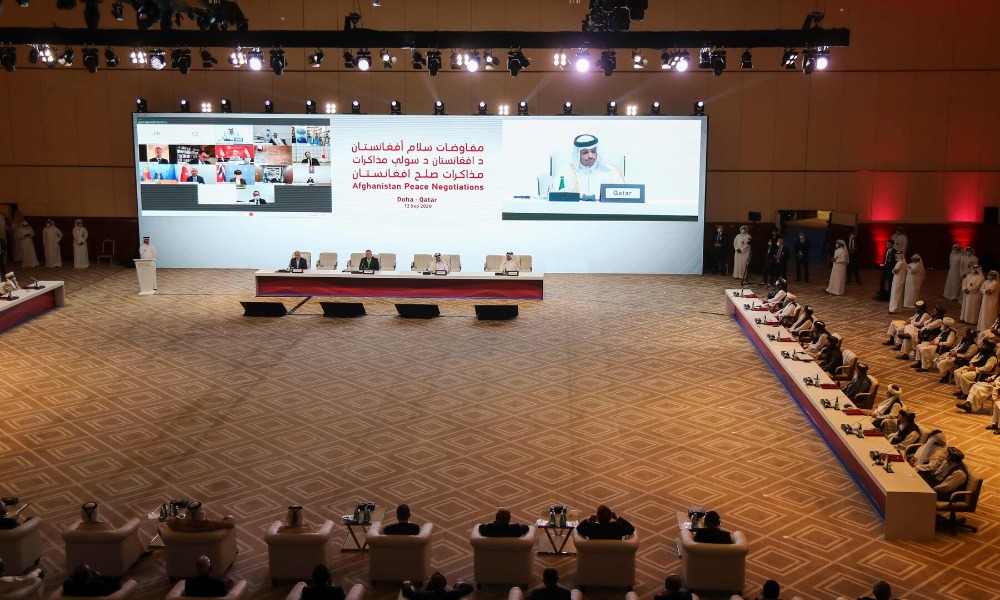
Senior Afghan leaders will fly to Doha for talks with the Taliban this week, as the insurgent group takes a hard stance on negotiations, even warning Turkey against plans to keep some troops in Afghanistan to run and guard Kabul’s main airport.
The eight-member delegation will include senior Afghan peace official Abdullah Abdullah and former president Hamid Karzai, and is expected to discuss the speeding up of peace talks, a government official told Reuters on the condition of anonymity.
The Taliban did not immediately respond to requests for comment on the talks, which are separate from the stalled intra-Afghan negotiations taking place between Taliban and Afghan government negotiators in the Qatari capital of Doha.
The news of the delegation’s visit came hours after the Taliban warned of “consequences” of plans to keep some Turkish troops in Afghanistan to run and guard Kabul airport after foreign forces pull out.
It was not immediately clear if the Kabul airport matter would be discussed between the Taliban and the senior Afghan delegation, expected to fly to Doha on Friday.
AIRPORT PLAN
Ankara, which has offered to run and guard the airport in the capital after NATO withdraws, has been in talks with the United States on financial, political and logistical support.
Turkey has repeated that the airport must stay open to preserve diplomatic missions in Afghanistan, where a blast rocked Kabul on Tuesday and clashes have intensified across the country.
“If Turkish officials fail to reconsider their decision and continue the occupation of our country, the Islamic Emirate… will take a stand against them,” the Taliban said in a statement, referring to Turkey’s plan.
The Taliban, who ruled Afghanistan with an iron fist from 1996 to 2001, have been fighting for 20 years to topple the Western-backed government in Kabul.
Emboldened by the departure of foreign forces by a September target, they are making a fresh push to surround cities and gain territory.
Turkish Defence Minister Hulusi Akar told reporters after a cabinet meeting on Monday evening that Turkey agreed to some points with U.S. counterparts on running the airport and work towards a deal continues.
“The airport needs to remain open, be operated. All countries say this. If the airport does not operate, the countries will have to withdraw their diplomatic missions there,” he said.
Talks now involving ministries should be complete by the time U.S. forces leave, a senior Turkish official told Reuters. “We still think there will be an agreement on the airport. We want to side with the Afghan people,” the official said.
EMBASSY URGES FRENCH TO LEAVE
The deteriorating situation across Afghanistan led France’s Embassy in Kabul to call on French citizens to leave Afghanistan on a free flight scheduled for Saturday.
“The French Embassy informs its compatriots who would remain in Afghanistan after July 17 that it will no longer be able to ensure the safety of their departure,” a statement on the embassy’s website said on Tuesday.
The senior Afghan delegation is expected to talk to the Taliban about a ceasefire as violence rises across Afghanistan.
Police said a blast rocked a busy area of Kabul on Tuesday, killing four people and wounding five. It was not clear who was behind the explosion or the target.
Clashes were continuing in the southern province of Kandahar, said Attaullah Atta, a provincial council member, with the Taliban being pushed back after a bid to break into a city prison.
Hundreds of families had fled the violence, he added.
Mohammad Daoud Farhad, director of Kandahar’s provincial hospital, said it had received eight dead and more than 30 people, mostly civilians, wounded in clashes in the past 24 hours.
Early on Tuesday, Afghan security forces had retreated from the district of Alingar in the eastern province of Laghman, a local government official said on condition of anonymity.
A ceasefire pact with the Taliban in the district fell through in May.












Kazakhstan’s Foreign Minister Mukhtar Tileuberdi has called for pragmatic and coordinated international engagement with Afghanistan, saying the country’s long-term stability is closely linked to the security and sustainable development of Central Asia.
Speaking during the general debate of the 81st session of the United Nations General Assembly in New York on Friday, Tileuberdi said humanitarian assistance to Afghanistan remains essential but alone cannot break the cycle of poverty, displacement and dependency.
He said Kazakhstan supports a “pragmatic, coordinated and step-by-step” approach to international engagement with Afghanistan, with the United Nations playing a central role.
Tileuberdi also said Kazakhstan is working with the UN to operationalize the United Nations Regional Centre for the Sustainable Development Goals for Central Asia and Afghanistan in Almaty.
He said the success of the centre should be measured by the results and assistance it delivers to the region.


Abu Muslim Farah defeat Khurasan Faryab 2-0 in ACL season six

Saar: Concerns over Pakistan’s political crisis discussed

Afghanistan Champions League: Omar Zawak Herat beat Toofan Herat 1-0

Blast in Pakistan’s Dera Ismail Khan kills 11, injures 30

Ariana Afghan Airlines increases Kabul-Delhi cargo flights

Saudi energy group signs major Afghanistan deals covering gas exploration and pipeline plans

Trump floats idea of renaming Atlantic or Pacific Ocean

US hits Egyptian bank branches with Iran sanctions as war marks six months

Nepal flood rescue mission enters critical phase as thousands remain missing

Iranian clubs to face Gulf opponents at neutral venues in Asian Champions League Elite
Saar: Concerns over Pakistan’s political crisis discussed

Exclusive interview with Abdul Latif Mansoor, Minister of MRRD

Tawsia: Overview of Afghanistan’s iron mines

Tahawol: Discussion on fresh Pakistani airstrikes on Afghanistan

Saar: Calls for international support for Afghanistan discussed
-

 World5 days ago
CNN, MS NOW and Politico sue Trump, challenging White House ban
-

 Latest News3 days ago
Ariana Afghan Airlines ranks seventh among 45 Central Asian airlines
-

 Latest News4 days ago
UN reiterates call for respect for international law after Kunar airstrikes
-

 Regional4 days ago
US and Iran hold first talks since June after Trump’s ‘annihilation’ threat
-

 Latest News3 days ago
Silk Road highway in Wakhan corridor now reaches the China border
-

 Latest News5 days ago
Afghan Official: Pakistan’s airstrikes will not go unanswered
-

 Sport4 days ago
Afghan boxing referee heads to China for international festival
-
 Regional5 days ago
G7 foreign ministers call on Iran to stop arming Houthis