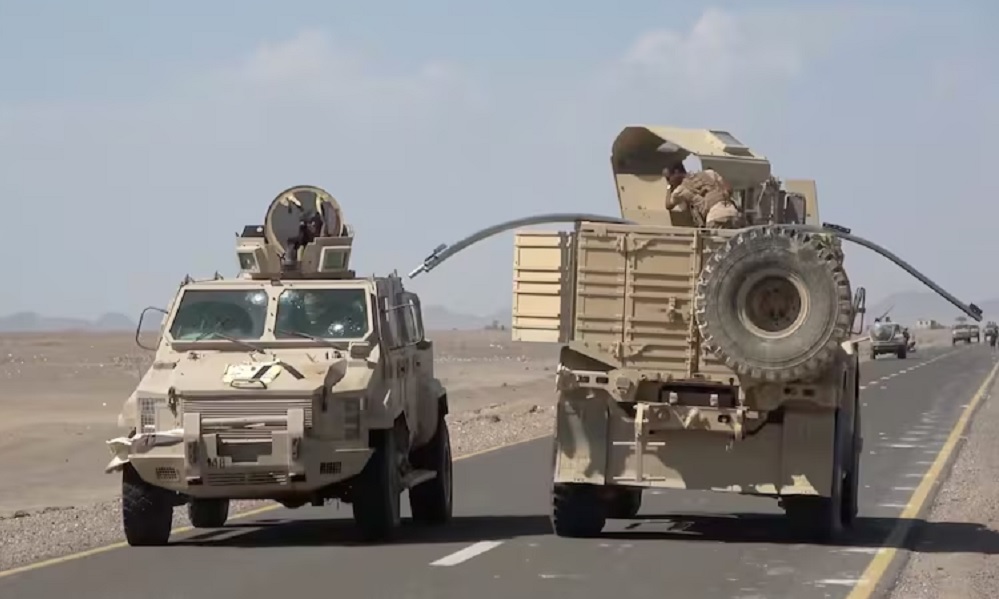
Saudi-backed Yemeni government forces staged a lightning advance on Monday to retake the coast around the Bab el-Mandeb Strait up to the city of Mocha, the government said, pushing the Iran-backed Houthis out of most of the areas they seized last month.
In response, the Houthis said they had attacked key locations in Saudi Arabia including the King Khalid International Airport in Riyadh, an Aramco refinery in Rabigh, the Abha international airport and the Khamis Mushait military base, Reuters reported.
The claims could not be immediately verified. Saudi Arabia and Aramco did not immediately respond to a request for comment.
The Yemeni forces of the internationally recognised government, backed by heavy Saudi air strikes, reached the outskirts of Mocha late on Monday and Houthi fighters were retreating into the highlands, four government sources said. The Defence Ministry said the city had fallen.
The advance, if confirmed, would loosen the Houthis’ grip on a vital Red Sea oil route already roiling energy markets alongside Iran’s closure of the Strait of Hormuz, though the group could still strike vessels with drones from other positions.
Fighting has raged along several front lines in Yemen for weeks since a dormant civil war erupted in a spillover from the US-Iran conflict, with the Houthis seeking to control the Bab el-Mandeb Strait and firing missiles and drones at Saudi cities and infrastructure.
The Saudi-led coalition fighting the Houthis also said late on Monday that naval forces carried out a military operation in Yemen’s Red Sea governorate of Hodeidah. The government forces had already taken key positions including an airstrip in the Dhubab district at the mouth of the strait whose seizure by the Houthis last month sent shock waves through energy markets.
Reuters could not independently verify the extent of the government gains. The Houthis, who have controlled many of Yemen’s more populous areas including the capital Sanaa since 2014, said the Saudi-backed government’s claims were baseless.
Meanwhile, the Houthis themselves made important advances near the third-largest city of Taiz, gaining sections of a mountain road to leave government forces besieged, according to five military sources with the Yemeni government. One government source denied the road had been cut.
The group also threatened to attack traffic in Saudi airspace.
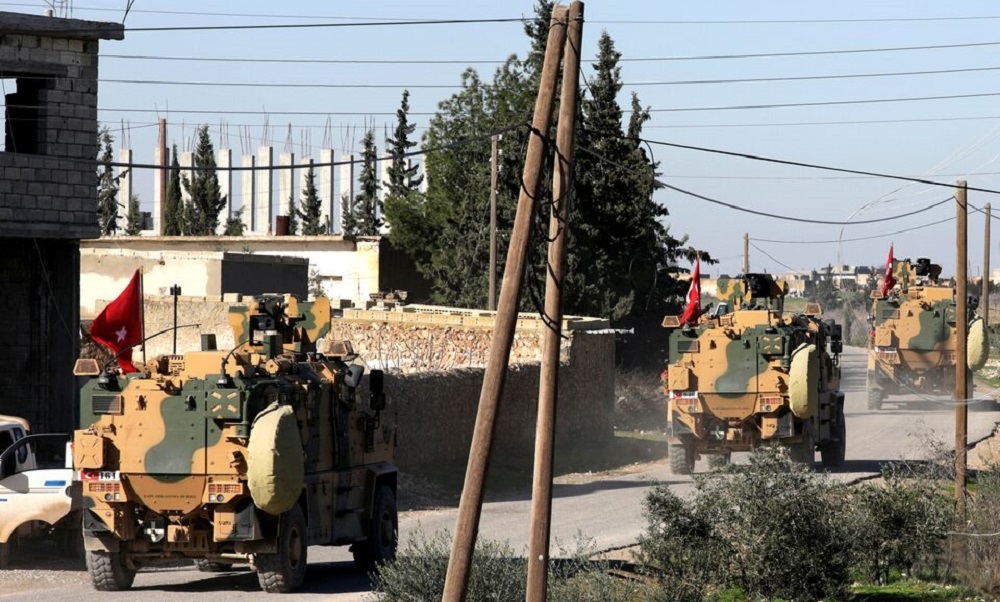
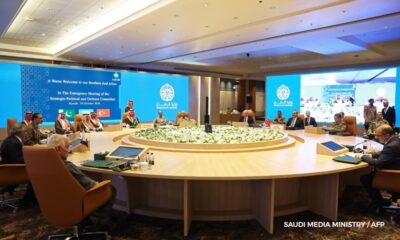
The escalating conflict has prompted Riyadh’s allies to act. Saudi Arabia, Turkey and Pakistan agreed at an emergency meeting in Riyadh on Monday to rapidly deploy military forces and capabilities in Saudi Arabia under their Mecca defence pact, according to a joint statement.
The fighting has worsened a humanitarian crisis in Yemen, the poorest state in the Arab region. The UN migration agency said on Monday that 184,000 people had been displaced since the war resumed.
Yemen’s internationally recognised president, Rashad al-Alimi, swore on Sunday to fight “until the country is liberated from the grip of the terrorist militia”.
Saudi Arabia said on Monday it had attacked hundreds of targets to provide air cover for the Bab el-Mandeb Strait and Yemeni ground forces. The Yemeni government said it had launched attacks on several fronts including in Sanaa province.
The Houthi-run health ministry said two people had been killed and seven wounded in strikes on the province’s Sanhan and Sa’wan districts.
HEAVIEST FIGHTING IS IN SOUTHWEST YEMEN
While the war has raged on several fronts, the heaviest fighting has been in the southwest, both in the coastal area near the strait and in the hills around Taiz.
The Houthis damaged a culvert on the Taiz-Aden road, making it impassable, and on Sunday their fighters made new advances into the town of al-Turbah, five government military sources said, though another government source denied this.
A Houthi-run news agency on Monday cited a military source as saying the group had driven government forces from the al-Mawasit district of Taiz province, reaching the home of Alimi, head of Yemen’s interim presidential council.
The advances left Taiz,a city with a population of over half a million and a garrison of thousands of government fighters, surrounded by Houthi forces, the government military sources said.
In al-Mudhaffar area, just outside Taiz but within the area besieged by the Houthis, a long queue formed outside a petrol station as people waited for fuel and cooking gas canisters.
“This is the daily state in Taiz,” said Shehab Hazaa.
MECCA ALLIANCE AGREES TO DEPLOY MILITARY FORCES IN SAUDI
In a statement following their meeting, Saudi Arabia, Turkey and Pakistan accused the Houthis of attempting to target Islam’s holiest sites, Mecca and Medina.
“The Parties also condemned in the strongest terms the attempted targeting of Mecca and Medina, as well as the continuing attacks targeting cities and civilian and economic facilities in the Kingdom, reaffirming their unequivocal rejection of any attack or threat against the Kingdom’s security and territorial integrity,” the statement said.
The “Mecca Joint Defence Agreement,” signed in August, is intended to strengthen collective deterrence against any act of aggression and stipulates that an armed attack against any of the three countries would be regarded as an attack on all.