
Business
Chamber claims corruption, insecurity eradicated in Afghanistan

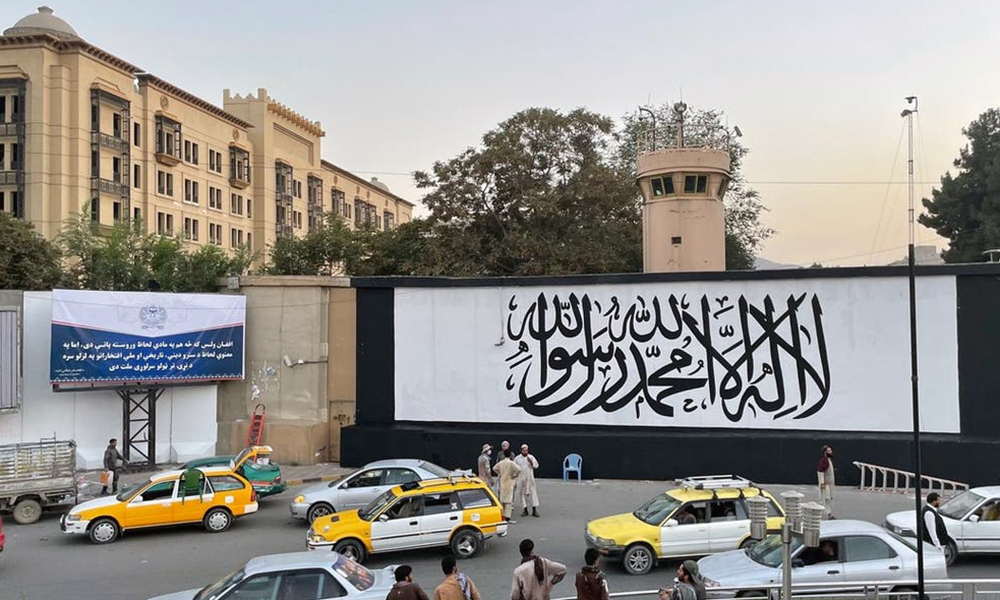
Officials of Afghanistan’s Chamber of Industries and Mines (ACIM) said on Tuesday that corruption and insecurity have been eradicated since the Islamic Emirate of Afghanistan (IEA) took power last year but stated that the country was dealing with a severe economic crisis.
Officials said that one example is that of factories. According to them hundreds of manufacturing businesses have closed down due to the crisis.
The sudden collapse of the former government in August last year resulted in foreign donors cutting off all funding to Afghanistan, freezing of the country’s foreign reserves and imposition of economic sanctions.
Afghanistan, which has for the past 20 years been largely reliant on foreign funding, has been hit hard by these decisions which have contributed enormously to the current humanitarian crisis.
Chamber officials meanwhile said that international sanctions on Afghanistan’s banking system have led to the closure of many factories.
“We are satisfied with the Islamic Emirate, they are trying to promote domestic products and industries. Problems we have are because of international sanctions. The problem must be solved and Afghan money must be released,” said Sakhi Ahmad Paiman, the deputy head of the ACIM.
Members of the Steel Association, which is a major electricity consumer in Afghanistan, said that they still have power supply problems but other issues, including the smuggling of raw materials, has been stopped.
“Our problems have decreased compared to the past. Our expectation is to decrease challenges regarding domestic products,” said Abdul Nasir Rishtia, a member of the Steel Association.
Economic analysts also called on the IEA to help Afghan traders expand the domestic markets.





Business
EU and FAO launch €5m programme to strengthen Afghanistan’s agrifood sector
FAO Representative in Afghanistan Richard Trenchard said agrifood businesses had shown potential to grow and create jobs despite difficult conditions.
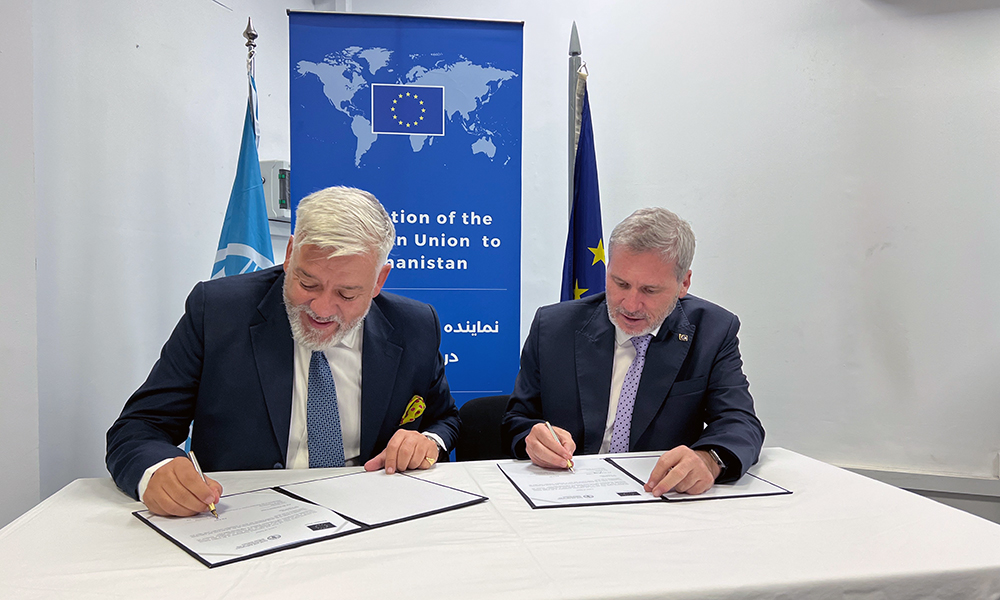
The European Union (EU) and the Food and Agriculture Organization of the United Nations (FAO) have launched a €5 million initiative to help Afghan farmers and agribusinesses access markets, improve incomes and withstand climate and economic shocks.
The programme will target vulnerable households, including returnees, internally displaced people and host communities, particularly in areas affected by food insecurity, climate risks and limited economic opportunities. Women and youth will be key beneficiaries.
Four one-stop service hubs will connect farmers and rural entrepreneurs with agricultural advice, specialised services, businesses and markets. Farmers will also gain access to FAO climate analysis and early-warning information to help them make timely production and marketing decisions.
The initiative will restore 2,000 hectares of degraded forests and rangelands and support 250 women- and community-led nurseries, combining environmental protection with new livelihood opportunities.
FAO will also provide matching grants and technical and business support to established agrifood and environmentally sustainable enterprises with growth potential. Participating businesses will contribute their own resources, helping expand processing, source from more local farmers and create rural jobs.
Nicola Bellomo, the EU’s new Chargé d’Affaires for Afghanistan, said the programme reflected the EU’s commitment to food security and economic empowerment.
“Afghanistan’s agricultural potential remains undervalued and constrained by the country’s extreme climate vulnerability,” Bellomo said, adding that the partnership would strengthen agricultural services, support agribusiness growth and promote nature-based solutions.
FAO Representative in Afghanistan Richard Trenchard said agrifood businesses had shown potential to grow and create jobs despite difficult conditions.
“When farmers can produce with confidence, businesses can grow and products can reach markets, agriculture becomes a powerful engine for recovery and resilience,” he said.
Business
UAE firm eyes investment in Salang’s second tunnel and pharmaceutical factories
The proposals will be submitted to the Inter-Ministerial Investment Committee for further review and discussion.
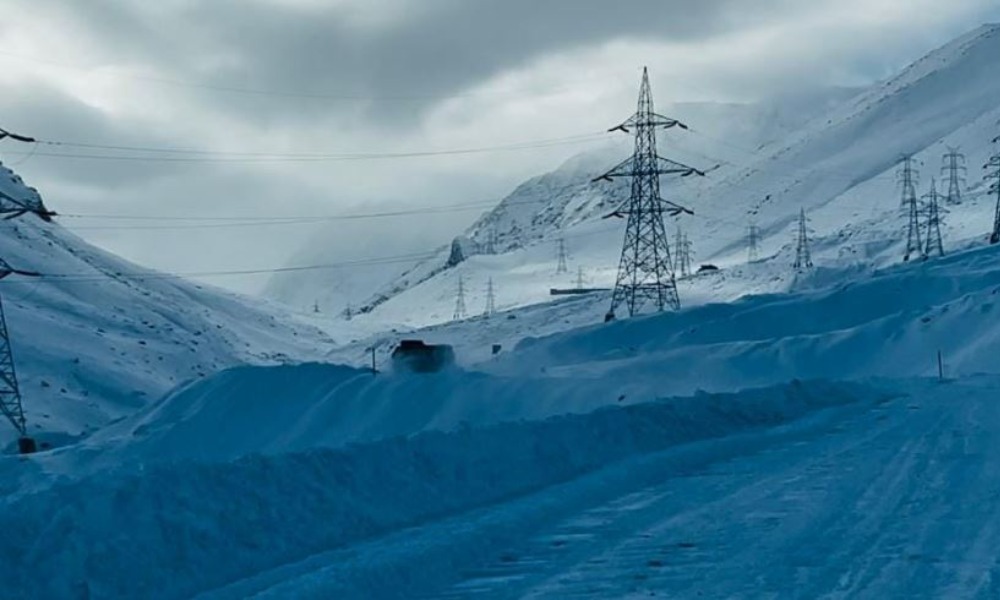
A United Arab Emirates-based company, HHM Global Industry Group, has expressed interest in investing in the construction of the second Salang Tunnel and establishing pharmaceutical factories in Afghanistan.
The issue was discussed at a regular meeting of the Inter-Ministerial Investment Committee, held on September 8, 2026, at the Marble Palace under the Economic Deputy Office of the Prime Minister’s Office.
The committee welcomed the company’s interest in investing in Afghanistan and assured its representatives that the relevant ministries and government agencies are prepared to provide comprehensive cooperation.
Following extensive discussions, company officials were asked to prepare detailed investment proposals for the construction of the second Salang Tunnel, pharmaceutical manufacturing facilities, as well as other potential investment projects.
The proposals will be submitted to the Inter-Ministerial Investment Committee for further review and discussion.
If implemented, the proposed investments could contribute to the development of Afghanistan’s transport infrastructure and strengthen domestic pharmaceutical production.
Business
Saudi energy group signs major Afghanistan deals covering gas exploration and pipeline plans
The agreements cover exploration across the Kushk and Tirpul contract area in Herat, spanning approximately 23,317 square kilometers.
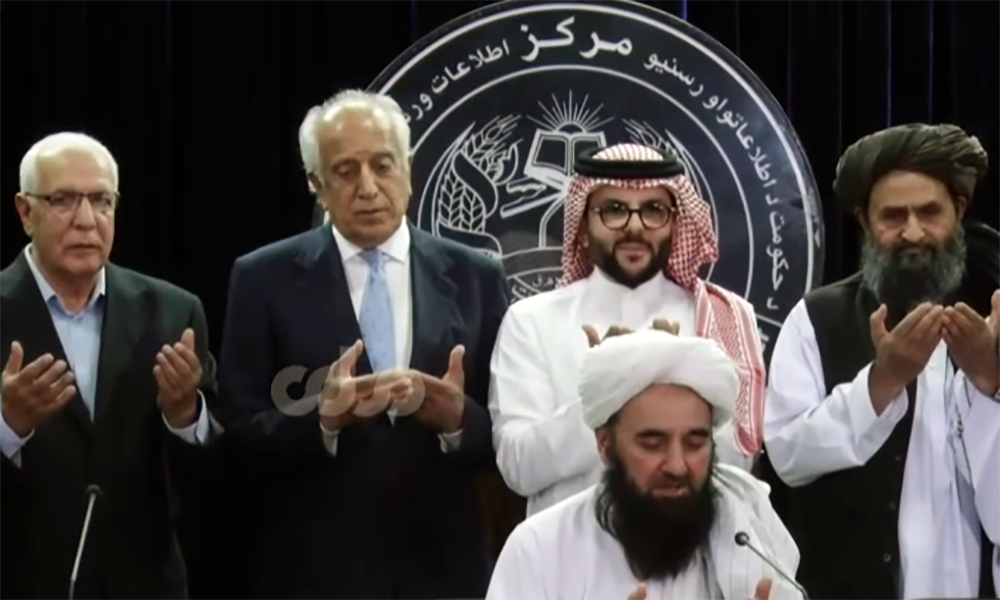
Saudi Arabia’s Delta Energy Group has signed a series of agreements with Afghanistan’s Ministry of Mines and Petroleum covering hydrocarbon exploration, natural gas utilization in Herat and a proposed regional gas pipeline.
According to a statement issued by Delta Energy on September 6, the agreements cover exploration across the Kushk and Tirpul contract area in Herat, spanning approximately 23,317 square kilometers.
Under the agreements, Delta Energy will conduct geological and geophysical studies, seismic surveys, exploration drilling and reservoir evaluations to determine the scale and commercial potential of Afghanistan’s hydrocarbon resources.
The company will also finance a study on the utilization of natural gas for Herat Industrial Park, Herat city and other approved areas, including potential applications in industry and power generation.
A separate agreement provides a framework to assess the proposed 700-kilometre CentGas “Corridor of Prosperity” pipeline, which would potentially connect a gas receipt point near Guzara district in Herat with a delivery point near Spin Boldak in Kandahar.
Delta Energy estimates the proposed pipeline could require about $10 billion in investment over 10 years, subject to technical and economic feasibility, financing, regulatory approvals and a final investment decision.
The company said the broader integrated programme could represent tens of billions of dollars in potential investment over the coming years, covering exploration, field development, gas utilization and related infrastructure. However, all subsequent phases will depend on exploration results, commercial viability, financing and required approvals.
Sheikh Badr Mohammed Al-Aiban, chairman of Delta International Holding Group, said the project was more than an oil and gas investment, describing it as an opportunity to develop an integrated energy ecosystem that could create jobs, support industry and improve regional connectivity.
Afghanistan’s Minister of Mines and Petroleum, Hidayatullah Badri, welcomed the agreements, saying cooperation with Delta Energy could help advance exploration of the country’s hydrocarbon resources, strengthen energy security and support economic activity.


Tahawol: Houthis’ return to regional power dynamics

ACL: Abu Muslim Farah 4-0 Istiqlal Kabul; Omar Zawak 3-1 Sarsabz Yashlar

Afghan interior minister meets outgoing Chinese ambassador

New warnings reignite debate over AI threat to humanity

Gulf states call off meeting with Iran, Houthis launch new attack on Saudi

Four mediators struggle to secure lasting Pakistan-Afghanistan ceasefire

Juma Khan Fateh surrenders to IEA forces in Badakhshan

Afghanistan’s trade diversification challenges Pakistan

Syria and Saudi Arabia condemn Kabul bombing, express solidarity with Afghanistan

Saudi energy group signs major Afghanistan deals covering gas exploration and pipeline plans
Tahawol: Houthis’ return to regional power dynamics

Tahawol: Calls for U.S. engagement with Afghanistan

Saar: End of Chinese ambassador’s mission in Kabul

Tahawol: Norwegian delegation’s call for engagement with Afghanistan discussed

Saar: Pakistan’s dual policy towards Afghanistan reviewed
-

 Sport5 days ago
Afghanistan Champions League Season 6 kicks off today: Abu Muslim Farah face Sarsabz Yashlar
-

 Sport3 days ago
Omar Zawak, Toofan Herat secure victories in Afghanistan Champions League
-
 Regional5 days ago
Pakistan warns Iran to rein in Houthis as Riyadh strikes back
-
 Latest News1 day ago
Khalilzad warns US risks losing influence in Afghanistan to China and Russia
-

 Regional3 days ago
Saudis shut down oil pipeline as Houthis tighten grip on Red Sea shipping
-

 Latest News3 days ago
Kabul to host tripartite meeting on Afghan migrants’ problems
-

 Sport1 day ago
Zadran calls on Afghan fans to rally behind team against India
-

 Latest News3 days ago
Pakistan court blocks expulsion of Afghan medical students