
Latest News
Afghan peace talks teams share demands that differ vastly

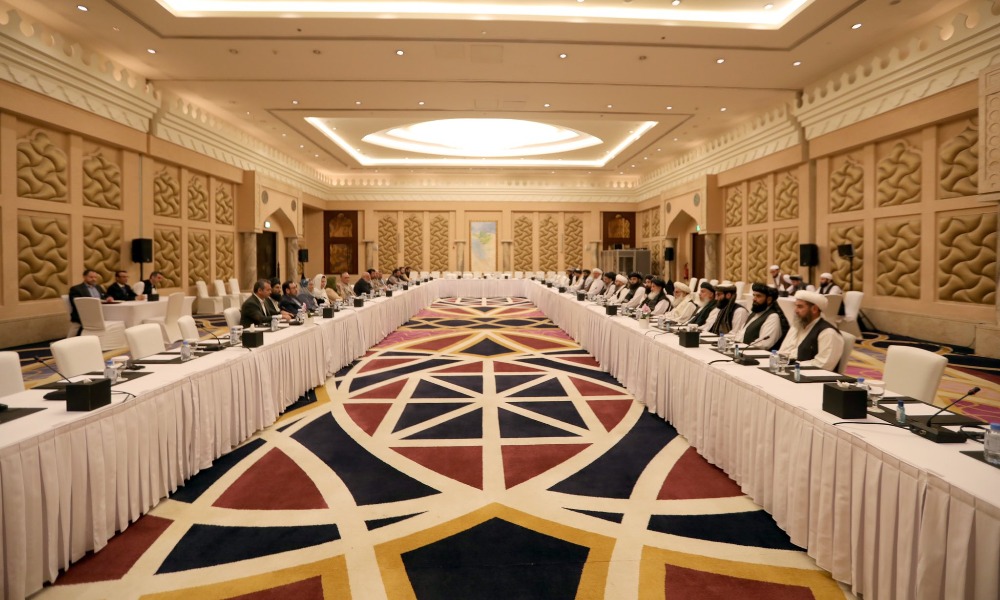
The Afghan Republic’s talks team and the Taliban’s team each presented their demands during discussions on Wednesday and while the republic’s team wants achievements to be preserved, the Taliban are set on an Islamic state.
This came on the fifth straight day of discussions between the two sides after last week’s breakthrough in the months-long deadlock.
Sources told Ariana News on condition of anonymity that the Republic’s team put forward 28 items and emphasized the need to preserve the achievements made over the past 19 years.
The Taliban in turn put forward 22 demands and emphasized the need for an interim government and women’s rights to be upheld in accordance with Sharia law.
The source said the requests by the Republic’s negotiators included the following:
- Declaring a lasting ceasefire without any conditions
- Preserving the Islamic Republic system
- Preserving the country’s flag
- Preserving the Afghan Constitution
- Preserving the Afghan national defense and security institutions
- Accepting all contracts and agreements that the government signed with various countries
- Disarming all Taliban fighters after a peace agreement has been signed
- Recruiting the Taliban into government structures after the completion of the peace process
- Accepting women, children, and people with disabilities’ rights as per national and international norms.
“Today both [teams of] negotiators discussed relevant issues on the agenda. Our negotiators focused on people’s demands,” said Najia Anwar, spokeswoman for the State Ministry on Peace Affairs.
The Taliban meanwhile called for the following:
- Removal of all Taliban names from blacklists
- Removal of the use of terms such as republic and democratic and for the next government to be named the Islamic government
- All educational and training institutions should operate in accordance with Sharia law
- Establishing an organization under the name of Amr-bil-Maroof to enforce Islamic law
- Establishing an interim government for between 12 and 18 months
- Both sides to keep the areas under their control currently [but local governments in Taliban areas to be handed over]
- Disarming the Taliban would be accepted once an Islamic government has been established
- Recognizing the Taliban as a shadow government until the peace process has been finalized
- Terms like war crimes and violations of human rights should be removed and the use of the words should be recognized as a crime
- Including at least 100,000 Taliban fighters into the Afghan security forces after a peace deal has been reached
- Civil society, human rights, women rights, and freedom of speech should be in accordance with Sharia law
- Establishing an Ulema council to advise the government and its decisions should be adhered to
“The Taliban and the government’s proposals should be discussed in the peace talks and I personally want a ceasefire first,” said Sima Samar, State Minister for Human Rights.
This comes after the Afghan Republic’s team and the Taliban agreed on procedural rules last week in order to take the talks forward.











Kazakhstan’s Foreign Minister Mukhtar Tileuberdi has called for pragmatic and coordinated international engagement with Afghanistan, saying the country’s long-term stability is closely linked to the security and sustainable development of Central Asia.
Speaking during the general debate of the 81st session of the United Nations General Assembly in New York on Friday, Tileuberdi said humanitarian assistance to Afghanistan remains essential but alone cannot break the cycle of poverty, displacement and dependency.
He said Kazakhstan supports a “pragmatic, coordinated and step-by-step” approach to international engagement with Afghanistan, with the United Nations playing a central role.
Tileuberdi also said Kazakhstan is working with the UN to operationalize the United Nations Regional Centre for the Sustainable Development Goals for Central Asia and Afghanistan in Almaty.
He said the success of the centre should be measured by the results and assistance it delivers to the region.


Abu Muslim Farah defeat Khurasan Faryab 2-0 in ACL season six

Saar: Concerns over Pakistan’s political crisis discussed

Afghanistan Champions League: Omar Zawak Herat beat Toofan Herat 1-0

Blast in Pakistan’s Dera Ismail Khan kills 11, injures 30

Ariana Afghan Airlines increases Kabul-Delhi cargo flights

Saudi energy group signs major Afghanistan deals covering gas exploration and pipeline plans

Trump floats idea of renaming Atlantic or Pacific Ocean

US hits Egyptian bank branches with Iran sanctions as war marks six months

Nepal flood rescue mission enters critical phase as thousands remain missing

Iranian clubs to face Gulf opponents at neutral venues in Asian Champions League Elite
Saar: Concerns over Pakistan’s political crisis discussed

Exclusive interview with Abdul Latif Mansoor, Minister of MRRD

Tawsia: Overview of Afghanistan’s iron mines

Tahawol: Discussion on fresh Pakistani airstrikes on Afghanistan

Saar: Calls for international support for Afghanistan discussed
-

 World5 days ago
CNN, MS NOW and Politico sue Trump, challenging White House ban
-

 Latest News3 days ago
Ariana Afghan Airlines ranks seventh among 45 Central Asian airlines
-

 Latest News4 days ago
UN reiterates call for respect for international law after Kunar airstrikes
-

 Regional3 days ago
US and Iran hold first talks since June after Trump’s ‘annihilation’ threat
-

 Latest News3 days ago
Silk Road highway in Wakhan corridor now reaches the China border
-

 Latest News4 days ago
Afghan Official: Pakistan’s airstrikes will not go unanswered
-
 Regional4 days ago
G7 foreign ministers call on Iran to stop arming Houthis
-
 Sport4 days ago
Afghan boxing referee heads to China for international festival