
Latest News
Afghanistan, Turkey, Pakistan, call on Taliban to commit to Afghan peace talks

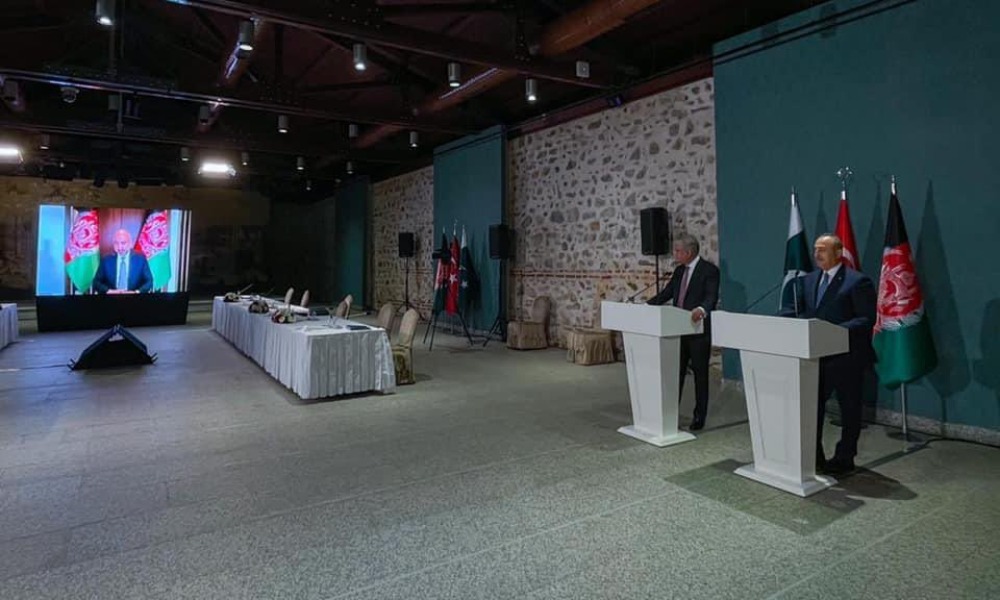
Afghanistan, Turkey, and Pakistan on Friday called on the Taliban to reaffirm their commitment to achieving an inclusive negotiated settlement leading to lasting peace in Afghanistan.
The Foreign Ministers of these countries held a trilateral meeting in Istanbul, Turkey, and discussed the Afghan peace process.
Foreign Minister Mohammad Haneef Atmar, who was tested positive for COVID-19, virtually attended the conference.
“Regretfully I tested positive for Covid-19 and had to attend the Afghanistan-Turkey-Pakistan Meeting virtually,” Atmar tweeted.
“Grateful to my brothers Mevlüt Çavuşoğlu and Shah Mahmood Qureshi for supporting a peaceful, sovereign, united and democratic Afghanistan.”
“Deploring violence, we called on Taliban for an immediate ceasefire and return to negotiation,” Atmar said.
In a joint statement issued after talks in Istanbul, the three diplomats stated that a sustainable peace can be achieved only through an inclusive Afghan-led and Afghan-owned political process that aims a permanent and comprehensive ceasefire along with an inclusive political settlement to end the conflict in the country.
The diplomats emphasized the urgent need for an immediate ceasefire both to end the existing high level of violence and to provide a conducive atmosphere for the peace talks.
A U.S.-backed Afghan peace conference to be hosted in Istanbul hosted by Turkey, Qatar, and the United Nations on Saturday was postponed over the Taliban’s non-participation.
Ankara has said the talks will be held after the Islamic fasting month of Ramadan but no new date has been set.
The foreign ministers of Turkey, Afghanistan, and Pakistan on Friday discussed the planned conference, aimed at fast-tracking an agreement between the Afghan government and the Taliban following Washington’s announcement that foreign troops will leave Afghanistan by Sept. 11.
The ministers “called on all parties, in particular, the Taliban to reaffirm their commitment for achieving an inclusive negotiated settlement leading to lasting peace in Afghanistan desired by the Afghan people, the region and the international community”, according to the joint statement.
They also “deplored the continuing high level of violence in Afghanistan.”
Speaking at a joint news conference after the talks, Turkish Foreign Minister Mevlut Cavusoglu said Ankara’s support for the Afghan peace process and efforts to organize the conference in Istanbul would continue.
“As the co-organizers, we are continuing talks on this with all sides,” he said, alongside Pakistani Foreign Minister Shan Mahmood Qureshi.
Afghan Foreign Minister Hanif Atmar joined the meeting via video link for health reasons, Cavusoglu said.
The Taliban had earlier refused to attend any summits until all foreign forces were pulled out of Afghanistan. The Taliban and the United States last year agreed that all foreign forces would be withdrawn from Afghanistan by May 1, a date that was pushed back last week by U.S. President Joe Biden.
The Islamist Taliban ruled Afghanistan from 1996 to 2001, when they were ousted by U.S.-led forces. Since then, they have waged a long-running insurgency and still control wide swathes of territory.
Reporter: Bais Hayat












Kazakhstan’s Foreign Minister Mukhtar Tileuberdi has called for pragmatic and coordinated international engagement with Afghanistan, saying the country’s long-term stability is closely linked to the security and sustainable development of Central Asia.
Speaking during the general debate of the 81st session of the United Nations General Assembly in New York on Friday, Tileuberdi said humanitarian assistance to Afghanistan remains essential but alone cannot break the cycle of poverty, displacement and dependency.
He said Kazakhstan supports a “pragmatic, coordinated and step-by-step” approach to international engagement with Afghanistan, with the United Nations playing a central role.
Tileuberdi also said Kazakhstan is working with the UN to operationalize the United Nations Regional Centre for the Sustainable Development Goals for Central Asia and Afghanistan in Almaty.
He said the success of the centre should be measured by the results and assistance it delivers to the region.


Abu Muslim Farah defeat Khurasan Faryab 2-0 in ACL season six

Saar: Concerns over Pakistan’s political crisis discussed

Afghanistan Champions League: Omar Zawak Herat beat Toofan Herat 1-0

Blast in Pakistan’s Dera Ismail Khan kills 11, injures 30

Ariana Afghan Airlines increases Kabul-Delhi cargo flights

Saudi energy group signs major Afghanistan deals covering gas exploration and pipeline plans

Trump floats idea of renaming Atlantic or Pacific Ocean

US hits Egyptian bank branches with Iran sanctions as war marks six months

Nepal flood rescue mission enters critical phase as thousands remain missing

Iranian clubs to face Gulf opponents at neutral venues in Asian Champions League Elite
Saar: Concerns over Pakistan’s political crisis discussed

Exclusive interview with Abdul Latif Mansoor, Minister of MRRD

Tawsia: Overview of Afghanistan’s iron mines

Tahawol: Discussion on fresh Pakistani airstrikes on Afghanistan

Saar: Calls for international support for Afghanistan discussed
-

 World5 days ago
CNN, MS NOW and Politico sue Trump, challenging White House ban
-

 Latest News3 days ago
Ariana Afghan Airlines ranks seventh among 45 Central Asian airlines
-

 Latest News4 days ago
UN reiterates call for respect for international law after Kunar airstrikes
-

 Regional3 days ago
US and Iran hold first talks since June after Trump’s ‘annihilation’ threat
-

 Latest News3 days ago
Silk Road highway in Wakhan corridor now reaches the China border
-

 Latest News4 days ago
Afghan Official: Pakistan’s airstrikes will not go unanswered
-

 Sport4 days ago
Afghan boxing referee heads to China for international festival
-
 Regional5 days ago
G7 foreign ministers call on Iran to stop arming Houthis