Latest News
Iranian and Indian officials discuss formation of regional contact group on Afghanistan
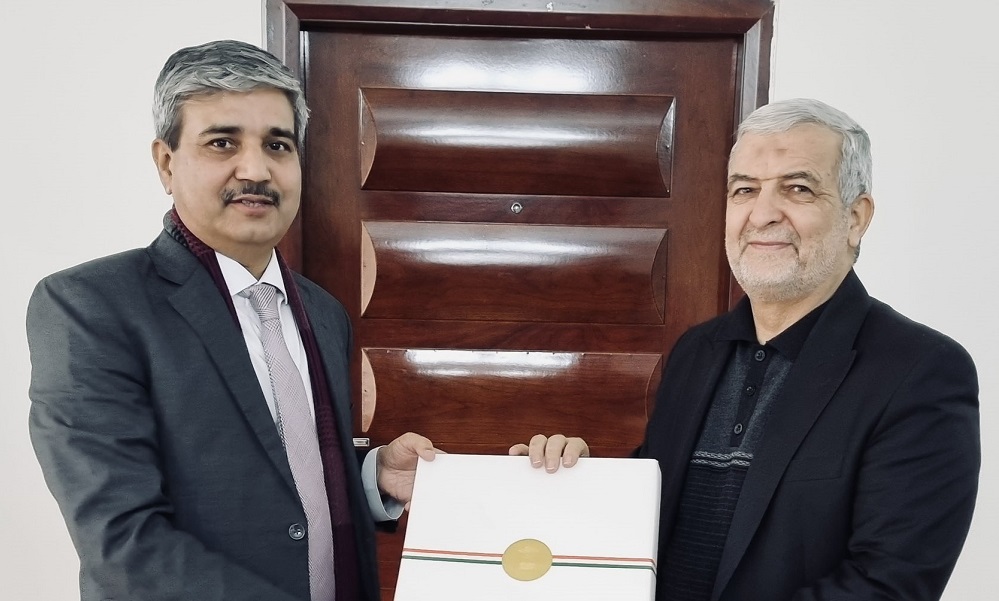
Iran’s special representative for Afghanistan, Hassan Kazemi Qomi, met with J.P. Singh, the joint secretary of Pakistan-Afghanistan-Iran division of India’s foreign ministry to discuss the formation of a regional contact group on Afghanistan.
Qomi said on X on Sunday that in the meeting, they discussed “the formation of a regional contact group to advance political and economic issues with the aim of creating stability” in Afghanistan.
They also discussed the role of Chabahar Port in the expansion of economic relations with Afghanistan.
Meanwhile, during his visit to Tehran, India’s Foreign Secretary Vinay Kwatra discussed with the Iranian Foreign Minister and his political and economic deputies the issue of Chabahar Port.
Arindam Bagchi, the spokesperson of India’s foreign ministry, said on X that Kwatra and the Iranian foreign minister, Amir Hossein Abdullahian, discussed bilateral relations, connectivity projects including Chabahar Port, and the challenges in the region.
Connecting to Chabahar Port will grant Afghanistan access to markets in Europe, the Middle East, India, and China, thereby strengthening Afghanistan’s global relationships.

Latest News
Iran pushes for regional meeting to resolve Kabul–Islamabad tensions
Tehran’s engagement marks the latest attempt by regional stakeholders to prevent further escalation and encourage both Kabul and Islamabad to return to the negotiating table.
Iran is stepping up diplomatic efforts to ease rising tensions between Afghanistan and Pakistan, with Foreign Minister Seyed Abbas Araghchi announcing on Sunday that Tehran is working to convene a regional meeting focused on defusing the crisis.
Araghchi said Iran recently launched a series of initiatives aimed at promoting stability between the two neighbors, including several rounds of phone consultations with key regional actors. He expressed hope that these efforts would produce “practical results” and lead to a broader regional summit dedicated to resolving disputes.
According to the Iranian foreign minister, he held discussions last week with his counterparts in Kabul and Islamabad, urging both sides to prioritize dialogue over confrontation. Araghchi also spoke with the foreign ministers of Qatar, Turkey, and Russia to coordinate diplomatic approaches and strengthen support for mediation efforts.
The push comes after earlier talks between Afghanistan and Pakistan—mediated by Qatar and Turkey—failed to generate a breakthrough. Tensions have continued to simmer along the disputed Durand Line, prompting concern among regional governments.
Pakistan’s Ministry of Foreign Affairs welcomed Tehran’s initiative, with spokesperson Tahir Hussain Andrabi describing Iran as a “brotherly and friendly country.” He said Islamabad supports any constructive role Iran can play and reaffirmed Pakistan’s commitment to resolving issues through peaceful dialogue and diplomacy.
Tehran’s engagement marks the latest attempt by regional stakeholders to prevent further escalation and encourage both Kabul and Islamabad to return to the negotiating table.
Latest News
Afghan refugees returning from Pakistan report widespread abuse, property seizures, and forced deportations
Many returnees claim that Pakistani government institutions have confiscated their homes, land, and all personal belongings.
Afghan migrants returning from Pakistan say mistreatment by Pakistani police and authorities has intensified in recent months.
Many of those who recently crossed back into Afghanistan through Spin Boldak in Kandahar are reporting widespread abuse, the seizure of their homes and property, and the forced deportation of unaccompanied children.
An ATN journalist visited Spin Boldak and documented the experiences of returning refugees.
Many returnees claim that Pakistani government institutions have confiscated their homes, land, and all personal belongings.
Shamsullah, a returnee, said: “I lived in Karachi for forty years. Our forefathers had moved there. I thought I would live there forever. I had even bought land, but I had to leave everything behind and return.”
Islamuddin, another returnee, shared a similar experience: “I left behind a house worth 1.5 to 2 million afghanis. Everyone was trying to seize our property. We barely managed to escape with our lives. Our Afghan brothers still living in Pakistan face terrible hardships.”
For many, the loss goes beyond property—entire futures have been disrupted.
Mohammad Shaheen, a final-year medical student, said he and his Pakistani wife have lost everything: “My wife is Pakistani and has a national ID card. They told me, ‘Because you are Afghan, you must take her with you.’ They said I can only return on a visa.”
Detention and Deportation of Children
Returnees report that Pakistani police have been detaining children aged 10 to 17, holding them for days or weeks without notifying their families, and then deporting them alone to Afghanistan.
Najibullah, an unaccompanied minor, said: “They arrested children, kept them in prison for a month, mistreated them, forced them to work, and later sent them to Afghanistan without their families.”
Allah Mohammad, another migrant child, added: “The abuse was unbearable. Many of our friends were arrested. Their families were devastated. They were expelled without any notice.”
Officials in Spin Boldak confirm that a large number of unaccompanied children have been deported by Pakistan.
Mohammad Ali Haqmal, spokesman for Spin Boldak district governor’s office, said: “Dozens of children have been expelled. They have no contact with their families. They were arrested and deported without their parents knowing. They face serious challenges, but the Islamic Emirate is assisting them.”
Extortion Along the Chaman–Spin Boldak Route
Migrants also allege that Pakistani police extort money at multiple checkpoints, allowing passage only after payments ranging from 20,000 to 80,000 Afghanis.
Yusuf Khan, a returnee, said: “We spent three months in prison. Even then, we had to pay 80,000 Afghanis to be released. We spent eight days traveling back.”
Local officials in Spin Boldak report that 1,200 to 1,500 migrant families—equivalent to 6,000 to 8,000 individuals—enter Afghanistan daily through the Chaman–Spin Boldak crossing.
Latest News
Tashkent: Central Asian leaders say regional stability hinges on Afghanistan
The two-day meeting comes at a time when Afghanistan’s stability — or lack thereof — continues to shape the wider region’s security landscape, trade connectivity and long-term development prospects.
The 7th Consultative Summit of Central Asian Leaders opened Saturday in Tashkent, where heads of six regional countries gathered to assess the evolving situation in Afghanistan and to chart a coordinated path for deeper political, economic and security cooperation.
The two-day meeting comes at a time when Afghanistan’s stability — or lack thereof — continues to shape the wider region’s security landscape, trade connectivity and long-term development prospects.
Uzbekistan’s President Shavkat Mirziyoyev, who initiated the idea of these high-level summits at the UN General Assembly in 2017, reiterated that Central Asia “cannot achieve lasting peace, stability or prosperity without a stable Afghanistan.” Tashkent has long positioned itself as a regional mediator on Afghan issues, hosting multiple rounds of diplomatic talks and pushing for expanded trade corridors that link Afghanistan to Central Asian markets.
Leaders at this year’s summit are expected to discuss a broad agenda: strengthening regional economic partnerships, accelerating joint infrastructure and transport projects, enhancing counter-terrorism and border security cooperation, and examining the impact of global geopolitical shifts on Central Asia. The discussions reflect growing concern that instability in Afghanistan — including economic pressures, migration flows and the presence of extremist groups — directly affects the region’s collective security.
Since Uzbekistan assumed the rotating chairmanship of the consultative process, more than 20 intergovernmental meetings have been held, underscoring a renewed commitment among Kazakhstan, Kyrgyzstan, Tajikistan, Turkmenistan and Uzbekistan to approach shared challenges with unified strategies. Analysts say the summit structure has become an increasingly important platform as Central Asian states seek to balance cooperation with major powers while safeguarding regional autonomy.
The Tashkent summit will continue through Sunday, with leaders expected to issue a joint statement outlining common priorities — many of which are likely to centre on ensuring that Afghanistan is integrated into regional economic plans rather than left isolated, a scenario observers warn would carry security risks for the entire region.
-
Business3 days agoPakistan will lose big market in both Afghanistan, Central Asia: Sarhadi
-
Latest News4 days agoAfghanistan suspends customs clearance for Pakistani medicine imports
-
Sport2 days agoAfghan Abdalyan beat Sri Lanka A by 3 wickets in Rising Stars Asia Cup opener
-
Latest News2 days agoPakistan says it Is ready to receive Its nationals living in Afghanistan
-
Latest News4 days agoCIA ran secret program to undermine Afghanistan’s opium industry, report reveals
-
Regional4 days agoUS Treasury issues Iran-related missile and drone sanctions
-
Latest News2 days agoTop Tajik officials arrive in Kabul for talks with Islamic Emirate
-
Sport2 days agoAfghanistan wins first-ever gold medal at Islamic Solidarity Games