
Latest News
Republicans and Democrats agree U.S. war in Afghanistan wasn’t worth fighting: poll

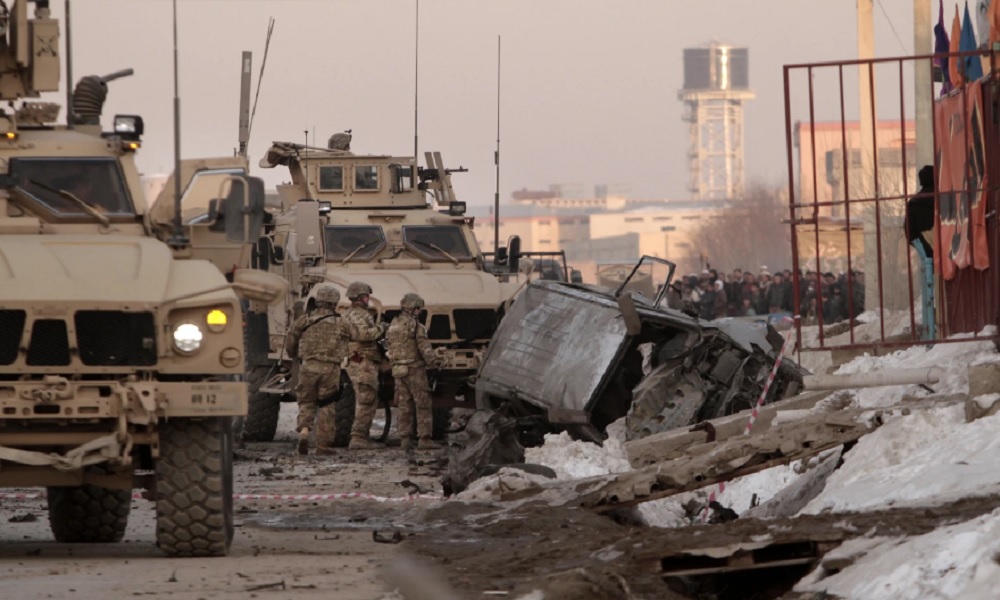
At a time when Americans are deeply divided along party lines, a new poll shows considerable agreement on at least one issue that is the United States’ two-decade-long war in Afghanistan was not worth fighting, the Associated Press reported on Wednesday.
The poll from the Pearson Institute for the Study and Resolution of Global Conflicts and The Associated Press-NORC Center for Public Affairs suggest the US withdrawal from Afghanistan, seen by many as chaotic and ill-planned, may have been a turning point for President Joe Biden’s approval ratings, which started a downward slide around that time and have not recovered since.
Two-thirds of Americans say the war in Afghanistan was not worth fighting; 65% of Democrats and 63% of Republicans agree on that evaluation. Many have doubts about how successful the U.S. was at accomplishing more specific goals such as eliminating the threat from extremists or improving opportunities for women.
“It was unwinnable from the beginning,” said Martin Stefen, a 78-year-old Republican who lives in Carson City, Nevada. He said the U.S. should have paid closer attention to what happened to the Soviet Union, which waged a decade-long war in Afghanistan during the 1980s only to pull out in defeat in 1989. And, he said, the U.S. should have had a more specific end goal for how it wanted the war in Afghanistan to go and a better understanding of the country’s tribal politics.
That thought was echoed by Justin Campbell, a 28-year-old Democrat from Brookhaven, Mississippi. He said it was clear after the U.S. was entrenched in Afghanistan that it didn’t have very deep support. Campbell said he’s not pleased that the Islamic Emirate of Afghanistan (IEA) is back in control.
“But I don’t think it was worth us staying over there,” he said.
Maliha Chishti, a lecturer and research associate at the Pearson Institute, said she was struck by the fact that after 20 years of war, so many American and Afghan lives lost and billions spent, the vast majority said they felt Afghanistan was not friendly to the U.S. or was an outright enemy. She said the responses demonstrate a frustration on the part of Americans and the need to ask questions about what went wrong with America’s attempts to intervene in Afghanistan.
“We invested all of this money to really build a state from scratch and when we left, that state completely collapsed,” she said.
Many Americans also say the United States was not successful with many of its key objectives in Afghanistan.
Eliminating the threat of terrorism in Afghanistan during the war is still seen as an important goal by many across party lines: 46% of Democrats and 44% of Republicans called that highly important. But only about one-quarter in each group said this successfully happened during the war.
Slightly fewer than half — 46% — say the U.S. and its allies were successful at the goal of apprehending or killing the individuals who were responsible for the Sept. 11 attacks, compared with 25% who think the U.S. was unsuccessful in achieving that goal.
Only about one in five Americans say the U.S. successfully improved opportunities for women and girls in Afghanistan, with 43% saying such efforts were unsuccessful. But many said advancing the rights of women and girls in Afghanistan was important to them. About three quarters said that goal was extremely, very or somewhat important to them.






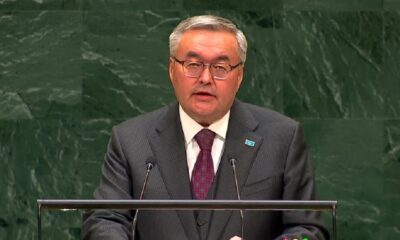




Kazakhstan’s Foreign Minister Mukhtar Tileuberdi has called for pragmatic and coordinated international engagement with Afghanistan, saying the country’s long-term stability is closely linked to the security and sustainable development of Central Asia.
Speaking during the general debate of the 81st session of the United Nations General Assembly in New York on Friday, Tileuberdi said humanitarian assistance to Afghanistan remains essential but alone cannot break the cycle of poverty, displacement and dependency.
He said Kazakhstan supports a “pragmatic, coordinated and step-by-step” approach to international engagement with Afghanistan, with the United Nations playing a central role.
Tileuberdi also said Kazakhstan is working with the UN to operationalize the United Nations Regional Centre for the Sustainable Development Goals for Central Asia and Afghanistan in Almaty.
He said the success of the centre should be measured by the results and assistance it delivers to the region.


Afghanistan Champions League: Omar Zawak Herat beat Toofan Herat 1-0

Blast in Pakistan’s Dera Ismail Khan kills 11, injures 30

Ariana Afghan Airlines increases Kabul-Delhi cargo flights

Khalilzad questions Pakistan’s commitment to Afghan welfare

India, UN envoy discuss Afghanistan’s humanitarian needs

Saudi energy group signs major Afghanistan deals covering gas exploration and pipeline plans

Trump floats idea of renaming Atlantic or Pacific Ocean

US hits Egyptian bank branches with Iran sanctions as war marks six months

Nepal flood rescue mission enters critical phase as thousands remain missing

Iranian clubs to face Gulf opponents at neutral venues in Asian Champions League Elite

Exclusive interview with Abdul Latif Mansoor, Minister of MRRD

Tawsia: Overview of Afghanistan’s iron mines

Tahawol: Discussion on fresh Pakistani airstrikes on Afghanistan

Saar: Calls for international support for Afghanistan discussed

Tahawol: Opening of the 81st UN General Assembly Session
-

 World4 days ago
CNN, MS NOW and Politico sue Trump, challenging White House ban
-

 Latest News3 days ago
Ariana Afghan Airlines ranks seventh among 45 Central Asian airlines
-

 Latest News4 days ago
UN reiterates call for respect for international law after Kunar airstrikes
-
 Latest News5 days ago
Khalilzad condemns Pakistan airstrikes, says current strategy is not working
-

 Regional3 days ago
US and Iran hold first talks since June after Trump’s ‘annihilation’ threat
-

 Latest News3 days ago
Silk Road highway in Wakhan corridor now reaches the China border
-

 Latest News4 days ago
Afghan Official: Pakistan’s airstrikes will not go unanswered
-

 Sport4 days ago
Afghan boxing referee heads to China for international festival