
Science & Technology
India’s moon rover confirms sulfur and detects several other elements near the lunar south pole

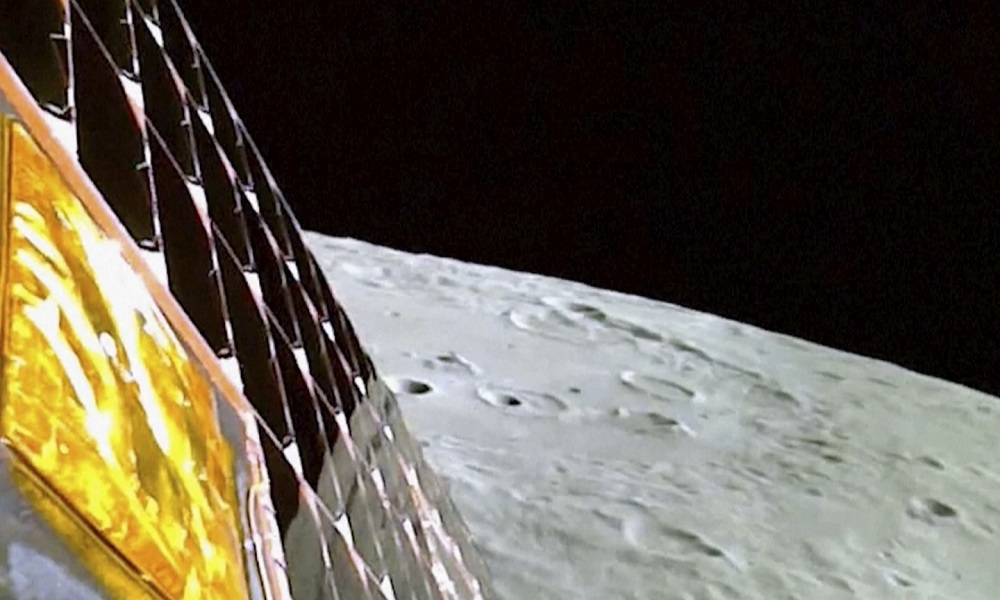
India’s moon rover confirmed the presence of sulfur and detected several other elements near the lunar south pole as it searches for signs of frozen water nearly a week after its historic moon landing, India’s space agency said Tuesday.
The rover’s laser-induced spectroscope instrument also detected aluminum, iron, calcium, chromium, titanium, manganese, oxygen and silicon on the lunar surface, the Indian Space Research Organization, or ISRO, said in a post on its website, AP reported.
The lunar rover had come down a ramp from the lander of India’s spacecraft after last Wednesday’s touchdown near the moon’s south pole. The Chandrayan-3 Rover is expected to conduct experiments over 14 days, the ISRO has said.
The rover “unambiguously confirms the presence of sulfur,” ISRO said. It also is searching for signs of frozen water that could help future astronaut missions, as a potential source of drinking water or to make rocket fuel.
The rover also will study the moon’s atmosphere and seismic activity, ISRO Chairman S. Somnath said.
On Monday, the rover’s route was reprogrammed when it came close to a 4-meter-wide (13-foot-wide) crater. “It’s now safely heading on a new path,” the ISRO said.
The craft moves at a slow speed of around 10 centimeters (4 inches) per second to minimize shock and damage to the vehicle from the moon’s rough terrain.
After a failed attempt to land on the moon in 2019, India last week joined the United States, the Soviet Union and China as only the fourth country to achieve this milestone.The successful mission showcases India’s rising standing as a technology and space powerhouse and dovetails with the image that Prime Minister Narendra Modi is trying to project: an ascendant country asserting its place among the global elite.
The mission began more than a month ago at an estimated cost of $75 million.
India’s success came just days after Russia’s Luna-25, which was aiming for the same lunar region, spun into an uncontrolled orbit and crashed. It would have been the first successful Russian lunar landing after a gap of 47 years. Russia’s head of the state-controlled space corporation Roscosmos attributed the failure to the lack of expertise due to the long break in lunar research that followed the last Soviet mission to the moon in 1976.
Active since the 1960s, India has launched satellites for itself and other countries, and successfully put one in orbit around Mars in 2014. India is planning its first mission to the International Space Station next year, in collaboration with the United States.








Science & Technology
Humanoid robot beats Usain Bolt’s 100m record at Beijing robot games
The record-breaking sprint was one of the highlights of the opening day of the five-day event, which is being held at Beijing’s National Speed Skating Oval, a venue built for the 2022 Winter Olympics.
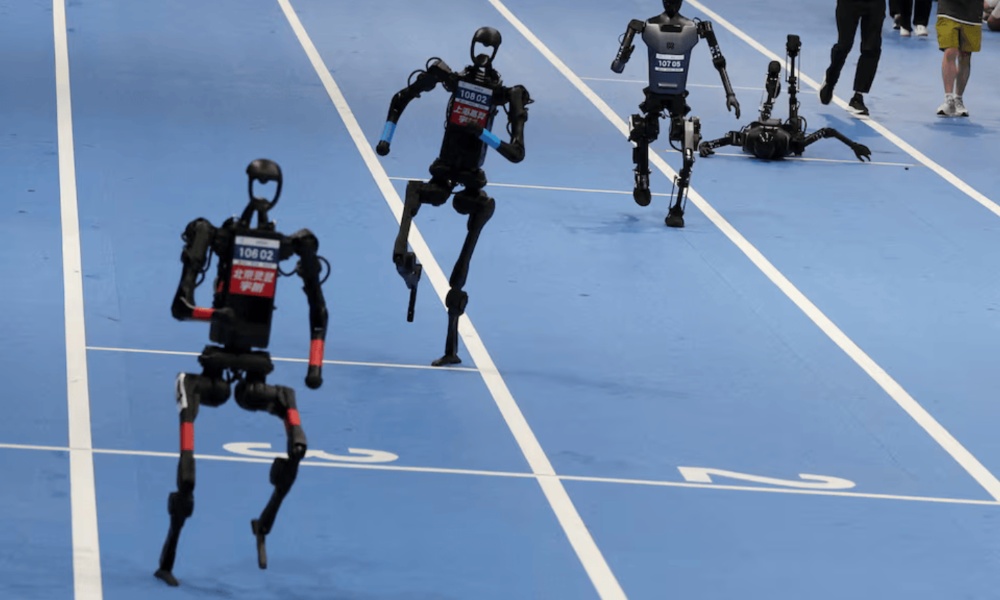
A Chinese humanoid robot has beaten Usain Bolt’s long-standing 100-metre world record, setting the stage for a spectacular second World Humanoid Robot Games that opened in Beijing on Saturday.
Tiangong Ultra clocked 9.39 seconds in the 100-metre sprint at the games, surpassing Bolt’s human world record of 9.58 seconds, set at the 2009 World Athletics Championships in Berlin. The robot, developed by the Beijing Humanoid Robot Innovation Center, narrowly defeated another humanoid, Honor’s Lightning, which finished in 9.47 seconds.
Lightning had already recorded an even faster 9.32 seconds during a trial run before the games. It reached a peak speed of 14.5 metres per second.
The record-breaking sprint was one of the highlights of the opening day of the five-day event, which is being held at Beijing’s National Speed Skating Oval, a venue built for the 2022 Winter Olympics.
The second edition of the World Humanoid Robot Games brings together 666 teams and 2,056 robots from 16 countries. The competition features 51 events and more than 1,000 matches across sports including running, football and table tennis, as well as other challenges designed to test the capabilities of humanoid machines.
Robots also surpassed another major human athletic benchmark. A humanoid developed by Beijing-based X-Humanoid reached 2.88 metres in the standing high jump, exceeding the human world record of 2.45 metres set by Cuba’s Javier Sotomayor in 1993.
The dramatic improvement in the 100-metre sprint is particularly striking. At last year’s inaugural games, Tiangong Ultra completed the same race in 21.50 seconds.
The rapid progress is part of China’s broader push to develop humanoid robots as a major emerging industry, with companies and policymakers investing heavily in artificial intelligence, robotics and advanced hardware for potential use in manufacturing, logistics and consumer applications.
Despite the impressive performances, the robots still face challenges that human athletes have long mastered. After Saturday’s sprint, Tiangong Ultra stumbled, while Lightning collapsed and had to be removed on a stretcher, highlighting difficulties with balance and braking at high speeds.
The games run through August 26 and are showcasing the rapid evolution of humanoid robots while also testing how far the machines can perform in increasingly demanding real-world sporting environments.

Enayatullah Alokozay, spokesperson for the Ministry of Communications and Information Technology, said Thursday the ministry has signed a contract with Afghan Wireless Communication Company (AWCC) for the construction of 31 telecommunications towers worth more than 269 million AFN under the 11th project of the Telecommunications Development Fund (TDF).
Alokozay said in a post on X that the towers will be built in 13 districts across Kandahar, Paktika, Helmand and Zabul provinces.
He added that the towers will provide services in areas that so far have had no access to any telecommunications services.
Science & Technology
Total darkness, then sunset as full eclipse wows spectators in Spain
Millions of people gathered in Iceland and northern Spain to witness Western Europe’s first total solar eclipse in 27 years.
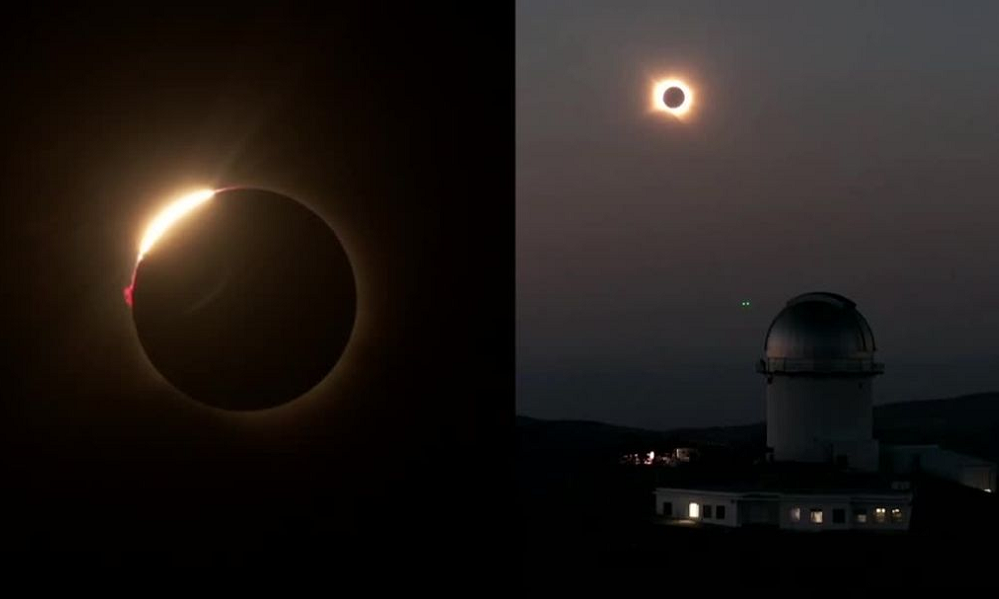
Spectators across Spain watched in wonder, some whipping off their protective glasses and rising to their feet in unison, as a rare total solar eclipse swept across the north of the country on Wednesday evening, plunging it into darkness.
Spain deployed a massive police contingent and set up special viewing spots across rural areas that offered the best views of the spectacle, Reuters reported.
Viewers in Buitrago de Lozoya, a rural district north of Madrid, clapped and cheered as the sky dimmed and Baily’s beads – bright points of sunlight that shine around the edge of the moon during a total eclipse – glistened on the horizon just after 8:30 p.m. (1830 GMT), lasting barely a minute.
“It’s impressive how the colours return little by little after totality – first the reds, then the blues – just like at dawn and sunset, totally deceiving your brain,” said economist Diego Fernandez, 32.
Rafael Jiménez, 50, a resident of Madrid, said the event felt like science fiction. “It was an absurd scene; we even got soaked when the garden sprinklers kicked in,” he said. “And then, just like that, we were watching the sunset again.”
Spain’s turn with the eclipse followed shortly after a less remarkable spectacle over much of overcast Iceland, although a break in the clouds in the far west of the Nordic country allowed holidaymakers and locals a glimpse of the celestial phenomenon. The eclipse was hidden behind clouds in central Reykjavik although the darkness of the totality was still evident.
“It was like a whole day just came at once and I felt goosebumps because it just made us think about … the shortness of life, how time can be different and it depends on your perspective,” lawyer Eduarda Ortiz, 33, told Reuters in the Icelandic capital.
Millions of people gathered in Iceland and northern Spain to witness Western Europe’s first total solar eclipse in 27 years.
Brian May, former guitarist for the rock band Queen, was among them. He travelled to an observatory in Spain’s Teruel province and chronicled the experience on his Instagram page.
“Here we go, the sun is disappearing. It’s amazing,” he said as the eclipse reached its climax and bystanders burst into cheers and applause after a countdown.
In Spain, authorities were expecting up to 6 million visitors in mostly rural areas under the eclipse’s path across the north of Spain and the Balearic Islands.
POLICE, PLANES AND HELICOPTERS ON STANDBY
The Iberian Peninsula last witnessed a total solar eclipse in 1912, but another is due on August 2, 2027, and an annular eclipse will follow in January 2028, completing the so-called “Iberian Eclipse Trio”.
The uncanny sensation when day briefly turns to twilight and some animals fall quiet, while the moon passes directly between Earth and the sun, has often been seen through history as an omen of cosmic struggle or a sign of divine power.
For Spain, the event has been a chance to showcase its less-travelled regions and draw tourists from its overcrowded beach resorts. Some seized the opportunity to get married, according to local press reports.
The eclipse took place in one of the country’s highest-risk periods for wildfires, with emergency crews fighting various fires on Wednesday, including a large one in the southern Andalucia region.
Authorities rolled out a large-scale police operation and public safety campaign to make sure the crowds did not set off wildfires.
A small fire erupted near an eclipse viewing point in the town of Peñíscola, in the Valencia region, local authorities said. The fire began in a vehicle and spread to 33 more before firefighters brought it under control, they said. Emergency crews, including aircraft, were dispatched to the area.
The authorities dispatched 25,000 police officers to guarantee security around the eclipse observation sites and deployed nearly 100 planes and helicopters.
As of late Wednesday, no wildfire incident tied to eclipse chasers was reported.
ECLIPSE FEVER IN THE LAND OF SAGAS
In Reykjavik, glasses that allow spectators to view the phenomenon without damaging their eyes have been sold out for days, as the country of roughly 400,000 people welcomed up to 80,000 visitors.
Totality reached Iceland’s westernmost coast at about 5:44 p.m. (1744 GMT), casting the far west of the island nation into total darkness for up to 2 minutes and 13 seconds.
The event has drawn both casual observers and “eclipse chasers”, enthusiasts who crisscross the globe to be in the path of totality whenever and wherever an eclipse occurs.
In Spain, 43-year old Gema, who did not give her last name, said as she left the Buitrago de Lozoya viewing point: “Everybody tells you about it, but it is more beautiful than you imagine.”


Saar: Afghanistan’s uncertain future in SCO

Islamic Emirate spokesperson reveals his real name

Less than 42% of Afghans have access to national power grid: UNDP

Iran calls for fewer border barriers as trade with Afghanistan expands

Afghanistan squad announced for three-match T20I series against India

Pakistan’s governance system has ‘collapsed’: Mohsin Naqvi

Afghanistan exports first stone shipment to US in $100,000 trade milestone

AFC confirms clubs for 2026/27 competitions; draw set for August 18

Only two days to go before Afghanistan and Ireland begin ODI series

Iran seeks to establish free trade zone with Afghanistan and China
Saar: Afghanistan’s uncertain future in SCO

Tahawol: IEA seeking Afghanistan seat at UN

Saar: U.S. sanctions against Iran

Saar: Ongoing return of Afghan refugees from Iran and Pakistan discussed

Tahawol: Expansion of IEA’s diplomatic ties with countries discussed
-

 Latest News1 day ago
Four mediators struggle to secure lasting Pakistan-Afghanistan ceasefire
-

 Latest News3 days ago
Syria and Saudi Arabia condemn Kabul bombing, express solidarity with Afghanistan
-

 Latest News2 days ago
US judge strikes down Trump visa suspension for 75 countries, including Afghanistan
-

 Latest News2 days ago
Achakzai urges Pakistan to end hostility towards Afghanistan
-

 Latest News4 days ago
Qatar and UAE condemn Kabul school bombing that injured dozens
-

 Sport2 days ago
Afghanistan-India T20I series could see major schedule change
-
 Latest News4 days ago
Pakistan needs national dialogue on Afghan policy: security expert
-

 Science & Technology4 days ago
Ministry of Communications signs contract with AWCC to build 31 telecom towers