
Latest News
SIGAR finds Ghani and his advisors fled the country with less than $1 million

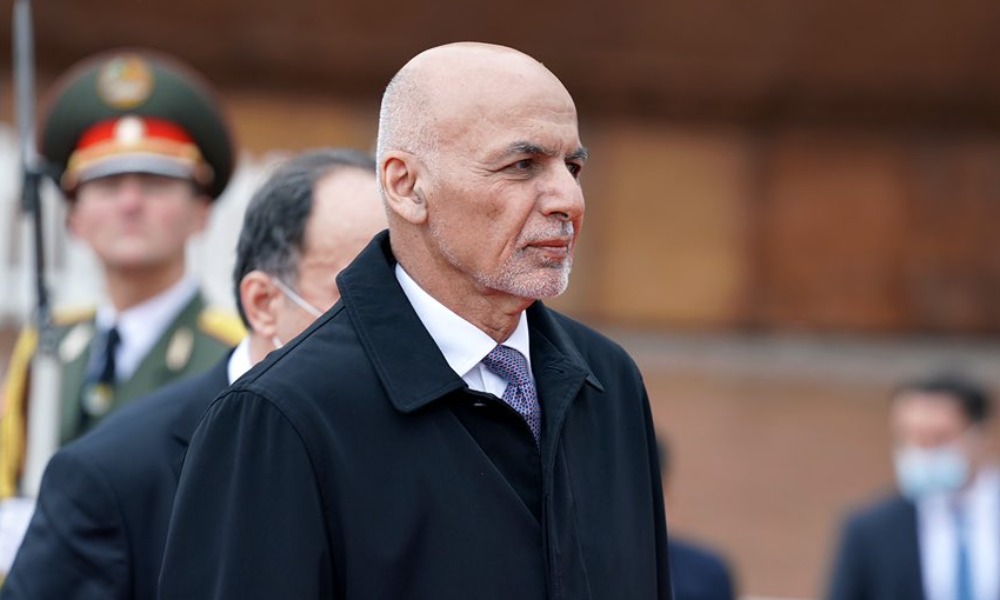
Washington’s oversight authority on Afghanistan reconstruction has found that allegations of theft of millions of dollars of cash by former president Ashraf Ghani and his senior advisors, at the time of their hurried departure, are likely untrue.
In the Special Inspector General for Afghanistan Reconstruction’s (SIGAR) interim report on the theft of funds, which was published on Tuesday, the investigative team found that while some cash was taken from the grounds of the palace and loaded onto helicopters, that carried Ghani, his wife Rula, and senior staff members to Uzbekistan, evidence indicates that the amount of cash on board did not exceed $1 million and may have been closer in value to $500,000.
SIGAR also identified suspicious circumstances in which approximately $5 million in cash was allegedly left behind at the presidential palace. “The origins and purpose of this money are disputed, but it was supposedly divided by members of the Presidential Protective Service” after the helicopters departed but before the Islamic Emirate of Afghanistan (IEA) captured the palace.
SIGAR examined other examples of alleged theft by senior Afghan officials as the government collapsed, including tens of millions of dollars from the operating budget of the National Directorate of Security.
Although there appears to have been ample opportunity and effort to plunder Afghan government coffers, “at this time SIGAR does not have sufficient evidence to determine with certainty whether hundreds of millions of dollars were removed from the country by Afghan officials as the government collapsed or whether any stolen money was provided by the United States,” the report read.
According to SIGAR, this is an interim report, as they are still waiting for responses to questions sent to Ghani.
“If forthcoming, those answers will be incorporated into a final report,” SIGAR stated.
Following the collapse of the former Afghan government, allegations were made that Ghani and his senior advisors fled Afghanistan with millions of dollars in cash loaded onto the helicopters that carried them from the presidential palace to Termez, Uzbekistan, on the afternoon of August 15, 2021.
“The hurried nature of their departure, the emphasis on passengers over cargo, the payload and performance limitations of the helicopters, and the consistent alignment in detailed accounts from witnesses on the ground and in the air all suggest that there was little more than $500,000 in cash on board the helicopters,” read the report.
“That being said, it is likely that significant amounts of U.S. currency disappeared from Afghan government property in the chaos of the Taliban (IEA) takeover – including $5million taken from the presidential palace and tens of millions taken from the vault at the National Directorate of Security,” SIGAR stated.
“Attempts to loot other government funds appear to have been common. Yet with Afghan government records and surveillance videos from those final days likely in Taliban (IEA) hands, SIGAR is currently unable to determine how much money was ultimately stolen, and by whom,” the report stated.
The Russian embassy in Kabul asserted in late August that there was $169 million on board the helicopters, and two days later the Afghan ambassador to Tajikistan, Zahir Aghbar, echoed these claims in a press conference.
Aghbar also vowed to file a request with Interpol to arrest Ghani. However, Aghbar declined to sit for an interview with SIGAR or provide any evidence substantiating this claim.










Kazakhstan’s Foreign Minister Mukhtar Tileuberdi has called for pragmatic and coordinated international engagement with Afghanistan, saying the country’s long-term stability is closely linked to the security and sustainable development of Central Asia.
Speaking during the general debate of the 81st session of the United Nations General Assembly in New York on Friday, Tileuberdi said humanitarian assistance to Afghanistan remains essential but alone cannot break the cycle of poverty, displacement and dependency.
He said Kazakhstan supports a “pragmatic, coordinated and step-by-step” approach to international engagement with Afghanistan, with the United Nations playing a central role.
Tileuberdi also said Kazakhstan is working with the UN to operationalize the United Nations Regional Centre for the Sustainable Development Goals for Central Asia and Afghanistan in Almaty.
He said the success of the centre should be measured by the results and assistance it delivers to the region.


Afghanistan Champions League: Omar Zawak Herat beat Toofan Herat 1-0

Blast in Pakistan’s Dera Ismail Khan kills 11, injures 30

Ariana Afghan Airlines increases Kabul-Delhi cargo flights

Khalilzad questions Pakistan’s commitment to Afghan welfare

India, UN envoy discuss Afghanistan’s humanitarian needs

Saudi energy group signs major Afghanistan deals covering gas exploration and pipeline plans

Trump floats idea of renaming Atlantic or Pacific Ocean

US hits Egyptian bank branches with Iran sanctions as war marks six months

Nepal flood rescue mission enters critical phase as thousands remain missing

Iranian clubs to face Gulf opponents at neutral venues in Asian Champions League Elite

Exclusive interview with Abdul Latif Mansoor, Minister of MRRD

Tawsia: Overview of Afghanistan’s iron mines

Tahawol: Discussion on fresh Pakistani airstrikes on Afghanistan

Saar: Calls for international support for Afghanistan discussed

Tahawol: Opening of the 81st UN General Assembly Session
-

 World4 days ago
CNN, MS NOW and Politico sue Trump, challenging White House ban
-

 Latest News3 days ago
Ariana Afghan Airlines ranks seventh among 45 Central Asian airlines
-

 Latest News4 days ago
UN reiterates call for respect for international law after Kunar airstrikes
-
 Latest News5 days ago
Khalilzad condemns Pakistan airstrikes, says current strategy is not working
-

 Regional3 days ago
US and Iran hold first talks since June after Trump’s ‘annihilation’ threat
-

 Latest News3 days ago
Silk Road highway in Wakhan corridor now reaches the China border
-

 Latest News4 days ago
Afghan Official: Pakistan’s airstrikes will not go unanswered
-

 Sport4 days ago
Afghan boxing referee heads to China for international festival