World
‘Trump Route’ paves way for strategic shift in the South Caucasus

Armenia and Azerbaijan have committed to a lasting peace after decades of conflict, US President Donald Trump said after the South Caucasus rivals signed a deal welcomed on Saturday by Iran and Western nations.
Armenian Prime Minister Nikol Pashinyan and Azerbaijan’s long-time President Ilham Aliyev met US President Donald Trump at the White House on Saturday where they signed a peace deal after decades of conflict.
‘Trump Route’ through Zangazur Corridor poised to reshape South Caucasus power dynamics
The recently brokered “Trump Route” — the US-backed plan to open the Zangazur Corridor linking mainland Azerbaijan with its Nakhchivan exclave — is emerging as a game-changing development in the South Caucasus, with potential to shift long-standing regional power balances.
The agreement, reached during a historic Washington summit between US President Donald Trump, Azerbaijani President Ilham Aliyev, and Armenian Prime Minister Nikol Pashinyan this week, formalizes the creation of an uninterrupted transport link across southern Armenia.
While Washington coined the term “Trump Route,” the project has long been a priority for Baku, which views it as critical to strengthening territorial continuity, boosting trade, and cementing its geopolitical position.
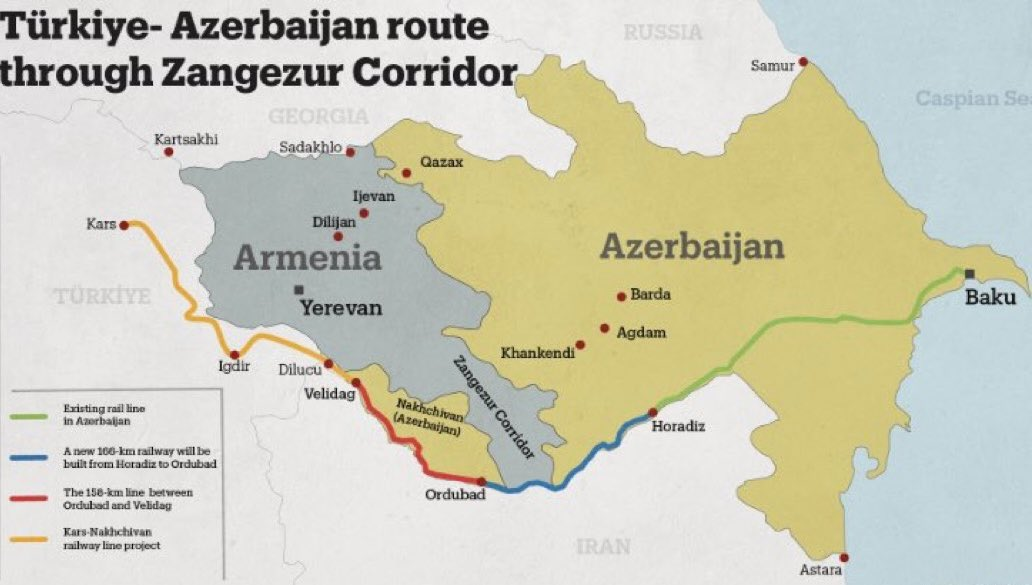
The corridor would provide Azerbaijan with a direct land route to Nakhchivan without transiting through Iran, reducing reliance on older, more vulnerable logistics networks. For Baku, it’s both a commercial lifeline and a strategic guarantee of national cohesion.
For Armenia, the corridor’s opening could unlock opportunities for regional trade integration and recalibration of its foreign policy, potentially reducing its dependence on a single set of alliances.
Washington’s involvement signals a deeper American role in the Caucasus, challenging Russia’s traditional dominance.
Beyond its transport function, the “Trump Route” is being framed as a symbol of a broader shift: the dismantling of outdated diplomatic structures, such as the OSCE Minsk Group, in favor of faster, more pragmatic settlement formats. By physically and politically linking territories long separated by regional tensions, the corridor embodies a move toward connectivity over isolation.
Analysts note that the corridor’s realization could accelerate Azerbaijan’s emergence as a key transit hub between Europe and Asia, while providing the US with a tangible foothold in a region where Russian influence is waning and geopolitical competition is intensifying.