Regional
Trump says ‘a whole civilisation will die tonight’; Qatar fears regional escalation
A senior Iranian source said on Tuesday afternoon that Tehran would not show flexibility as long as Washington continues to demand its “surrender under pressure.”

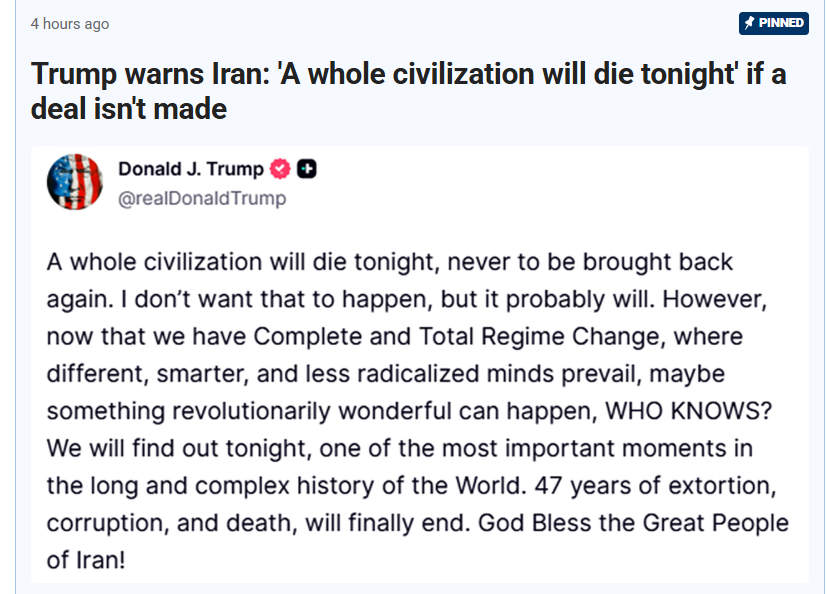
Tensions in the Middle East have escalated sharply after U.S. President Donald Trump on Tuesday warned that “a whole civilisation will die tonight” amid growing confrontation with Iran and deepening instability across the region.
In a series of statements posted on social media, Trump issued a direct ultimatum to Tehran, demanding that Iran reopen the strategically vital Strait of Hormuz or face severe consequences. “I don’t want that to happen, but it probably will… we will find out tonight,” he said, describing the moment as one of the most significant in modern history.
The warning follows earlier remarks in which Trump threatened that Iran would be “living in hell” if it failed to comply with U.S. demands.
The Strait of Hormuz, a narrow but critical waterway, carries roughly 20 percent of the world’s oil and liquefied natural gas shipments, making it a focal point of global economic and security concerns.
A senior Iranian source meanwhile told Reuters on Tuesday afternoon that Tehran would not show flexibility as long as Washington continues to demand its “surrender under pressure.”
The source, who asked not to be named, said Qatar on Monday had conveyed Tehran’s message to the United States and regional countries that if Washington attacks Iran’s power plants, “the entire region and Saudi Arabia will fall into complete darkness with Iran’s retaliatory strikes”.
He said what the U.S. wants is the reopening of the Strait of Hormuz, and Iran will not open it in exchange for empty promises.
He also warned that “if the situation gets out of control, Iran’s allies will also close the Bab El-Mandeb Strait” – a crucial 30-km wide maritime chokepoint connecting the Red Sea to the Gulf of Aden and the Indian Ocean. It is located between the southwestern tip of the Arabian Peninsula (Yemen) and the Horn of Africa (Djibouti and Eritrea).
The escalating rhetoric comes against the backdrop of an intensifying conflict involving the United States, Israel, and Iran, which has been ongoing since late February. Iran has continued to launch attacks across the region, claiming to target U.S. interests, a justification widely rejected by the international community.
Meanwhile, Qatar has warned that the situation is approaching a dangerous tipping point. Speaking in Doha, Foreign Ministry spokesperson Majed Al-Ansari said the region is “very close” to an uncontrollable escalation.
“We have been warning since 2023 that escalation left unchecked will get us into a situation where it cannot be controlled,” Al-Ansari said, urging all parties to pursue an immediate resolution to the conflict. “There are no winners if this war continues,” he added.
Qatar has previously acted as a mediator between Washington and Tehran, though officials say it is not currently engaged in active negotiations. Nevertheless, Doha has expressed support for ongoing diplomatic efforts, including initiatives led by Pakistan, to de-escalate tensions.
U.S. Vice President JD Vance also issued a warning, stating that Washington still has additional measures at its disposal if Iran fails to respond to diplomatic overtures. He indicated that the United States expects a response from Tehran within hours.
Al-Ansari emphasized that any future agreement must involve regional stakeholders and include international guarantees, particularly regarding the Strait of Hormuz. “Hormuz is a natural strait, not a canal, and all countries in the region have the right to use it freely,” he said.
Analysts warn that continued escalation could have far-reaching consequences, not only for regional stability but also for global energy markets and international security, as fears grow that the conflict could spiral into a broader confrontation.