
Regional
Iranian and Saudi foreign ministers meet in China in restoration of diplomatic ties

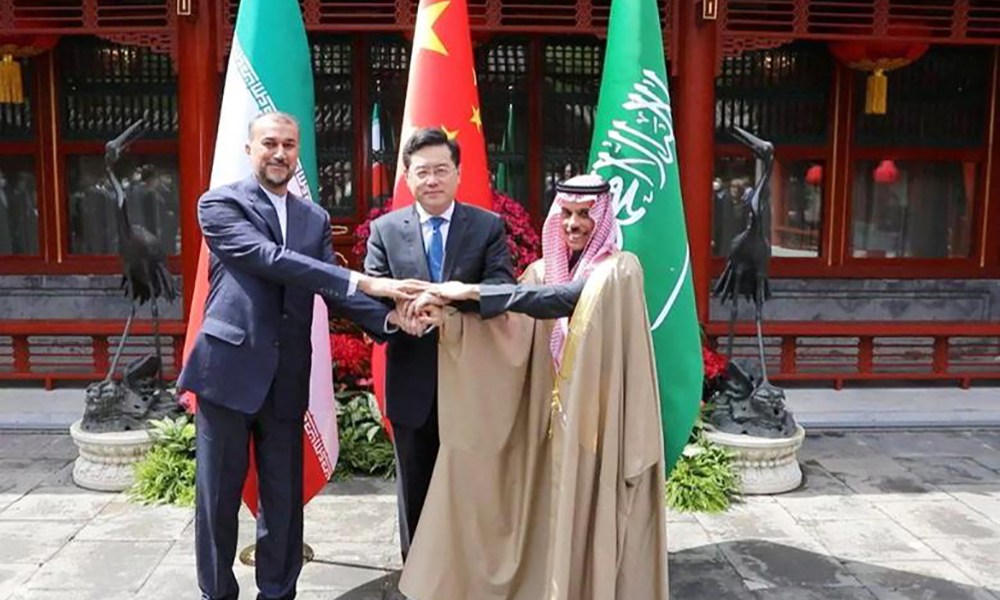
The foreign ministers of Iran and Saudi Arabia met in Beijing on Thursday for the first formal gathering of their top diplomats in more than seven years, after China brokered a deal to restore relations between the top regional powers, Reuters reported.
After years of hostility that fuelled conflicts across the Middle East, Iran and Saudi Arabia agreed to end their diplomatic rift and reopen diplomatic missions in a significant deal facilitated by China last month.
In brief footage broadcast on Iranian state TV, Prince Faisal bin Farhan Al Saud and his Iranian counterpart, Hossein Amirabdollahian, greeted each other before sitting down side by side.
Saudi Arabia and Iran, the Gulf’s dominant Sunni Muslim and Shi’ite Muslim powers respectively, said in a joint statement they would launch arrangements to reopen embassies and consulates within the two-month period stipulated in the deal.
“The technical teams will continue coordination to examine ways of expanding cooperation including the resumption of flights and bilateral visits of official and private sector delegations and facilitating the granting of visas for the citizens of the two countries,” they said.
In a tweet, Iran’s Amirabdollahian said the Thursday meeting with his Saudi counterpart was “positive”, adding that “the emphasis on stability and sustainable security” were among the issues agreed upon and “on the common agenda”.
In March, Chinese President Xi Jinping helped broker the surprise deal in a display of Beijing’s growing influence in the Middle East. China’s role in the breakthrough shook up dynamics in a conflict-ridden region where the United States has for decades been the main mediator.
The detente between the Sunni kingdom and the revolutionary Shi’ite theocracy could help stabilise the Middle East, where the two sides have supported sectarian proxy forces that are either at daggers drawn or openly at war.
Saudi Arabia cut ties with Iran in 2016 after its embassy in Tehran was stormed during a dispute between the two countries over Riyadh’s execution of a Shi’ite cleric.
The relationship began worsening a year earlier, after Saudi Arabia and the United Arab Emirates intervened in Yemen’s war, where the Iran-aligned Houthi movement had ousted a Saudi-backed government and taken over the capital Sanaa.
It is unclear whether the restoration of diplomatic relations could help bolster peace-making in Yemen, where Saudi Arabia has been in tough talks with the Houthis on a permanent ceasefire.
However, the rapprochement could mean improved security for Saudi Arabia as it pursues its vast Vision 2030 project to modernise and diversify its long oil-dependent economy. The kingdom has accused Iran of arming the Houthis, who launched missiles and drones at Saudi cities and oil facilities.
In 2019, Riyadh blamed an attack on Aramco oil facilities, which knocked out half of its oil output, directly on the Islamic Republic. Iran denied those accusations, Reuters reported.
Tehran and Riyadh, according to the joint statement, underlined the importance of reviving a security pact signed in 2001, under which both sides agreed to cooperate to tackle terrorism, drug-smuggling and money-laundering, as well as a trade and technology pact from 1998.






Regional
Flames, smoke seen near Riyadh airport; Houthis claim attacks on Saudi capital
The Saudi-led military coalition fighting the Houthis said its air defences had destroyed a missile fired by the Yemeni group toward Riyadh early on Saturday.
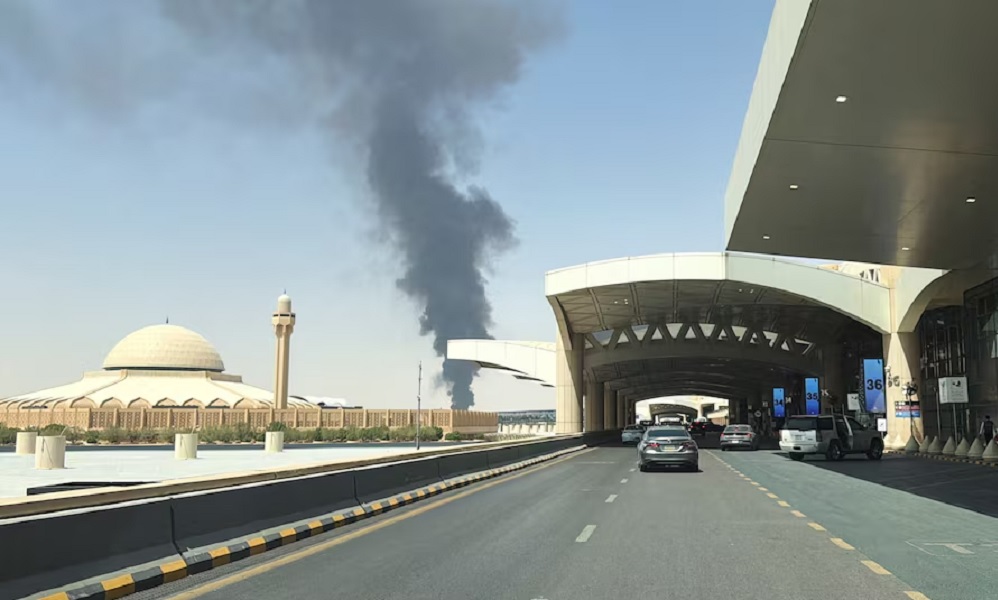
Yemen’s Houthis said they attacked “sensitive” sites in the Saudi capital Riyadh on Saturday with missiles and drones, hours after flames and a large plume of smoke were seen near the city’s main airport.
Saudi Arabia had sent alerts overnight warning of potential danger around Riyadh, amid an escalation in attacks by the Houthis in the kingdom, Reuters reported.
Reuters video and photographs showed a huge pillar of black smoke rising in the area, with the airport highway, main terminal building and other facilities in the foreground. At one point in the video, flames were visible rising from behind what appeared to be fuel tanks.
While the Iranian-backed Houthis have launched repeated attacks against Saudi Arabia since July, Saturday’s claim appeared to be their first reported strike on Riyadh since the current escalation began.
The Houthis did not specify what they had targeted in Riyadh, but said they had also attacked an Aramco facility in the Red Sea city of Yanbu, a key Saudi oil export hub.
They said the operation came as a response to an attack in the Yemeni capital Sanaa.
The Saudi-led military coalition fighting the Houthis said its air defences had destroyed a missile fired by the Yemeni group toward Riyadh early on Saturday.
In a statement, the coalition also said it had foiled attacks targeting civilians in the Saudi cities of Bish and Farasan in the southwest and Taif in the west, as well as Yanbu on the Red Sea coast. It did not say whether there was any damage.
Saudi civil defence sent the alerts by phone overnight for potential danger of aerial attacks in Riyadh and the city of Al-Kharj east of the capital, before issuing an all-clear on Saturday morning. A Reuters journalist in Riyadh’s Olaya area heard booms before the all-clear was sent.
Although some alerts had been issued in Riyadh this year after the start of the US-Iran war, these were the first since the escalation with the Houthis began in July.
The fighting between the Houthis and Saudi Arabia has developed as a new theatre of conflict in the wider war that began with US and Israeli strikes against Iran at the end of February. US President Donald Trump has rebuffed Saudi requests for direct US military intervention against the Houthis.
A US State Department security alert issued on Saturday for Americans in the Middle East cited Houthi attacks. The State Department urged US citizens in the region to “exercise heightened vigilance” and that Americans outside the Middle East “should seriously reconsider travel to and through the region.”
HOUTHI WARNING
The Houthis, who control the most populous parts of Yemen and much of the north, have been launching attacks against Saudi Arabia since declaring a naval blockade against Riyadh in July, with strikes targeting Saudi vessels in the Red Sea.
The attacks have targeted Saudi cities, energy infrastructure and shipping, creating new threats to global oil supplies and putting at risk the main alternative Red Sea route for Gulf exports while traffic through the Strait of Hormuz remains blockaded.
Turkish Foreign Minister Hakan Fidan said Saudi Arabia may have military needs due to the ongoing Houthi attacks and Turkey was ready to help under a trilateral defence pact that also includes Pakistan.
It was unclear what kind of support Turkey might provide but Fidan, in an interview with broadcaster NTV, said Saudi needs could include “some technical issues.”
The trilateral agreement signed last month stipulates that an armed attack on any of the three countries would be regarded as an attack on all of them.
Mohsen Rezaei, secretary of Iran’s Supreme National Security Council, told Al Jazeera in an interview aired on Saturday that Tehran wanted the war between Saudi Arabia and the Houthis to end, adding that he believed Yemenis also wanted a settlement with Saudi Arabia.
Rezaei also said Iran had conveyed its conditions to mediators for re-engaging in stalled negotiations with the United States, including “ending the war on all fronts”.
Consultations were continuing with Qatari and Pakistani mediators and Tehran was awaiting a response from Trump, Rezaei said.
The UN Security Council in a statement on Friday “condemned in the strongest terms continued Houthi attacks against the Kingdom of Saudi Arabia, including attacks impacting civilian and energy infrastructure, which have resulted in the injury of civilians, including women and children.”
In the statement, the Security Council also condemned “Houthi military escalation in Yemen”.
Iran executed a man convicted of passing missile site intelligence to Israel during the 12-day war, according to the judiciary.
Iran’s judiciary-run Mizan news agency said Hossein Pedaran was hanged after the Supreme Court upheld his death sentence on charges of espionage and intelligence cooperation with Israel, Reuters reported.
It said Pedaran had provided Israel’s Mossad intelligence service with information on sensitive military sites in the central province of Isfahan, and had carried out the espionage for financial gain.
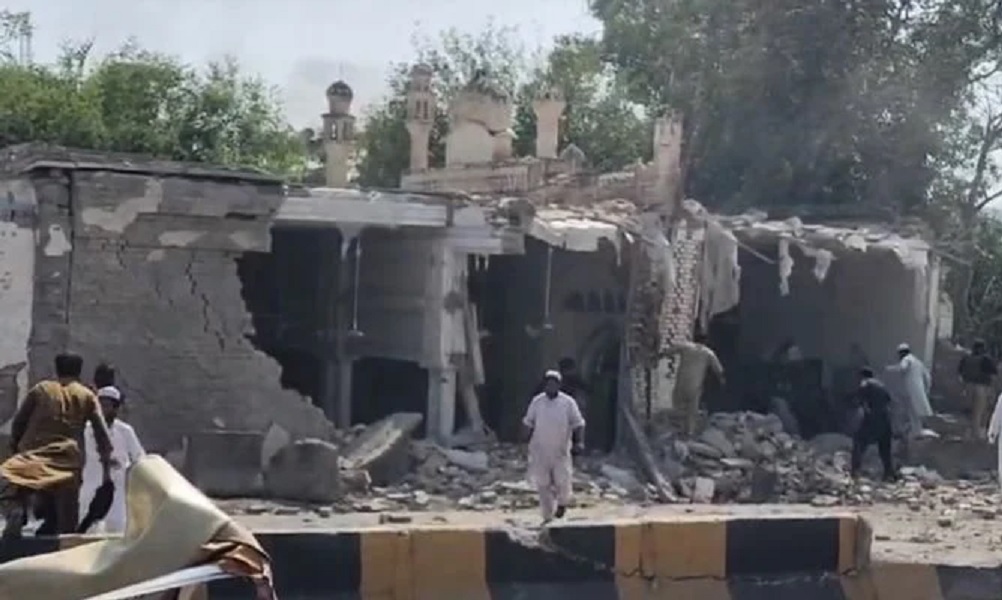
At least 15 people were killed and more than 50 others injured in a blast near a mosque in Kohat district of Khyber Pakhtunkhwa province on Friday, Pakistan’s Geo News reported.
Police said the blast occurred during Friday prayers and damaged the outer section of the mosque. Several police personnel were among those injured.
Khyber Pakhtunkhwa’s Inspector General of Police, Zulfiqar Hameed, said an explosives-laden vehicle struck the gate of the old Police Lines before exploding. He said the incident was followed by gunfire and another explosion at a Special Branch building.
Security forces and rescue teams were deployed at the scene, while emergency measures were declared at the district hospital to treat the injured.
There was no immediate claim of responsibility for the bombing.


Sorkh Poshan Khafi beat Toofan Herat 3-1 in Afghanistan Champions League

ACL: Arman FC fight back to beat Khurasan Faryab 2-1

Tahawol: Impact of middle East war on Afghanistan

Pakistan says Kohat attackers had roots in Afghanistan

Saar: Pakistan blames Afghanistan for deadly attack

Four mediators struggle to secure lasting Pakistan-Afghanistan ceasefire

Syria and Saudi Arabia condemn Kabul bombing, express solidarity with Afghanistan

Afghanistan’s trade diversification challenges Pakistan

Saudi energy group signs major Afghanistan deals covering gas exploration and pipeline plans

ATN secures exclusive rights to broadcast T20I series in India across Afghanistan
Tahawol: Impact of middle East war on Afghanistan
Saar: Pakistan blames Afghanistan for deadly attack

Tahawol: Kabul’s warning over any threat from Pakistan discussed

Debate on Afghanistan and New Investment Opportunities

Tahawol: Reasons behind Qatari, Turkish security officials’ Kabul visit discussed
-
 Latest News5 days ago
UN warns of mounting humanitarian and human rights pressures in Afghanistan
-

 Regional5 days ago
Saudi Arabia calls alleged Mecca attack a ‘red line’ as Houthis deny involvement
-
 Latest News5 days ago
Five Years On: IEA touts economic growth despite international isolation
-

 Sport5 days ago
India take 2-0 lead in 3-match series against Afghanistan
-

 Latest News4 days ago
Five years out of school: Amnesty raises alarm over Afghan girls’ education
-
 Latest News4 days ago
Russia urges dialogue and economic support for Afghanistan, warns against excessive pressure
-

 Sport4 days ago
ACL: Ariana Khost win, Aino Mina and Khurasan Faryab draw
-
 Latest News3 days ago
Afghanistan seeks stronger ties with Saudi Arabia, dialogue with Pakistan: Mujahid