
Latest News
Moscow summit productive diplomacy in support of Afghan peace process: Khalilzad


US Special Representative for Afghanistan Reconciliation Zalmay Khalilzad said Friday that he wrapped up two days in Moscow at the “Extended Troika” meeting, aimed at accelerating peace negotiations.
Khalilzad called the meeting a “productive diplomacy in support of the Afghan peace process.”
“We encouraged delegations representing the Islamic Republic and the Taliban, which included many prominent leaders, to prepare for and attend a leaders’ meeting in Istanbul in early April, the next critical milestone in the peace process,” Khalilzad tweeted.
1/3 Wrapped up two days in Moscow at “Extended Troika” meeting. Productive diplomacy in support of the #AfghanPeaceProcess. The Extended Troika group (US, Russia, China, & Pakistan) issued a strong statement in support of accelerating peace negotiations. https://t.co/NINFcntQY7
— U.S. Special Representative Zalmay Khalilzad (@US4AfghanPeace) March 19, 2021
He also welcomed the appointment of Jean Arnault, a very experienced diplomat, as the UN representative to assist with peace negotiations.
Russia hosted the peace summit in Moscow on Thursday which brought together representatives of the Afghan Republic and the Taliban, along with other key stakeholders, aimed at accelerating the peace process in Afghanistan.
Russia, China, the US, and Pakistan, also known as the Troika, issued a joint statement on Thursday, calling on the warring parties for a permanent and comprehensive ceasefire.
The four countries participating in the extended “Troika” have agreed as follows:
- We acknowledge the widespread and sincere demand of the Afghan people for a lasting and just peace and an end to the war and confirm that a sustainable peace can only be achieved through a negotiated political settlement.
- We call on all parties to the conflict in Afghanistan to reduce the level of violence in the country and on the Taliban not to pursue a Spring offensive, so as to avoid further casualties and to create an environment conducive to reaching a negotiated political settlement.
- As stated in the UNSC resolution 2513 (2020), we do not support the restoration of the Islamic Emirate and we call on the Government of the Islamic Republic and the High Council for National Reconciliation to engage openly with their Taliban counterparts regarding a negotiated settlement.
- We urge participants in the intra-Afghan negotiations to engage immediately in discussions on fundamental issues to resolve the conflict, including the foundations of the future peaceful and stable Afghan state, the content of a political roadmap leading to an inclusive government, and the modalities of a permanent and comprehensive ceasefire. At this pivotal moment, our four states call on the parties to negotiate and conclude a peace agreement that will bring an end to over four decades of war in Afghanistan.
- We strongly advocate a durable and just political resolution that will result in the formation of an independent, sovereign, unified, peaceful, democratic, and self-sufficient Afghanistan, free of terrorism and an illicit drug industry, which contributes to the creation of pull factors for the voluntary, sustainable, and expeditious return of Afghan refugees; stability; and global security.
- We call on all Afghans including the Government of the Islamic Republic and the Taliban to ensure that terrorist groups and individuals do not use Afghan soil to threaten the security of any other country.
- We reaffirm that any peace agreement must include protections for the rights of all Afghans, including women, men, children, victims of war, and minorities, and should respond to the strong desire of all Afghans for economic, social, and political development including the rule of law.
- We encourage all concerned countries to support the Afghan people and contribute to a lasting peace in the interest of all. We reaffirm our commitment to mobilize international political and economic support for a post-political settlement in Afghanistan.
- We appreciate the long-standing support of the State of Qatar to facilitate the peace process, and we support the continuation of discussions between the parties’ negotiating teams in Doha, which began in September 2020 and which have resulted in meaningful progress toward a political settlement.
- We recognize and welcome all international efforts that are underway to facilitate and support a negotiated settlement as soon as possible. We note that the UN Secretary-General Guterres’ appointment of Mr. Jean Arnault as his personal envoy on Afghanistan and regional issues. We welcome the UN playing a positive and constructive role in the Afghan peace and reconciliation process.
Meanwhile, the Afghan government welcomed the joint statement of the Troika and called it “a step forward towards beginning serious negotiations for achieving peace based on the demands of the people of Afghanistan.”
“Welcome joint statement of Troika+ talks in Moscow and share the call for ending hostilities and moving towards a peaceful settlement that preserves our sovereignty, unity, democracy, and equal rights of all Afghans, “ Foreign Minister Mohammad Haneef Atmar said.







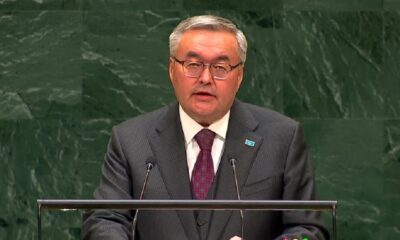




Kazakhstan’s Foreign Minister Mukhtar Tileuberdi has called for pragmatic and coordinated international engagement with Afghanistan, saying the country’s long-term stability is closely linked to the security and sustainable development of Central Asia.
Speaking during the general debate of the 81st session of the United Nations General Assembly in New York on Friday, Tileuberdi said humanitarian assistance to Afghanistan remains essential but alone cannot break the cycle of poverty, displacement and dependency.
He said Kazakhstan supports a “pragmatic, coordinated and step-by-step” approach to international engagement with Afghanistan, with the United Nations playing a central role.
Tileuberdi also said Kazakhstan is working with the UN to operationalize the United Nations Regional Centre for the Sustainable Development Goals for Central Asia and Afghanistan in Almaty.
He said the success of the centre should be measured by the results and assistance it delivers to the region.


Saar: Concerns over Pakistan’s political crisis discussed

Afghanistan Champions League: Omar Zawak Herat beat Toofan Herat 1-0

Blast in Pakistan’s Dera Ismail Khan kills 11, injures 30

Ariana Afghan Airlines increases Kabul-Delhi cargo flights

Khalilzad questions Pakistan’s commitment to Afghan welfare

Saudi energy group signs major Afghanistan deals covering gas exploration and pipeline plans

Trump floats idea of renaming Atlantic or Pacific Ocean

US hits Egyptian bank branches with Iran sanctions as war marks six months

Nepal flood rescue mission enters critical phase as thousands remain missing

Iranian clubs to face Gulf opponents at neutral venues in Asian Champions League Elite
Saar: Concerns over Pakistan’s political crisis discussed

Exclusive interview with Abdul Latif Mansoor, Minister of MRRD

Tawsia: Overview of Afghanistan’s iron mines

Tahawol: Discussion on fresh Pakistani airstrikes on Afghanistan

Saar: Calls for international support for Afghanistan discussed
-

 World5 days ago
CNN, MS NOW and Politico sue Trump, challenging White House ban
-

 Latest News3 days ago
Ariana Afghan Airlines ranks seventh among 45 Central Asian airlines
-

 Latest News4 days ago
UN reiterates call for respect for international law after Kunar airstrikes
-

 Regional3 days ago
US and Iran hold first talks since June after Trump’s ‘annihilation’ threat
-

 Latest News3 days ago
Silk Road highway in Wakhan corridor now reaches the China border
-

 Latest News4 days ago
Afghan Official: Pakistan’s airstrikes will not go unanswered
-
 Regional4 days ago
G7 foreign ministers call on Iran to stop arming Houthis
-

 Sport4 days ago
Afghan boxing referee heads to China for international festival