Latest News
Key UN agency gets only ‘small budget’ for Afghanistan this year
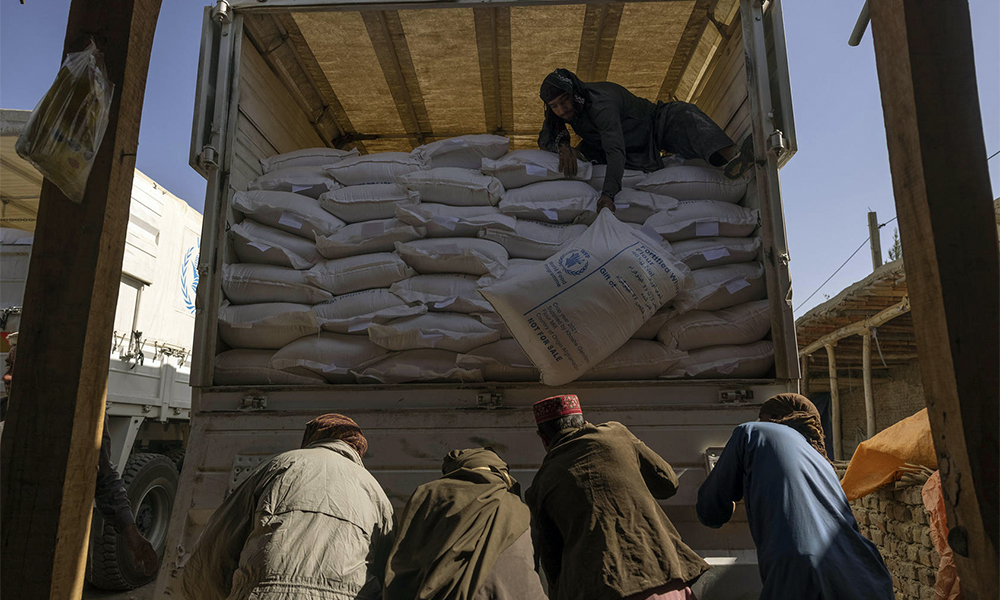
The United Nations Office for the Coordination of Humanitarian Affairs (OCHA) expresses concern that the international community has provided only a small budget for the continuation of aid programs in Afghanistan for the current year, and the lack of funds has threatened to suspend the continuation of most programs.
OCHA published a report on Sunday and said that more than $3 billion was requested for the continuation of humanitarian programs in Afghanistan in 2024, but only a small part of it has been provided so far.
This United Nations agency said: “In 2023, humanitarian partners in Afghanistan provided assistance in some way to at least 32.1 million people. But in 2024, only $87 million of the $3.06 billion budget was received for the plan to meet humanitarian needs, which has put the continuation of many programs at risk.”
The United Nations Office for the Coordination of Humanitarian Affairs said that last year due to budget cuts, the organization was forced to stop providing food aid to 18 million Afghans.
OCHA said in the report that from January to December 2023, humanitarian aid donors provided food and alternative livelihoods to 26.3 million Afghans and health services to 16.5 million people.
The United Nations has announced that a total of 32.1 million people received aid in 2023, with 27.6 million directly benefiting. The organization has spent $1.47 billion in 2023 for its programs, including $850 million from the 2022 budget.
Prolonged settlement, widespread presence of explosives, continued restrictions on women’s rights and freedoms, increased gender-based violence, child labor, early marriages, climate change, especially earthquakes and droughts, the return of millions of migrants from Pakistan and internally displaced persons, Ocha said. Afghanistan remains primarily a security crisis, the agency said.
According to the United Nations humanitarian aid plan in 2024, more than half of Afghanistan’s population will need humanitarian aid in some way.
The United Nations has emphasized that among all the needy, 17.3 million of the most vulnerable people, including those with disabilities, are covered by the aid mission.

Latest News
TAPI project sees rapid progress in Afghanistan
Afghanistan’s Islamic Emirate says work on the TAPI Pipeline is advancing steadily, with major infrastructure activities continuing at a rapid pace across the country.
Zabihullah Mujahid said around 130 kilometers of the route have been leveled so far, while 91 kilometers of pipeline have already been installed.
He said the total distance from the border of Turkmenistan to the Herat Industrial Park covers 153 kilometers, where the pipeline will extend.
According to Mujahid, completion of the project is expected to bring major economic transformation to Herat, with thousands of factories projected to become operational.
The 1,814-kilometer pipeline, including 816 kilometers passing through Afghanistan to Pakistan, is designed to transport 33 billion cubic meters of gas annually. Work on the Afghan section began in September 2024, with 52 percent completed so far, while the Herat section is expected to be finished by the end of 2026.
Once operational, the project is expected to provide Afghanistan with millions of dollars in annual transit revenue, while the country will also receive 500 million cubic meters of gas initially, increasing to 1 billion and later 1.5 billion cubic meters in future phases.
Latest News
Ashura observed across Afghanistan with calls for unity and justice
Afghanistan marked the 10th of Muharram, the Day of Ashura, with religious ceremonies held across Kabul and several other provinces, as thousands of mourners gathered to commemorate the martyrdom of Imam Hussain (RA), the grandson of Prophet Muhammad (PBUH).
Ashura commemorates one of the most significant events in Islamic history, when Imam Hussain (RA) and 72 of his loyal companions were martyred in the Battle of Karbala. The occasion is observed annually across the Muslim world through prayers, mourning ceremonies, and acts of charity.
Former Afghan President Hamid Karzai described Ashura as an opportunity to strengthen national unity and solidarity. In a message marking the occasion, he expressed hope that Afghans would draw inspiration from the spiritual significance of Ashura and work together for the
progress, prosperity, and development of a united Afghanistan enriched by knowledge and education.
Religious scholars also emphasized that the uprising of Imam Hussain (RA) continues to symbolize justice, sacrifice, unity, and resistance against oppression, carrying a timeless message for Muslim societies and humanity as a whole.
Meanwhile, officials of the Islamic Emirate attending Ashura commemorations said all necessary measures had been taken to ensure religious ceremonies were held peacefully and securely across the country.
The Ministry of Interior also confirmed that extensive security measures had been implemented for Ashura, with large numbers of security personnel deployed to protect mourners, mosques, Hussainiyas, and other venues hosting commemorative events.
In Kabul and several other provinces, Ashura ceremonies concluded peacefully as worshippers observed the occasion through prayers, religious gatherings, and the distribution of food and charity in memory of the martyrs of Karbala.
Latest News
Afghanistan records historic 95% drop in opium production: UNODC
Afghan authorities maintain that the cultivation, production, and trafficking of narcotics in the country have been reduced to near zero under current enforcement measures.
The United Nations Office on Drugs and Crime (UNODC) says Afghanistan’s anti-narcotics campaign has achieved a “historic record” following a 95% reduction in opium poppy cultivation over the past three years, while warning that the growing production of synthetic drugs is emerging as a major global concern.
In an interview with Ariana News, the UNODC representative in Afghanistan said the narcotics situation in the country has changed significantly since the 2022 ban on the cultivation and production of illicit drugs, with sustained reductions recorded between 2023 and 2025.
UNODC representative Polleak Ok Serei described the development as unprecedented, saying the 95% reduction in poppy cultivation represents a major global milestone.
“In the past three years — 2023, 2024, and 2025 — the 95% reduction in opium poppy cultivation has been maintained. This is a remarkable achievement and a truly historic record. Previous efforts lasted only one year,” he said. “This is not only important for Afghanistan, but for the entire world, as Afghanistan previously produced around 80% of the global illicit opium supply.”
He added that following these developments, UNODC has adjusted its programs, shifting greater focus toward alternative livelihoods for farmers who previously depended on poppy cultivation.
According to him, while these efforts have shown progress, they remain insufficient due to Afghanistan’s broader humanitarian, economic, and environmental challenges.
UNODC also warned that the shift from traditional narcotics to synthetic drugs is creating new challenges for health systems, requiring updated medical responses and treatment approaches.
“We have had to adapt our activities accordingly,” the UN official said. “We are focusing heavily on alternative livelihoods for farmers, because those previously dependent on this production need new sources of income. We also had to reassess health interventions, particularly due to the shift from traditional drugs to synthetic drugs, which requires different medical approaches.”
The UN agency stressed that drug trafficking is a transnational issue requiring coordinated international cooperation among law enforcement and judicial authorities.
“Drug trafficking is a cross-border phenomenon. There are traffickers operating not only inside Afghanistan but also outside the country. Therefore, international cooperation between police and judicial authorities is essential,” he said.
UNODC called on neighboring countries and the international community to increase cooperation and investment in long-term solutions, including rural livelihoods, addiction treatment, and dismantling trafficking networks.
The statement comes as UNODC’s World Drug Report 2026 highlights rapid changes in global drug markets, driven by technology, instability, and the emergence of new synthetic substances.
According to the report, global drug production and trafficking patterns are shifting significantly, particularly in the opioid market. While Afghanistan’s opium production has sharply declined since 2022, production increases in countries such as Myanmar have not fully offset global supply changes, leading traffickers to increasingly turn toward synthetic opioids such as fentanyl and other highly potent substances.
The report warns that these new synthetic drugs can be significantly more powerful and deadly than traditional narcotics, posing serious risks to public health and security worldwide.
UNODC also noted that rising global demand for drugs such as methamphetamine and cocaine is expanding trafficking routes into new regions, including Africa and Asia, further complicating international control efforts.
Meanwhile, Afghan authorities maintain that the cultivation, production, and trafficking of narcotics in the country have been reduced to near zero under current enforcement measures.
-
Latest News4 days agoPakistani truckers return home after 9 months stranded in Afghanistan
-
International Sports4 days agoIran goalkeeper shines in heroic draw against Belgium at FIFA World Cup 2026
-
International Sports4 days agoMessi, David, and Undav lead thrilling 2026 FIFA World Cup Golden Boot race
-
Latest News4 days agoEarthquake of magnitude 5.2 strikes Afghanistan’s Hindu Kush region
-
International Sports2 days agoKnockout picture begins to take shape at FIFA World Cup 2026
-
Latest News3 days agoContract signed for reconstruction of 15km section of Salang Highway
-
Latest News4 days agoIran invites Afghanistan’s prime minister to attend funeral ceremony of Ali Khamenei
-
Business4 days agoKazakhstan signs $18.8 million zinc ore supply agreement with Afghan company