
Science & Technology
Top 10 offshore pipelines set to transform global energy in 2026
2026 will see a significant increase in operational offshore pipelines compared to 2025, marking a pivotal year for global energy transport.


The offshore energy sector is gearing up for a massive year in 2026, with more than 385 oil and gas pipelines scheduled to commence operations worldwide, including 113 offshore projects, according to GlobalData. While some projects face delays due to political and economic shifts, the largest planned pipelines promise to reshape energy transport across multiple continents.
The longest offshore pipelines set to start in 2026 will mostly transport gas in shallow waters, though major projects will also carry oil in North America. South America, the Middle East, Australia, and Asia will host the five longest pipelines.
Highlights include:
-
Vaca Muerta Sur – Argentina: 565km oil pipeline connecting Vaca Muerta oilfields to Punta Colorada export facility. Capacity: 550,000 barrels/day. Cost: $3bn+.
-
North Field East – Qatar: 500km gas pipeline expanding LNG production by 50%, including carbon capture facilities. Partners: Shell, ExxonMobil, ConocoPhillips, Eni, TotalEnergies.
-
Scarborough–Pluto – Australia: 433km LNG pipeline through deep and shallow waters, capacity: 708 million cubic feet/day. Total project cost: $12bn.
-
Block B–O Mon – Vietnam: 433km gas pipeline feeding four gas-fired power plants. Capacity: 656 million cubic feet/day.
-
Rosmari–Marjoram – Malaysia: 207km deep-water gas pipeline with 800 million cubic feet/day capacity. Operated by Sarawak Shell Berhad.
-
Walker Ridge 52–Garden Banks 72 – US: 169km oil pipeline in Gulf of Mexico.
-
Darwin Pipeline Duplication – Australia: 123km gas pipeline extending the Bayu Undan export system.
-
Texas Gulflink – US: 92km oil pipeline with capacity of 1–2 million barrels/day.
-
Aasta Hansteen–Irpa – Norway: 80km gas pipeline operating in extreme deepwater conditions.
-
Bintulu–Samalaju – Malaysia: 70km gas pipeline supplying a new 842MW power plant and industrial park.
2026 will see a significant increase in operational offshore pipelines compared to 2025, marking a pivotal year for global energy transport.









Science & Technology
Binance says it has covered $6 billion of $6.3 billion stolen in hack
The US Federal Bureau of Investigation (FBI) said on Saturday the North Korean state-sponsored unit known as TraderTraitor was responsible for the attack.

Binance, the world’s biggest cryptocurrency exchange, said it has covered $6 billion of the $6.3 billion stolen from its platform by using company money to buy replacement tokens, after a hack that US officials said was carried out by a North Korean state-sponsored unit known as TraderTraitor.
“We had already covered $6B of the impacted amount of the hacked loss,” Binance said on X on Saturday, after saying earlier that it had covered 90% of the stolen funds, Reuters reported.
The remaining amount, now less than 10%, consists of assets that are less liquid and may take longer to source in the required amounts, according to Binance.
The US Federal Bureau of Investigation (FBI) said on Saturday the North Korean state-sponsored unit known as TraderTraitor was responsible for the attack.
North Korea has for years denied using state-linked cyber units for espionage, financial theft and revenue. Its mission in Geneva and embassy in China did not respond to requests for comment.
Members of the unit were observed by law enforcement converting stolen assets into the cryptocurrency ethereum, the FBI said in a statement, adding that it expects “further laundering” of the assets through the use of related technology.
Analysts had previously blamed North Korea and said it could be the largest financial heist of all time.
Binance has been working with industry partners to freeze some of the affected assets, with about $3 billion located as of Friday.
The company has repeatedly said it would bear the financial impact of the funds stolen in the hack.
The money spent re-buying tokens came from using part of its $1 billion Secure Asset Fund for Users (SAFU), a bitcoin reserve it holds to protect customers in the event of security breaches, as well as some of its Futures Insurance Fund, and the company’s own corporate treasury, it said on X.
Co-CEO Yi He said on Saturday that 50% of its SAFU funds would be used, while the company said it was committing to replenishing the fund to return it to about $1 billion.
Crypto prices fell on Friday, while Binance sought to reassure customers that their funds were safe after the hack.
Co-CEO Richard Teng had said that the breach was a “complex attack” involving a compromised laptop and malicious software designed to delete evidence of its activity, making it harder to trace and investigate.
After the hack, the exchange stopped allowing customers to withdraw their funds, but it said on Saturday it was still on track to reopen withdrawals on Sunday.
Withdrawals were not open as of 02:50 GMT on Sunday.
Binance said it has set aside around $6.34 billion of company funds internally to cover the losses.
Binance also said it had taken a new snapshot of assets held on its platform as of 0000 GMT on October 31, as part of its proof-of-reserves process.
Users holding the 10 listed tokens — BTC, ETH, USDT, BNB, SOL, USDC, XRP, USD1, RLUSD, and ZEC — would be able to verify that their assets were backed at a minimum ratio of 1:1 once the full proof was available, it said.
Science & Technology
Governments take websites offline as critical cyber flaws trigger global alert
Security patches were released prompting authorities to urge organisations to update affected systems immediately or take vulnerable services offline until they could be secured.

Governments and organisations across Europe and beyond have taken websites and online services offline after the discovery of two critical vulnerabilities in widely used web software triggered an international cyber-security alert.
The vulnerabilities affect PHP, a programming language used extensively to operate websites and online applications. Attackers could potentially exploit the flaws to execute malicious code remotely on vulnerable servers, threatening sensitive information and digital infrastructure.
Security patches were released on Wednesday, October 21, prompting authorities to urge organisations to update affected systems immediately or take vulnerable services offline until they could be secured.
The Netherlands, Finland, France, Belgium and Germany have also reported precautionary shutdowns affecting government websites and other public-facing services.
In the Netherlands, affected platforms included Overheid.nl, MijnOverheid.nl and DigiD. The country’s National Cyber Security Centre also temporarily took its own website offline.
Finland’s state IT services provider, Valtori, suspended public government web services as a precaution, while France’s Interior Ministry temporarily took the websites of local administrative authorities offline.
In Belgium, the Foreign Ministry took its websites offline amid concerns about potential exploitation, although the country’s cybersecurity centre said it had not observed attacks on Belgian websites at the time.
Germany’s federal IT service provider also temporarily disabled several websites, with officials saying the measure was precautionary and no security incidents were known to have occurred.
The disruption extended beyond government agencies. Websites and online services belonging to hospitals, educational platforms and other organisations were also affected, highlighting the potential reach of vulnerabilities in widely deployed software.
In Australia, the Australian Cyber Security Centre’s website, cyber.gov.au, was among the government services affected by the security alert. Australian authorities said they were not aware of active exploitation of the vulnerabilities.
In the United States, the National Security Agency and other cybersecurity authorities urged organisations to prepare for immediate updates and take vulnerable systems offline if they could not be secured promptly. The Wikimedia Foundation, which operates Wikipedia, also took some systems offline as a precaution while addressing the flaws.
Cybersecurity company Cloudflare reported seeing early attacks associated with the vulnerabilities, although reports of exploitation do not establish that every affected organisation suffered a breach.
The incident highlights the risks created by the internet’s reliance on shared software. PHP is used across a substantial proportion of websites, meaning a single vulnerability can affect organisations in multiple countries and sectors simultaneously.
Security specialists have urged website operators to identify affected systems, install the relevant patches and examine server logs for signs of unauthorised access. Applying an update may prevent further exploitation, but organisations must also investigate whether attackers gained access before their systems were secured.
Authorities have not established that all affected websites were breached. The precautionary shutdowns are intended to reduce exposure while administrators apply fixes and verify that their systems are safe to restore.
The alert has underscored the challenge facing governments and businesses in responding to critical software vulnerabilities that can rapidly become an international security concern.
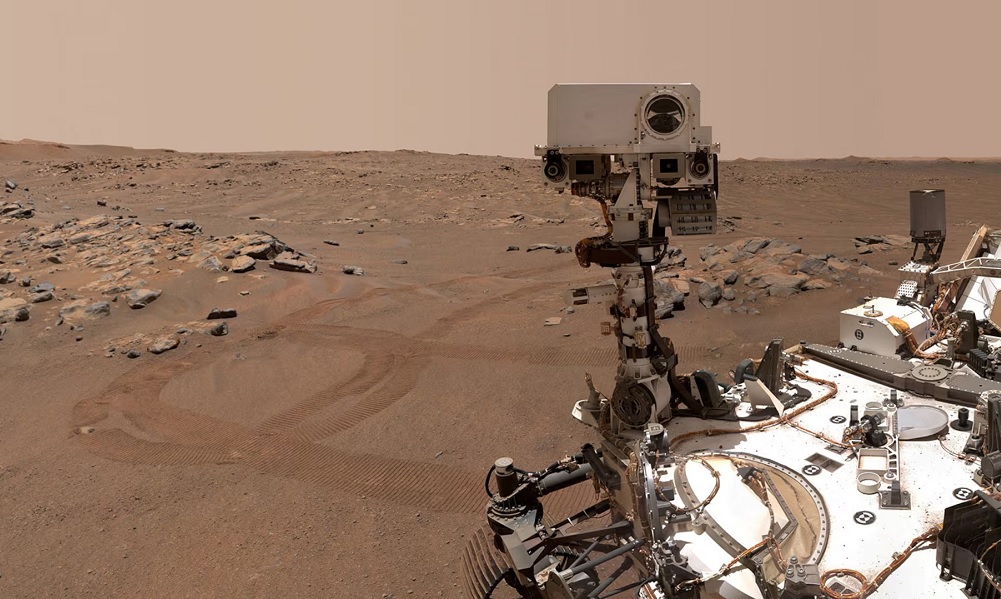
NASA’s robotic Perseverance rover has now driven farther than any other vehicle on the surface of any world other than Earth, racking up 28.1 miles (45.2 km) since arriving on Mars in 2021, the US space agency said on Tuesday.
The car-sized, six-wheeled rover reached the milestone 5-1/2 years into its mission to explore if conditions conducive to microbial life ever existed on Earth’s neighbor, Reuters reported.
In doing so, it is visiting some of the most ancient terrain ever encountered in the solar system.
“Perseverance’s engineering hardware and instruments are in excellent shape with all redundant systems still available,” Steven Lee of NASA’s Jet Propulsion Laboratory in California, told Reuters.
“A recent assessment of all systems concluded that they are capable of operating well into the 2030s, likely beyond,” added Lee, the project manager for NASA’s two Mars rovers, Perseverance and Curiosity.
Perseverance has exceeded the previous figure of 28.06 miles (45 km) driven on the Martian surface by NASA’s Opportunity rover from 2004 to 2018. Both also exceeded the driving distances of any lunar rover.
TRAVERSING JEZERO CRATER
Perseverance, with its suite of scientific instruments, has focused on the Jezero Crater, a region in the northern hemisphere of Mars believed to have been flooded with water and home to a lake basin billions of years ago.
The rover set the milestone in a journey toward an area called Idubi, through the region off the crater’s western rim nicknamed Lac de Charmes.
Its companion rover, Curiosity, rolls along in the Gale Crater near the Martian equator.
Perseverance is showing no signs of slowing down, Lee added.
Its mobility system mechanisms are being tested to show it can drive 100 km (62 miles) or more, he said, with the hardware to be tested to the equivalent of 150 km to 300 km (93 miles to 186 miles) in the effort.
NASA attributed a major role in Perseverance’s success to its self-driving capability, an autonomous navigation system called AutoNav. Lee said 90% of its drives are done autonomously, with no human intervention.
“Perseverance takes stereo images of the terrain ahead, generates a 3D software map, and selects the safest path towards a drive goal,” he said.
Another key component is the Vision Compute Element, a fast co-processor computer that allows the rover to process images and run its self-driving software very quickly, almost continuously during drives, Lee added.
That contrasts with previous rovers, which needed to pause to “think” before each drive segment, he said.
“Perseverance builds on the 29-year legacy of our past Mars rovers — Sojourner, Spirit, Opportunity and Curiosity — each incorporating prior lessons and improving our ability to drive on another world,” Lee said.
POTENTIAL BIOSIGNATURE
Lee said the rover’s biggest achievement was almost certainly its discovery, unveiled last year, of a potential biosignature, or possible sign of ancient microbial life.
This was found in reddish rock believed to have formed 3.2 billion to 3.8 billion years ago in a river channel feeding the lake that once filled Jezero Crater.
The Lac de Charmes terrain, Lee said, may yield clues to early planetary geological processes, such as the effects of large meteorite impacts. Jezero Crater was formed by such an impact early in Martian history.
Lee cited orbital evidence that some areas of the rim were once hydrothermal systems with warm or hot groundwater.
“These areas may once have provided a warm, watery subsurface environment conducive to life,” he added. “Indeed, some paleontologists hypothesize that life on Earth began in such environments.”
The rover’s original mission envisaged just 12.4 miles (20 km) of driving. NASA recently approved an extension of its mission to explore the crater rim until roughly the end of 2028.
The rover’s plutonium-based power system is performing as expected, Lee said, adding it has “many years of useful energy still available.”


Tahawol: US offers to ease Kabul-Islamabad tensions

Pakistan welcomes US offer to facilitate dialogue with Afghanistan, while Kabul rejects Islamabad’s allegations

Afghan PM accepts credentials of Belarusian ambassador

Afghanistan target T20I clean sweep against Zimbabwe in Sharjah

Saar: Identity of ISIS suspect arrested in pakistan revealed

Cricket Bonanza: Afghanistan set for packed international schedule

Afghanistan finish runners-up after 6-0 defeat to Brazil in futsal final

India, Pakistan summon top diplomats over border incident

Pakistan says Mecca pact members to hold emergency talks on engaging Houthis

Afghanistan inaugurates 121 km Wakhan road to China border
Tahawol: US offers to ease Kabul-Islamabad tensions
Saar: Identity of ISIS suspect arrested in pakistan revealed

Tahawol: Disruptions in Iran’s trade with neighboring and regional countries

Saar: Regional opportunities and challenges for Afghanistan discussed

Exclusive interview with Nooruddin Turabi, Director General of ANDMA
-
 Sport4 days ago
Afghanistan beat India 2-1 at FIFA U-15 World Cup & Festival
-
 Business2 days ago
US sanctions and blockade measures disrupt Iran’s trade with Afghanistan and regional neighbors
-
 Latest News4 days ago
Trial of eight Afghan men accused of child sexual exploitation moved to London
-
 World5 days ago
Netanyahu, Eisenkot stake rival claims to lead Israel after deadlocked vote
-
 Latest News4 days ago
Several Pakistani soldiers killed and wounded in retaliatory strikes in Paktika: Defense Ministry
-

 Sport3 days ago
Rashid Khan makes history as first-ever bowler to claim 200 T20I wickets
-
 Sport1 day ago
Afghanistan storm into Hong Kong Sixes final after beating Scotland
-
 Sport5 days ago
Ahmadzai, Rashid and Farooqi lead Afghanistan to 37-run win over Zimbabwe