
World
Iran, US end nuclear talks in Rome, agree to meet next week


Iran and the United States agreed on Saturday to hold another round of talks next week over Tehran’s nuclear ambitions, Iranian state TV reported, as they ended their second round of negotiations in Rome over their decades-long standoff.
Iran’s Foreign Minister Abbas Araqchi and President Donald Trump’s Middle East envoy Steve Witkoff negotiated indirectly through an Omani official who will shuttle messages between the two sides, Iranian officials said, a week after a first round of indirect talks in Muscat that both sides described as constructive.
Araqchi and Witkoff interacted briefly at the end of the first round, but officials from the two countries have not held direct negotiations since 2015 under former U.S. President Barack Obama.
Araqchi, in a meeting with his Italian counterpart ahead of the talks, said Iran had always been committed to diplomacy and called on “all parties involved in the talks to seize the opportunity to reach a reasonable and logical nuclear deal”.
“Such an agreement should respect Iran’s legitimate rights and lead to the lifting of unjust sanctions on the country while addressing any doubts about its nuclear work,” Araqchi was quoted as saying by Iranian state media.
He said in Moscow on Friday that Iran believes reaching an agreement on its nuclear programme with the U.S. is possible as long as Washington is realistic.
“Rome becomes the capital of peace and dialogue,” Italian Foreign Minister Antonio Tajani wrote on X. “I encouraged (Araqchi) to follow the path of negotiation against nuclear arms. The hope of the Italian government is that all together may find a positive solution for the Middle East.”
Tehran has however sought to tamp down expectations of a quick deal, after some Iranian officials speculated that sanctions could be lifted soon. Iran’s utmost authority, Supreme Leader Ayatollah Ali Khamenei, said this week he was “neither overly optimistic nor pessimistic”.
For his part, Trump told reporters on Friday: “I’m for stopping Iran, very simply, from having a nuclear weapon. They can’t have a nuclear weapon. I want Iran to be great and prosperous and terrific.”
Meanwhile, Israel has not ruled out an attack on Iran’s nuclear facilities in the coming months, according to an Israeli official and two other people familiar with the matter.
Trump, who ditched a 2015 nuclear pact between Iran and six powers during his first term in 2018 and reimposed crippling sanctions on Tehran, has revived his “maximum pressure” campaign on the country since returning to the White House in January.
Washington wants Iran to halt production of highly enriched uranium, which it believes is aimed at building an atomic bomb.
Tehran, which has always maintained its nuclear programme is peaceful, says it is willing to negotiate some curbs in return for the lifting of sanctions, but wants watertight guarantees that Washington will not renege again.
Since 2019, Iran has breached and far surpassed the 2015 deal’s limits on its uranium enrichment, producing stocks far above what the West says is necessary for a civilian energy programme.
A senior Iranian official, who described Iran’s negotiating position on condition of anonymity, listed its red lines as never agreeing to dismantle its uranium enriching centrifuges, halt enrichment altogether or reduce its enriched uranium stockpile below levels agreed in the 2015 deal.
Iran also rejects negotiating about defence capabilities such as its ballistic missile program and the range of Tehran’s domestically-produced missiles.
Russia, a party to Iran’s 2015 nuclear agreement, has offered “to assist, mediate, and play any role” that will be beneficial to Iran and the U.S..
(Reuters)







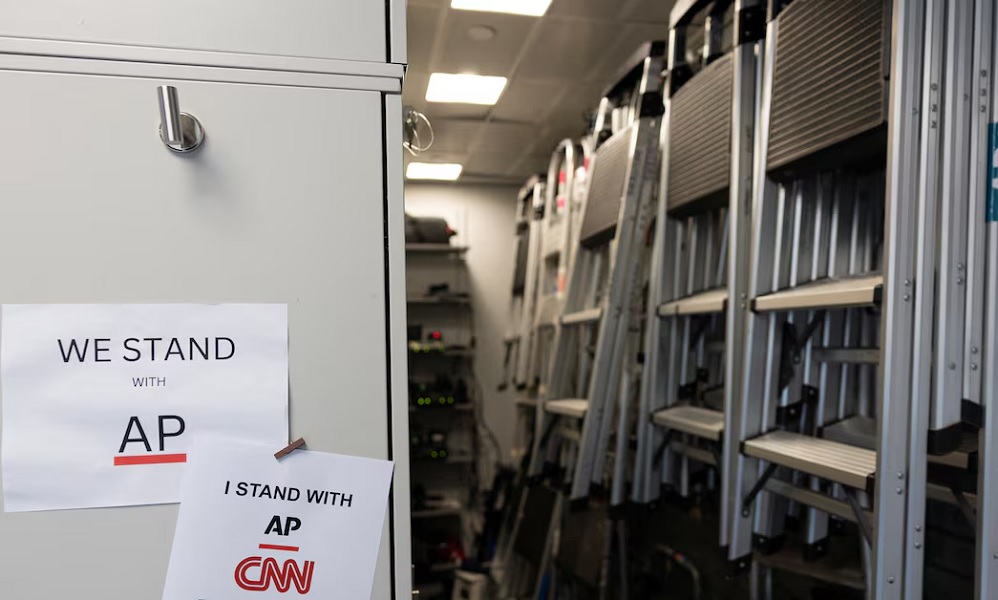
The White House said on Thursday it has reinstated journalists from CNN, MS NOW and Politico after a federal judge deemed US President Donald Trump’s ban of the three news outlets likely unconstitutional and ordered their access immediately restored.
The midday reinstatement came after a chaotic few hours earlier on Thursday when the journalists continued to be blocked from entering the White House grounds. That prompted the three news organizations to request an immediate hearing before US District Judge Tim Kelly, who issued his decision overnight, Reuters reported.
Kelly, acting in a lawsuit brought by CNN, MS NOW and Politico on Monday, ordered a halt to Trump’s ban for 14 days in a press freedom case that has played out over the past week in the courtroom and White House grounds.
Kelly found that the revocation of the White House credentials of the journalists “likely violated their constitutional due process rights.”
The judge, who Trump appointed in 2017 during his first presidential term, also raised doubts about the US Justice Department’s national security arguments for justifying the ban, noting that Trump himself had said the action was due to what the president alleged was false or negative coverage.
Hours after Kelly issued his order, CNN, MS NOW and Politico told the judge they remained barred, and asked for the emergency hearing. Politico said its reporter’s credentials were confiscated. An MS NOW reporter said she was blocked from the White House. CNN said some of its staff members were denied entry onto the grounds.
In response, Micah Stopperich, the director of press operations at the White House, said in a court filing that the White House began the process of reinstating press badges for affected reporters at 7:25 a.m., and that the “White House press team dropped badges at the entry gate for members of the press to pick up around 9:55 a.m.”
After receiving Stopperich’s declaration, the judge denied the request by the news organizations for an emergency hearing but gave them an opportunity to inform him of any factual developments later in the day.
The sharpest conflict yet between Trump and the press played out during a key diplomatic moment for the US president: his appearance at the United Nations General Assembly in New York and his hosting of Chinese President Xi Jinping on Thursday.
A source familiar with the White House television press pool said its members would not reinstate their coverage until the White House formally reinstates CNN to the pool. Earlier this week, they had suspended pooled coverage in solidarity with CNN.
There were no TV pool cameras set up for Xi’s arrival on the White House’s South Lawn on Thursday morning, and FOX News, MS NOW and CNN did not air the two leaders’ arrival ceremony live.
During Trump’s welcome of Xi to the White House, the president made a joke to photographers in the Oval Office about the Chinese having the friendliest press corps.
CNN is one of the five news organizations – along with ABC, CBS, FOX News and NBC – that make up the primary White House television pool. They share the costs of covering the president, take turns organizing coverage and provide footage to other outlets.
CNN had been scheduled to cover Trump’s trip to New York for the General Assembly on Monday, but was not able to provide a pool feed.
NATIONAL SECURITY CONCERNS
Trump announced the ban on Friday on his social media platform, saying those news organizations “shouldn’t be able to constantly write or report FICTION and LIES when they’re covering the President of the United States.” Trump framed their reporting as a threat to US national security.
The three outlets sued Trump and other members of his administration, saying the ban violated the US Constitution’s First Amendment protections for free speech and a free press, as well as their due process rights. A coalition of press freedom groups and dozens of news organizations, including Reuters, later filed a legal brief supporting the three news outlets.
Kelly ordered the Trump administration to immediately return the outlets’ press passes and stop enforcing the ban for two weeks. The judge rejected the administration’s stated national security concerns.
“The record lacks factual support for defendants’ contention that the revocation of plaintiffs’ hard passes will in fact protect national security or that national security will be endangered if the court orders their passes reinstated while this litigation proceeds,” Kelly wrote.
In a filing on Tuesday, the Justice Department accused the outlets of threatening national security with their coverage, citing stories about US missile stockpiles, construction of Trump’s White House ballroom and turnout at the recent Republican midterm convention.
Theodore Boutrous, an attorney for the three outlets, welcomed the judge’s decision in a statement, saying: “This is a strong ruling vindicating freedom of the press, due process and the rule of law. We greatly appreciate the court’s swift action.”
TENSIONS WITH THE PRESS
Although other presidential administrations have battled with the press, Trump’s campaign against the media has been unprecedented. Upending decades of tradition, his White House had denied basic access to many major news organizations, launched personal attacks on journalists and filed multiple lawsuits against news organizations.
Kelly’s ruling came a day after Trump experienced another legal setback.
On Wednesday, an Iowa judge dismissed Trump’s 2024 lawsuit against the Des Moines Register newspaper and pollster J. Ann Selzer. Trump sued the Register, its parent company Gannett and Selzer over a poll published ahead of the November 2024 US election that showed Democratic presidential candidate Kamala Harris leading him in Iowa. Trump accused the newspaper and its longtime pollster of fraudulently misleading readers.
In his ruling Wednesday, Iowa District Judge Scott Beattie said the poll was legally protected speech.
World
Trump welcomes Chinese President Xi as US-China summit gets underway
WATCH: ▶️ Trump’s decision to meet Xi at Joint Base Andrews airport marked the first time since 1962 that a US president has personally welcomed a foreign leader at the base.
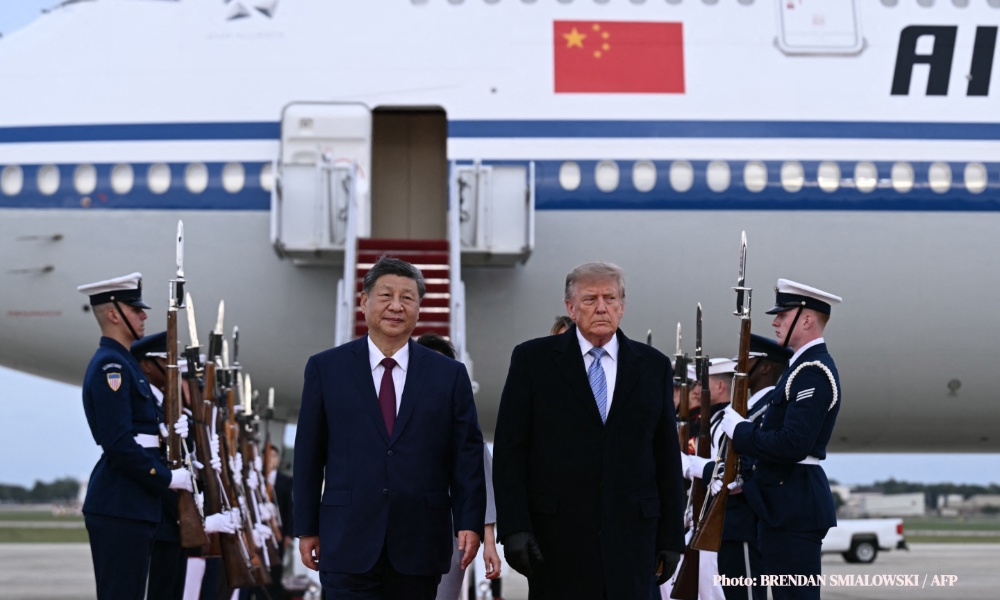
US President Donald Trump welcomed Chinese President Xi Jinping to Washington with a high-profile military ceremony, as the two leaders begin a three-day summit focused on trade, technology and other major areas of tension between the two countries.
Xi arrived at Joint Base Andrews in Maryland on Wednesday evening, where Trump and First Lady Melania Trump personally greeted him and his wife, Peng Liyuan.
The Chinese leader was welcomed with a red carpet, a military honor guard, marching band and a flyover by two US B-1 bombers. Trump’s decision to meet Xi at the airport marked the first time since 1962 that a US president has personally welcomed a foreign leader at the base.
Xi’s visit to Washington is his first since 2015 and comes as the two countries seek to maintain a fragile trade truce.
US Treasury Secretary Scott Bessent said on Wednesday that Washington and Beijing had agreed to extend their current trade truce until January. The arrangement had been due to expire on 10 November.
The agreement has involved the US lowering tariffs on some Chinese goods in exchange for China easing restrictions on exports of rare earth minerals.
Bessent said discussions with Chinese Vice Premier He Lifeng also covered the possibility of reaching a broader trade agreement.
In a statement carried by China’s state news agency Xinhua, Xi said the US and China should be “partners rather than rivals”, adding that cooperation between the two countries could benefit the world.
The summit is expected to address a wide range of issues, including trade and tariffs, rare earth minerals, agricultural exports, artificial intelligence, Taiwan and the ongoing conflict involving Iran.
Trump is expected to seek increased Chinese purchases of US agricultural products, greater access to Chinese rare earth minerals and lower Chinese tariffs on American goods.
Taiwan is also expected to feature in the talks, with Beijing opposing US arms sales to the self-governing island.
Xi is travelling with senior Chinese officials including Cai Qi, a member of the Communist Party’s Politburo Standing Committee, Vice Premier He Lifeng and Foreign Minister Wang Yi.
The Chinese president is expected to attend a state dinner at the White House on Thursday, with leaders from the US artificial intelligence industry among the guests.
The two countries are competing for greater influence in AI, while also debating the regulation and potential risks associated with the technology.
Xi’s visit will conclude on Friday.
World
Trump warns in UN speech he could ‘annihilate’ Iran without peace deal
Members of the Cuban delegation walked out of the hall as Trump referenced his pressure campaign against the country.
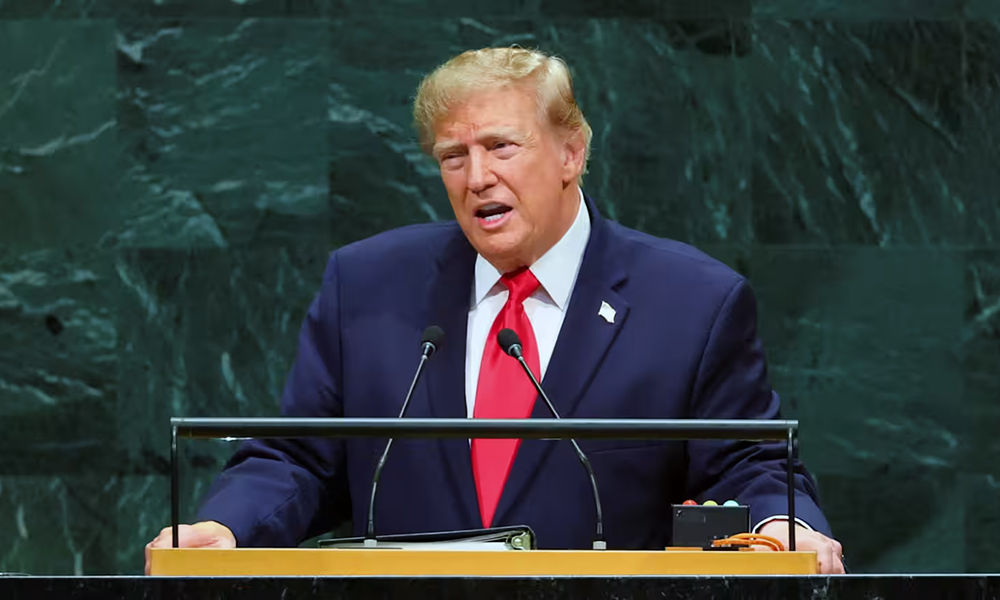
US President Donald Trump used his UN General Assembly speech on Tuesday to make the case for his war on Iran, arguing he has prevented Tehran from obtaining a nuclear weapon and warning that he could “annihilate the Islamic Republic” if no deal is reached to end the conflict, Reuters reported.
While predicting his administration would strike a peace deal with Iran following the November 3 US midterm elections, Trump called on other nations to join America in isolating Iran economically to force it to the negotiating table.
“I have a big decision to make. Will a deal be made with Iran that lets them rebuild and create a far greater country than it ever was before?” Trump said. “Or do I annihilate the Islamic Republic and do it quickly, never giving them a chance to kill and destroy people and countries again?”
He later told reporters at the United Nations that US officials had held a “very good” three-hour meeting with the Iranian delegation on Tuesday. He subsequently appeared to clarify that special envoys Steve Witkoff and Jared Kushner had met with mediators rather than Iranian officials directly.
“Steve and Jared had a very productive meeting today with mediators of Iran, merely mediators,” he told reporters at the start of a meeting with Gulf leaders at the UN. “Let’s see what happens with that.”
Since returning to office last year for a second term, Trump has sent waves through the global order, joining Israel to attack Iran, ordering a raid on Venezuela that captured the country’s leader, and threatening to seize Greenland.
In a 37-minute speech ahead of a whirlwind diplomatic schedule that included meetings with the leaders of Britain, Ukraine and Japan, Trump laid out his foreign policy vision, arguing that the Iran war had spared the world the threat of a nuclear-armed menace while asserting US dominance in the Western Hemisphere is essential to preventing crises from taking root.
“Our actions in Venezuela are proof that the United States will no longer permit threats to America to gain a foothold anywhere in the Western Hemisphere,” Trump said. “While others have spoken of peace, I have made peace.”
Outside the UN headquarters, dozens of anti-Iranian-government demonstrators gathered, a few of them holding up signs calling for democracy and decrying dictatorship.
Trump brushed aside suggestions that the midterm elections, in which his Republican Party risks losing control of Congress, could constrain his handling of the war. Some analysts have argued that a Democratic takeover of the legislature would weaken his leverage in the conflict.
“What they don’t realize is that I’m not running,” Trump said, referring to the leadership in Tehran. “I did that already, and won in a landslide. We won in a giant landslide, and I’ll be here for 2-1/2 years.”
Taking aim at US neighbors, Trump labeled Mexico “the epicenter of cartel violence,” urged its government to “reclaim control of its soil,” and said his administration was pursuing “a fundamental change in the situation in Cuba.”
Members of the Cuban delegation walked out of the hall as Trump referenced his pressure campaign against the country.
“It’s an absolutely failed state, it’s failing like never before, and it will fall,” said Trump.
Yet Trump’s appearance was less dramatic than in 2025, when he used a combative speech to chastise world leaders, warning that some countries were “going to hell,” and complained about UN facilities after being briefly stranded on a malfunctioning escalator and suffering an initial teleprompter failure, read the report.
Trump renewed his criticism of the UN, highlighting his efforts to cut its bureaucracy, but offered no fresh attacks or indications that the US would leave any additional UN agencies.
Trump spoke less than a week after a UN fact-finding mission said it had reasonable grounds to believe US forces committed war crimes in two strikes on Iran, including one that hit a primary school in the southern city of Minab.
He renewed his criticism of international bodies that could serve as a check on US power, singling out the International Criminal Court and declaring that US military personnel would not be subject to its authority.
“We will never allow US service members or anyone else to be investigated or given show trials by an anti-American tribunal with no jurisdiction over us,” he said.
Ahead of a UN Security Council meeting on AI and international security on Wednesday, Trump acknowledged the challenges of the new technology but said, “I’m not going to stifle growth of something that will be bigger than the Industrial Revolution.”
The speech kicked off a day of high-level diplomacy at the United Nations, where Trump was due to meet more than a dozen world leaders as wars in the Middle East and Ukraine continued to test his foreign policy agenda.
British Prime Minister Andy Burnham said he had “established a good connection” with Trump in their first-ever meeting, where they discussed trade, Ukraine and the status of the Falkland Islands. Trump called Burnham a “natural business person” after the meeting.
At the press-facing start of their talks, Japanese Prime Minister Sanae Takaichi said the meeting would demonstrate the strength of the US-Japan alliance amid a “severe security environment, including in Asia,” an apparent nod to China. Trump is due to meet Chinese President Xi Jinping in Washington later this week.
Trump lavished praise on Takaichi, calling her a friend and predicting she would “go down as one of the great prime ministers.”
On his meeting with Ukrainian President Volodymyr Zelenskiy, Trump told reporters that the two talked about finding a solution to end Russia’s war in Ukraine.


Exclusive interview with Abdul Latif Mansoor, Minister of MRRD

Sorkh Poshan Khafi rout Istiqlal Kabul 6-0 in ACL season six

Tawsia: Overview of Afghanistan’s iron mines

Afghanistan Champions League: Arman FC and Aino Mina play out goalless draw

Afghanistan says Pakistani military post destroyed near Spin Boldak

Saudi energy group signs major Afghanistan deals covering gas exploration and pipeline plans

ATN secures exclusive rights to broadcast T20I series in India across Afghanistan

Trump floats idea of renaming Atlantic or Pacific Ocean

US hits Egyptian bank branches with Iran sanctions as war marks six months

Nepal flood rescue mission enters critical phase as thousands remain missing
Exclusive interview with Abdul Latif Mansoor, Minister of MRRD
Tawsia: Overview of Afghanistan’s iron mines

Tahawol: Discussion on fresh Pakistani airstrikes on Afghanistan

Saar: Calls for international support for Afghanistan discussed

Tahawol: Opening of the 81st UN General Assembly Session
-

 Sport5 days ago
Afghanistan to face Japan and Nepal in Asian Games cricket group stage
-
 Regional5 days ago
Iran and US trade threats after Houthi attacks escalate regional conflict
-

 World4 days ago
CNN, MS NOW and Politico sue Trump, challenging White House ban
-
 Health5 days ago
Four-day polio vaccination campaign begins across Afghanistan
-

 Latest News4 days ago
UN reiterates call for respect for international law after Kunar airstrikes
-
 Latest News4 days ago
Khalilzad condemns Pakistan airstrikes, says current strategy is not working
-

 Latest News2 days ago
Ariana Afghan Airlines ranks seventh among 45 Central Asian airlines
-

 Latest News4 days ago
Afghan Official: Pakistan’s airstrikes will not go unanswered