
Latest News
Afghan peace plan outlines roadmap to future political system

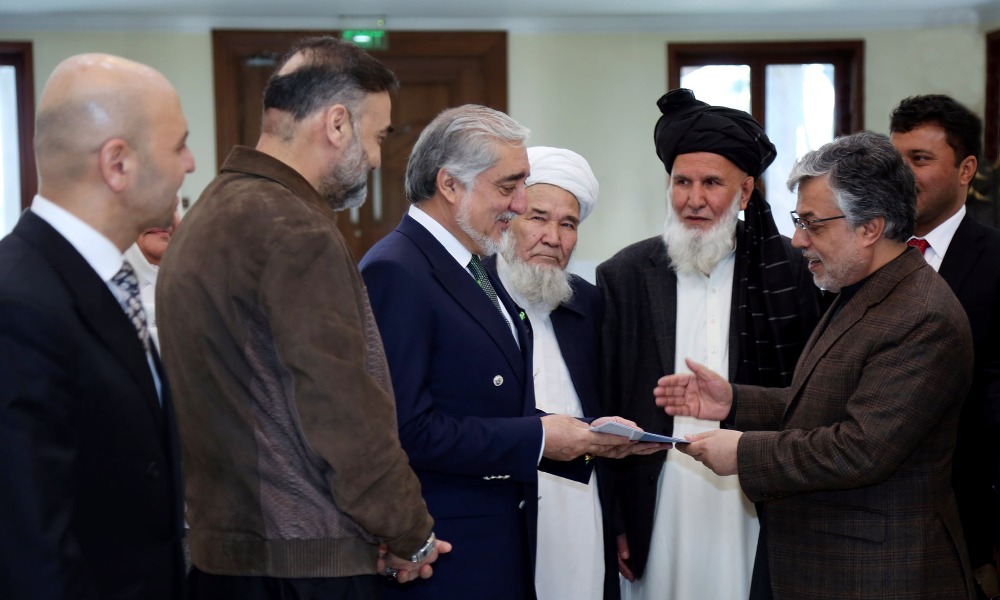
The High Council for the National Reconciliation (HCNR) has drafted a unified peace plan for the upcoming Istanbul Summit.
A copy of the draft seen by Ariana News shows that the plan has four parts including a principle for the future of Afghanistan, a Peace roadmap/President Ashraf Ghani’s plan, a future political system, and an end to the ongoing conflict in the country.
According to the plan, two-thirds of the power is earmarked for the Islamic republic and one-third for the Taliban.
The first part of the plan calls for a number of stipulations including Islam to be the official religion of Afghanistan; civil rights to be preserved based on the Afghan Constitution; an amendment brought to parts of the Constitution, for International support to be preserved, and for a neutral foreign policy, elections, and an accountable government.
The second part includes Ghani’s three-phase roadmap to the restoration of peace in the country.
Ghani’s roadmap – from an unending war towards a just and lasting peace includes three phases, a political agreement; a peace government; and peacebuilding, state-building, and market-building.
In the first phase, Ghani proposed a political settlement, an internationally monitored ceasefire, a regional and international guarantee of peace as well as continued counter-terrorism efforts, and the convening of a Loya Jirga to approve the agreement.
The second phase will be to hold a presidential election and establish a “government of peace” and implement arrangements to move towards a new political system.
The third phase will involve building a “constitutional framework, security, reintegration of refugees and considering government priorities” for Afghanistan’s development.
In the third part of the draft, two political systems – a Presidential Structure with four Vice Presidents including a woman or a parliamentary system that could be implemented after a referendum for amending the Constitution – have been proposed for the future of Afghanistan
The fourth part is focused on ending the war in the country. In this part, a regular framework for the end of the conflict, and the implementation and monitoring of a ceasefire are highlighted.
This comes as US Special Representative for Afghanistan Reconciliation Zalmay Khalilzad met with President Ashraf Ghani and Abdullah Abdullah Chairman of the High Council for National Reconciliation (HCNR) on Saturday to discuss the peace process and the upcoming Istanbul summit.
“Khalilzad met with Ghani twice during the day and discussed the upcoming Istanbul summit, the timeframe, finalization of the list of participants, and the preparations for the conference,” the Presidential Palace said.
HCNR Chairman Abdullah stated in a tweet that he and Khalilzad discussed “the Afghan Peace Process, the Doha talks, internal consensus and preparations for the upcoming conference in Turkey.”
“We welcome the acceleration of the process & achieving a comprehensive political settlement,” Abdullah tweeted.
The Istanbul summit is expected to be held on April 16 in Turkey.







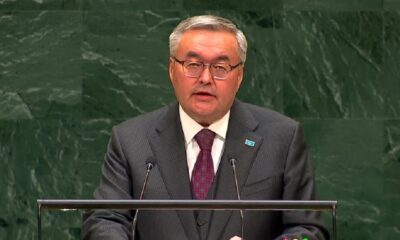




Kazakhstan’s Foreign Minister Mukhtar Tileuberdi has called for pragmatic and coordinated international engagement with Afghanistan, saying the country’s long-term stability is closely linked to the security and sustainable development of Central Asia.
Speaking during the general debate of the 81st session of the United Nations General Assembly in New York on Friday, Tileuberdi said humanitarian assistance to Afghanistan remains essential but alone cannot break the cycle of poverty, displacement and dependency.
He said Kazakhstan supports a “pragmatic, coordinated and step-by-step” approach to international engagement with Afghanistan, with the United Nations playing a central role.
Tileuberdi also said Kazakhstan is working with the UN to operationalize the United Nations Regional Centre for the Sustainable Development Goals for Central Asia and Afghanistan in Almaty.
He said the success of the centre should be measured by the results and assistance it delivers to the region.


Saar: Concerns over Pakistan’s political crisis discussed

Afghanistan Champions League: Omar Zawak Herat beat Toofan Herat 1-0

Blast in Pakistan’s Dera Ismail Khan kills 11, injures 30

Ariana Afghan Airlines increases Kabul-Delhi cargo flights

Khalilzad questions Pakistan’s commitment to Afghan welfare

Saudi energy group signs major Afghanistan deals covering gas exploration and pipeline plans

Trump floats idea of renaming Atlantic or Pacific Ocean

US hits Egyptian bank branches with Iran sanctions as war marks six months

Nepal flood rescue mission enters critical phase as thousands remain missing

Iranian clubs to face Gulf opponents at neutral venues in Asian Champions League Elite
Saar: Concerns over Pakistan’s political crisis discussed

Exclusive interview with Abdul Latif Mansoor, Minister of MRRD

Tawsia: Overview of Afghanistan’s iron mines

Tahawol: Discussion on fresh Pakistani airstrikes on Afghanistan

Saar: Calls for international support for Afghanistan discussed
-

 World5 days ago
CNN, MS NOW and Politico sue Trump, challenging White House ban
-

 Latest News3 days ago
Ariana Afghan Airlines ranks seventh among 45 Central Asian airlines
-

 Latest News4 days ago
UN reiterates call for respect for international law after Kunar airstrikes
-
 Latest News5 days ago
Khalilzad condemns Pakistan airstrikes, says current strategy is not working
-

 Regional3 days ago
US and Iran hold first talks since June after Trump’s ‘annihilation’ threat
-

 Latest News3 days ago
Silk Road highway in Wakhan corridor now reaches the China border
-

 Latest News4 days ago
Afghan Official: Pakistan’s airstrikes will not go unanswered
-

 Sport4 days ago
Afghan boxing referee heads to China for international festival