
Latest News
Engagement key to reform of IEA policies restricting women’s rights

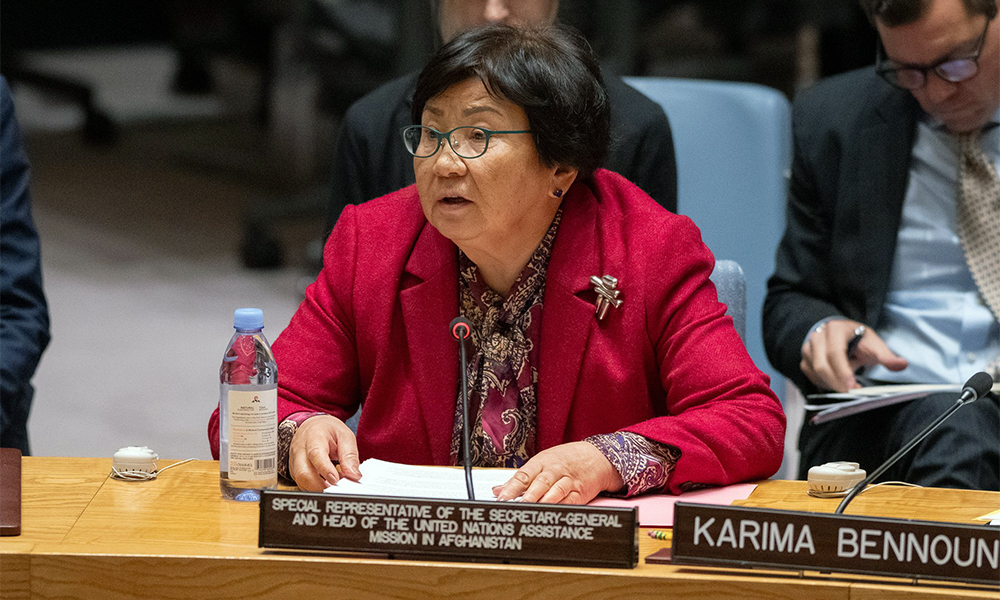
The international community must continue to engage with Islamic Emirate leaders in Afghanistan despite deep disagreement with their approach to women’s rights and inclusive governance, the UN Special Representative for the country told the Security Council on Tuesday.
Roza Otunbayeva, who also heads the UN Assistance Mission in Afghanistan (UNAMA), called for a “reframed engagement strategy”, expressing concern over the “lack of positive direction” in current efforts.
“The lack of trust on all sides is a serious impediment to building confidence but the doors to dialogue are still open,” she said.
“This moment, despite its problems, is an opportunity. We must ensure that the doors to dialogue are not shut.”
Otunbayeva said engagement has been significantly undermined by the more than 50 Taliban decrees aimed at eliminating women from public life and education.
“The policies that drive the exclusion of women are unacceptable to the international community,” she said.
She also cited a new UN report based on more than 500 interviews with Afghan women, 46 percent of whom said the Islamic Emirate should not be recognized under any circumstances.
“The question, however, is whether to continue engaging with the de facto authorities despite these policies, or to cease engaging because of them,” she said.
“UNAMA’s view is that we must continue to engage and to maintain a dialogue.
“Dialogue is not recognition. Engagement is not acceptance of these policies. On the contrary: dialogue and engagement are how we are attempting to change these policies.”
Otunbayeza told the Council that this engagement could be more structured and purposeful while remaining principled.
“A reframed engagement strategy must first acknowledge that the de facto authority bears responsibility for the well-being of the Afghan people, in all dimensions but especially concerning women,” she stressed.
Other components would include mechanisms to address the de facto authorities’ long-term concerns, as well as “a sincere intra-Afghan dialogue of the sort that was interrupted when the Taliban took power in August 2021.”
Additionally, “a more coherent position of the international community” would also be required, she said.
Sima Bahous, head of the UN’s gender equality agency, UN Women, also briefed the Council. She told ambassadors that Taliban decrees are costing Afghanistan roughly one billion dollars a year, which will only increase.
The edicts are also exacerbating the dire humanitarian situation in a country where more than two-thirds of the population depend on assistance to survive and some 20 million, mainly women and girls, are facing acute hunger.
She insisted that the way forward must be guided by women’s voices and the principles of the UN Charter.
Bahous recommended that the Security Council Committee that oversees sanctions against Afghanistan convene a session to examine the role it can play in responding to violations of women’s rights in the country.
“We must consider the messages we send when we frame the situation in Afghanistan purely or exclusively as a humanitarian crisis,” she further advised.
“It is an economic crisis, a mental health crisis, a development crisis, and more. And the thread that connects these different facets is the underlying women’s rights crisis. This must be the primary lens through which we understand what is going on and what we must do.”
She also urged ambassadors to fully support efforts to explicitly codify “gender apartheid” in international law.












Kazakhstan’s Foreign Minister Mukhtar Tileuberdi has called for pragmatic and coordinated international engagement with Afghanistan, saying the country’s long-term stability is closely linked to the security and sustainable development of Central Asia.
Speaking during the general debate of the 81st session of the United Nations General Assembly in New York on Friday, Tileuberdi said humanitarian assistance to Afghanistan remains essential but alone cannot break the cycle of poverty, displacement and dependency.
He said Kazakhstan supports a “pragmatic, coordinated and step-by-step” approach to international engagement with Afghanistan, with the United Nations playing a central role.
Tileuberdi also said Kazakhstan is working with the UN to operationalize the United Nations Regional Centre for the Sustainable Development Goals for Central Asia and Afghanistan in Almaty.
He said the success of the centre should be measured by the results and assistance it delivers to the region.


Abu Muslim Farah defeat Khurasan Faryab 2-0 in ACL season six

Saar: Concerns over Pakistan’s political crisis discussed

Afghanistan Champions League: Omar Zawak Herat beat Toofan Herat 1-0

Blast in Pakistan’s Dera Ismail Khan kills 11, injures 30

Ariana Afghan Airlines increases Kabul-Delhi cargo flights

Saudi energy group signs major Afghanistan deals covering gas exploration and pipeline plans

Trump floats idea of renaming Atlantic or Pacific Ocean

US hits Egyptian bank branches with Iran sanctions as war marks six months

Nepal flood rescue mission enters critical phase as thousands remain missing

Iranian clubs to face Gulf opponents at neutral venues in Asian Champions League Elite
Saar: Concerns over Pakistan’s political crisis discussed

Exclusive interview with Abdul Latif Mansoor, Minister of MRRD

Tawsia: Overview of Afghanistan’s iron mines

Tahawol: Discussion on fresh Pakistani airstrikes on Afghanistan

Saar: Calls for international support for Afghanistan discussed
-

 World5 days ago
CNN, MS NOW and Politico sue Trump, challenging White House ban
-

 Latest News3 days ago
Ariana Afghan Airlines ranks seventh among 45 Central Asian airlines
-

 Latest News4 days ago
UN reiterates call for respect for international law after Kunar airstrikes
-

 Regional4 days ago
US and Iran hold first talks since June after Trump’s ‘annihilation’ threat
-

 Latest News3 days ago
Silk Road highway in Wakhan corridor now reaches the China border
-

 Latest News5 days ago
Afghan Official: Pakistan’s airstrikes will not go unanswered
-

 Sport4 days ago
Afghan boxing referee heads to China for international festival
-

 Regional3 days ago
Iran airlines cancel flights as US sanctions hit