
Latest News
UNAMA chief briefs UNSC, says humanitarian situation remains a ‘grave concern’

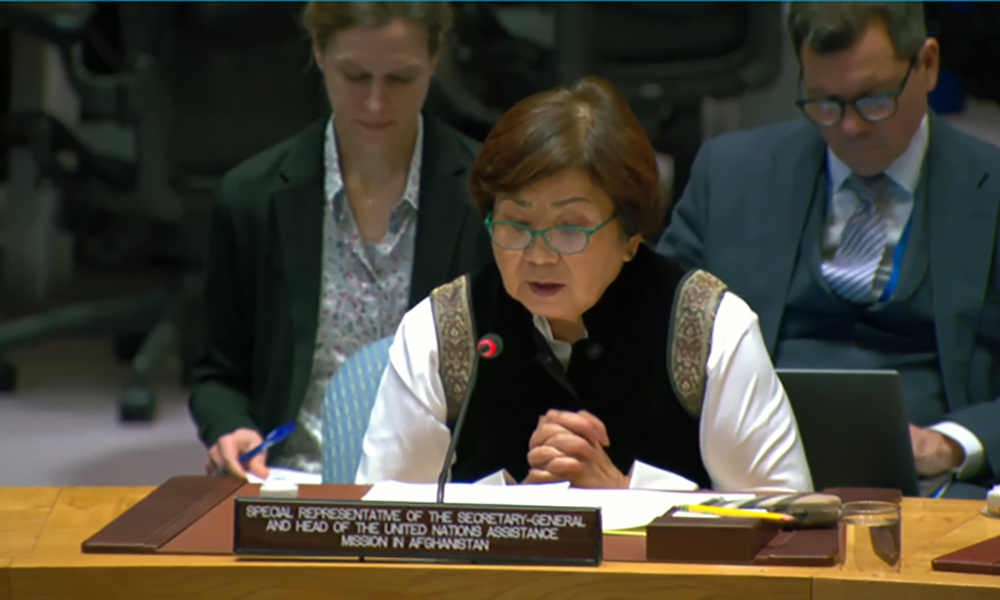
UN Secretary-General’s Special Representative for Afghanistan, Roza Otunbayeva briefed the United Nations Security Council on Wednesday and said the humanitarian situation remains a grave concern; and that as another winter approaches, more than 20 million people will depend on aid.
She also said key features of the human rights situation in the country are “a record of systemic discrimination against women and girls.”
According to her, there was “repression of political dissent and free speech, a lack of meaningful representation of minorities, and ongoing instances of extrajudicial killing, arbitrary arrests and detentions, torture and illtreatment.”
She thanked the Security Council for considering the situation in Afghanistan “several times over the past month,” and that “in a world of multiplying crises, I am grateful for this ongoing attention to Afghanistan.
“Many Afghans inform me that they fear being forgotten, as they have been in the past. I strongly believe that my role, and that of UNAMA, is to prevent this from happening.”
According to her, the lack of progress in resolving human rights issues is a key factor behind the current impasse and that accepting and working to uphold the international norms and standards, as set out in the UN Treaties that Afghanistan has ratified, “will continue to be a non-negotiable condition for a seat at the United Nations.”
She noted however that the Islamic Emirate “continue to maintain a generally good level of security,” although unexploded ordnance remains a significant concern.
According to her, the Shia community remains at disproportionate risk of harm – especially by ISIL-KP (Daesh).
“At the same time regional countries remain deeply concerned about additional possible threats emanating from inside Afghanistan. In particular, Pakistan remains convinced that the de facto authorities (IEA) have done too little to contain the Tehreek-e-Taliban Pakistan, which has claimed major recent terrorist attacks inside Pakistan.
Otunbayeva said she was in Islamabad last week and raised the issue of the expulsion of undocumented Afghans living in Pakistan.
She said Pakistan’s decision has led to a deterioration of relations between the two countries; and that “it is essential that both sides take measures to prevent further deterioration and begin working on issues of common interest.”
According to her, almost 500,000 Afghans have returned home and that “a consortium of humanitarian actors” are working constantly alongside the IEA to provide these families with assistance.
“This has proven to be an effective cooperation and the de facto authorities IIEA) have responded with great professionalism despite lacking resources. The returnees are the poorest of the poor. 80,0000 of them have nowhere in Afghanistan to go. The human rights consequences for women and girls forced to return are particularly severe,” she said.
Otunbayeva also raised the issue of education and said while the international community has called for the ban on girls’ education to be reversed, the overall quality of education had deteriorated.
She also raised the issue of climate change and its effects on Afghanistan.
“Afghanistan is one of the most climate change-affected countries in the world while it has contributed least to its causes. I continue to believe that the de facto authorities (IEA) need to be part of this global conversation.”
She went on to say that addressing Afghanistan’s climate crisis should transcend politics – especially as the lack of water from recurring drought has reached a level of urgency that is felt across the country including Kabul.
“The de facto authorities (IEA) have demonstrated a desire to engage with the international community on this issue.
“I urge all of us to find ways of including Afghanistan in future meetings on climate change,” she said.
In terms of the UN’s future approach to dealing with the IEA, she said the organization should be guided by two factors; a durable and more detailed international consensus on Afghanistan and making far greater use of the IEA’s willingness to engage in dialogue with members of the international community.
“Dialogue does not legitimize. It can be used to express disapproval yet encourage change,” she said and that “there must be more direct engagement with the de facto authorities (IEA), including in Kabul.”
The IEA has not yet commented on Otunbayeva’s report.












Kazakhstan’s Foreign Minister Mukhtar Tileuberdi has called for pragmatic and coordinated international engagement with Afghanistan, saying the country’s long-term stability is closely linked to the security and sustainable development of Central Asia.
Speaking during the general debate of the 81st session of the United Nations General Assembly in New York on Friday, Tileuberdi said humanitarian assistance to Afghanistan remains essential but alone cannot break the cycle of poverty, displacement and dependency.
He said Kazakhstan supports a “pragmatic, coordinated and step-by-step” approach to international engagement with Afghanistan, with the United Nations playing a central role.
Tileuberdi also said Kazakhstan is working with the UN to operationalize the United Nations Regional Centre for the Sustainable Development Goals for Central Asia and Afghanistan in Almaty.
He said the success of the centre should be measured by the results and assistance it delivers to the region.


Abu Muslim Farah defeat Khurasan Faryab 2-0 in ACL season six

Saar: Concerns over Pakistan’s political crisis discussed

Afghanistan Champions League: Omar Zawak Herat beat Toofan Herat 1-0

Blast in Pakistan’s Dera Ismail Khan kills 11, injures 30

Ariana Afghan Airlines increases Kabul-Delhi cargo flights

Saudi energy group signs major Afghanistan deals covering gas exploration and pipeline plans

Trump floats idea of renaming Atlantic or Pacific Ocean

US hits Egyptian bank branches with Iran sanctions as war marks six months

Nepal flood rescue mission enters critical phase as thousands remain missing

Iranian clubs to face Gulf opponents at neutral venues in Asian Champions League Elite
Saar: Concerns over Pakistan’s political crisis discussed

Exclusive interview with Abdul Latif Mansoor, Minister of MRRD

Tawsia: Overview of Afghanistan’s iron mines

Tahawol: Discussion on fresh Pakistani airstrikes on Afghanistan

Saar: Calls for international support for Afghanistan discussed
-

 World5 days ago
CNN, MS NOW and Politico sue Trump, challenging White House ban
-

 Latest News3 days ago
Ariana Afghan Airlines ranks seventh among 45 Central Asian airlines
-

 Latest News4 days ago
UN reiterates call for respect for international law after Kunar airstrikes
-

 Regional3 days ago
US and Iran hold first talks since June after Trump’s ‘annihilation’ threat
-

 Latest News3 days ago
Silk Road highway in Wakhan corridor now reaches the China border
-

 Latest News5 days ago
Afghan Official: Pakistan’s airstrikes will not go unanswered
-

 Sport4 days ago
Afghan boxing referee heads to China for international festival
-
 Regional5 days ago
G7 foreign ministers call on Iran to stop arming Houthis