Connect with us

Climate Change

Millions without power as cyclone Remal pounds Bangladesh and India

Published

on

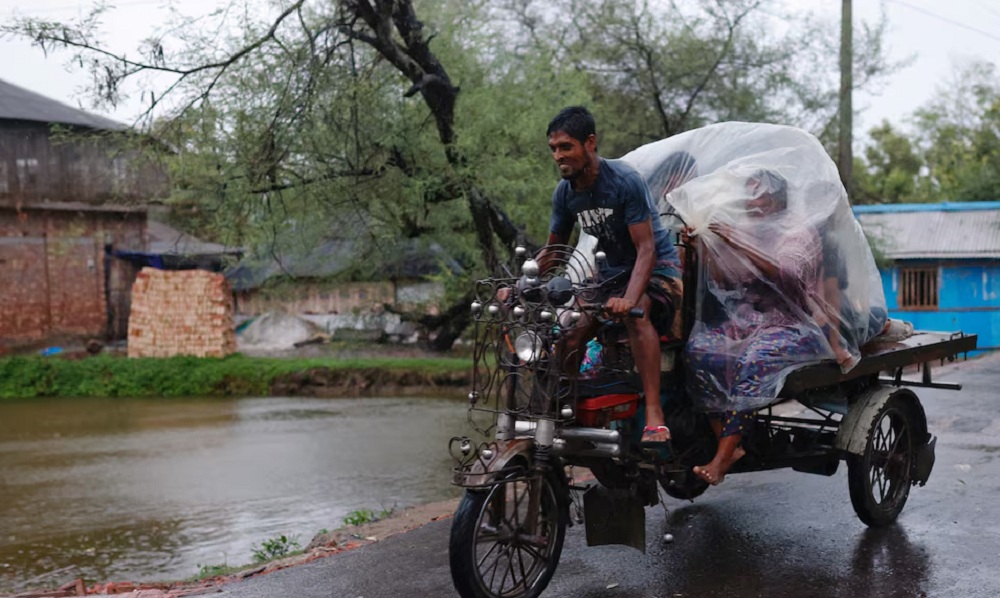
Strong winds and heavy rain pounded the coastal regions of Bangladesh and India as severe cyclone Remal made landfall late on Sunday, leaving millions without electricity after power poles fell and some trees were uprooted by gusty winds.

The storm crossed the coastal regions of Bangladesh’s Mongla port and the adjoining Sagar Islands in India’s West Bengal state with wind speed measuring up to 135 kmph (about 84 mph), the India Meteorological Department (IMD) said, Reuters reported.

The storm will gradually weaken into a cyclone during the morning on Monday and then move northeast and gradually weaken further, the IMD said in its latest weather update.

The landfall process began around 9 pm local time in India on Sunday and continued for about five hours, the regional meteorological office in Kolkata said.

One person was killed in the major metropolitan city of Kolkata when concrete chunks fell on him during the peak of the storm, police said. Roofs of thatched huts were blown away while mud houses were flattened in the coastal areas of both countries as authorities waited to ascertain the full scale of losses.

The low-lying coasts of South Asian neighbours Bangladesh and India have experienced frequent severe storms in recent years as climate change forces a rise in sea surface temperatures. Remal is the year’s first cyclone in the region.

Bangladesh moved about 800,000 people from the port areas of Mongla and Chittagong and nine coastal districts to storm shelters from Sunday morning. As many as 110,000 people were also taken to shelters in India.

Dhaka set up nearly 8,000 cyclone shelters and mobilised 78,000 volunteers ahead of the storm while the Indian navy said it had kept ships, aircraft, divers and medical supplies on standby for deployment if required.

While early warnings and timely evacuations helped both countries avert major casualties from the storm, there was a heavy toll on power infrastructure.

Authorities in Bangladesh shut down electricity supply to many areas in advance to avoid accidents while many coastal towns were left in the dark as fallen trees and broken lines disrupted supply, power ministry officials said.

“We have no electricity since night, my mobile battery will run out anytime. By the grace of Allah, the cyclone was not as violent as we thought,” said Rahat Raja, a resident in the coastal district of Satkhira in Bangladesh.

Reports of at least 356 uprooted electricity poles and damage to scores of transformers were received during the first hour of the landfall process, Arup Biswas, the minister for power in West Bengal government, said.

More than 50 international and domestic flights had to be cancelled in Kolkata city as operations were suspended from Sunday noon. Bangladesh also suspended operations at Mongla and Chittagong ports.

“Normal airport operations will resume from 9 am,” said C Pattavi, the director of the Kolkata airport, adding that the airport’s operational areas were clear from waterlogging.

River embankments in the Sundarbans delta, the largest mangrove forest in the world, shared by India and Bangladesh, also suffered heavy damage with high tides breaching protective embankments at many places.

Kolkata, like the state’s coastal belt, was also lashed by heavy rains with water logging in many areas, television footage showed. At least six trees were uprooted, which blocked roads, while there were also reports of wall collapses, police said.

The cyclone also brought heavy rains to Bangladesh capital Dhaka, causing flooding of roads and severely impacting commuters.


Climate Change

Iran war is supercharging the clean energy transition, UN climate chief says

Published

on

The Iran war is “supercharging” the world’s shift to renewable energy, as countries scramble to reduce their exposure to volatile oil and ​gas markets, the U.N. climate secretary said on Thursday.

The U.S.-Israeli war ‌with Iran has upended oil and gas supplies, prompting some countries to ration fuel and others to roll out subsidies and tax cuts to shield consumers from surging prices, Reuters reported.

Early signs indicate the ​war, which began two months ago, is speeding up some countries’ low-carbon ​transition.

Demand for rooftop solar systems across Europe has surged, while countries ⁠including Pakistan have reported a jump in electric vehicle sales.

Chinese President Xi Jinping called this month ​to speed up the construction of a new energy system to safeguard energy ​security, emphasising hydropower development and the expansion of nuclear power.

“Those who’ve fought to keep the world hooked on fossil fuels are inadvertently supercharging the global renewables boom,” said Simon Stiell, Executive ​Secretary of the U.N.’s climate secretariat UNFCCC.

“Renewables offer safer, cheaper, cleaner energy ​that can’t be held captive by narrow shipping straits, or global conflicts,” Stiell told a meeting ‌of ⁠government officials at the International Energy Agency in Paris.

However, the war has also prompted some nations to increase the use of highly polluting coal or furnace oil-based power generation as they struggle to replace gas from the Middle East.

Turkey’s Climate Minister ​Murat Kurum – who will ​preside over the ⁠U.N.’s COP31 climate summit this year – said fossil fuel dependency now topped the global political agenda.

“The best way to protect ​citizens from the violent convulsions of global energy markets is ​to accelerate ⁠the clean-energy transition,” he said in a statement after the IEA event.

Around 60 governments including Brazil, Germany, Canada and Nigeria, met in Colombia this week for a summit to ⁠discuss how ​to phase out fossil fuels.

Conference hosts Colombia and ​the Netherlands said on Thursday countries had agreed to continue working, over the next year, on ​how to do this in their trade systems.

Continue Reading

Climate Change

Uzbek president emphasizes Afghanistan’s role in regional water cooperation

Published

on

At a regional water summit in Astana on Wednesday, Uzbekistan’s President Shavkat Mirziyoyev emphasized the importance of involving Afghanistan in broader regional cooperation on water, climate, and environmental issues.

He underlined that Afghanistan’s participation is essential for effective management of shared water resources in Central Asia, particularly in the Aral Sea basin, where upstream and downstream countries are closely interconnected.

The Uzbek president also called for increased international support for environmental protection and land reclamation projects inside Afghanistan.

He further stressed that long-term stability in the region will depend on the development of a legal framework governing water allocation that clearly defines the rights and obligations of all countries in the basin.

Uzbekistan’s authorities have expressed concern over the construction of the Qosh Tepa canal in Afghanistan, saying it could “radically change the water regime and balance” in Central Asia.

The Islamic Emirate of Afghanistan (IEA), however, has said that Uzbekistan will not be harmed by the canal.


Continue Reading

Climate Change

Webinar series highlights growing climate pressures on livelihoods in Afghanistan

Afghanistan is widely regarded as one of the countries most vulnerable to climate change, with limited capacity to manage its effects.

Published

on

A recent webinar series hosted by the United Nations Assistance Mission (UNAMA) in Afghanistan has underscored the escalating impact of climate change on humanitarian needs and livelihoods across Afghanistan.

Held in partnership with Samuel Hall, the six-part series in late 2025 brought together Afghan experts, humanitarian workers, UN agencies, NGOs and local stakeholders to examine the country’s mounting environmental challenges and explore potential responses.

Afghanistan is widely regarded as one of the countries most vulnerable to climate change, with limited capacity to manage its effects. Participants warned that communities are already facing severe consequences, including rising displacement, worsening food insecurity and increasing pressure on natural resources.

The discussions highlighted that nearly 70 percent of the population depends on climate-sensitive agriculture, leaving livelihoods exposed to shifting weather patterns. A changing water cycle has intensified water scarcity nationwide, while urban centres such as Kabul are grappling with declining groundwater levels.

At the same time, increasingly erratic seasonal flooding continues to damage homes, infrastructure and farmland, compounding humanitarian needs.

Speakers also pointed to the growing link between climate change and displacement, noting that environmental shocks are driving both internal migration and cross-border movements as livelihoods come under strain.

Across the six sessions, participants explored a range of themes, including water management, climate finance, the role of women and youth, and the intersection of climate change with peace and security.

The series aimed to amplify Afghan perspectives and maintain focus on the country’s climate challenges, particularly as Afghanistan remains largely absent from global climate forums.

Organisers said the discussions highlighted both the scale of the crisis and the depth of local expertise available to respond, while calling for sustained, coordinated and evidence-based action.

Summary notes and recordings from the sessions have been released to inform policymakers, donors and practitioners, outlining key recommendations and areas requiring further investment and collaboration.

Continue Reading

Trending

Copyright © 2025 Ariana News. All rights reserved!