
Latest News
ILT20 2024: All you need to know

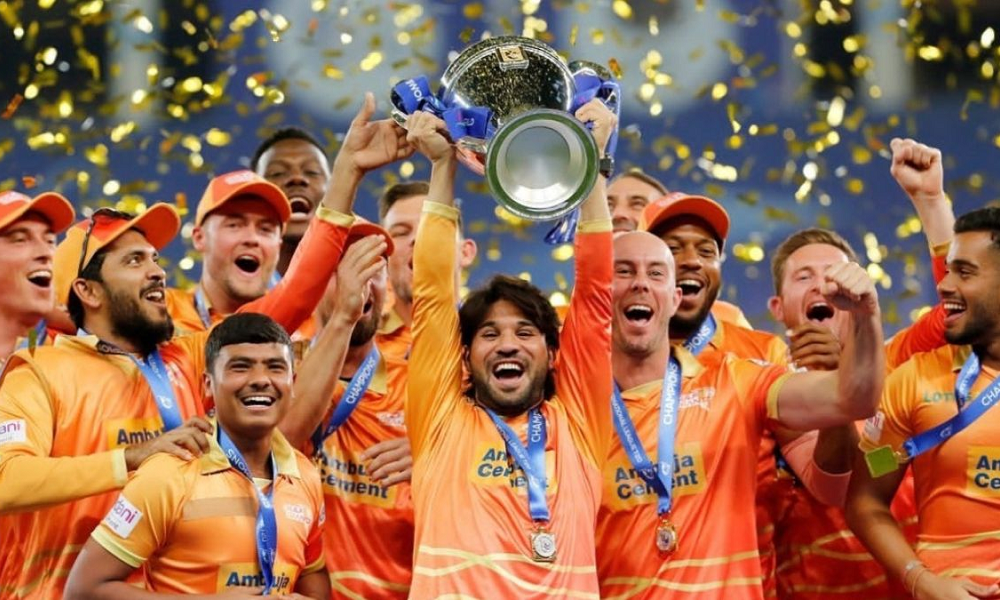
The much-awaited cash-rich International League T20 (ILT20) gets underway on Friday in the United Arab Emirates and will run through to February 17.
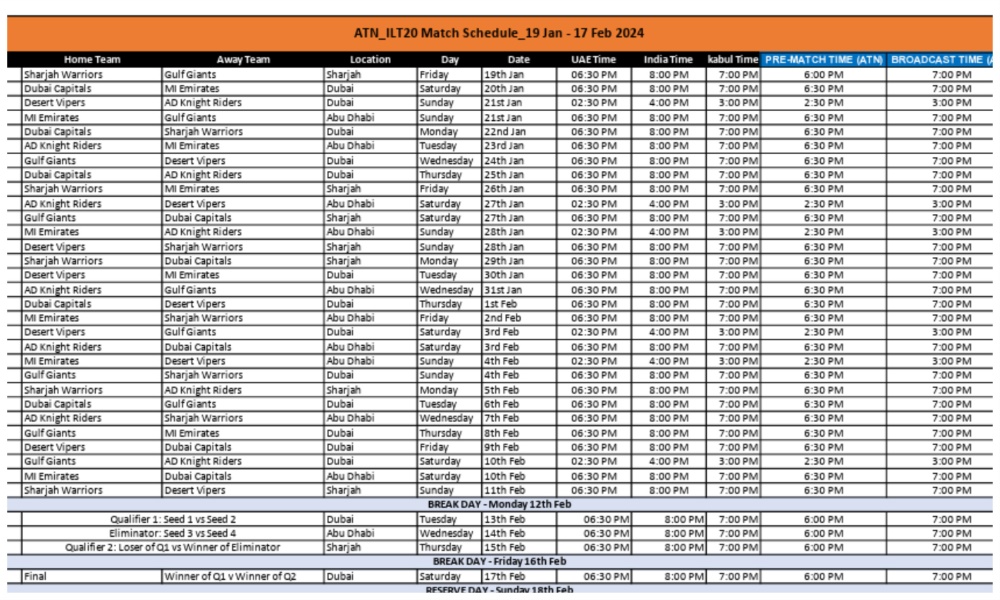
Matches, 34 in total, will be played in Dubai, Abu Dhabi and Sharjah.
There are six teams and many have links to IPL teams. The teams are Abu Dhabi Knight Riders, Desert Vipers, Dubai Capitals, Gulf Giants, MI Emirates, and Sharjah Warriors.
The six teams will compete in a double round-robin format between January 19 and February 11, with two points available for a win and one point for a tie.
The top four teams will then move into the playoffs (February 13 – February 17), with the first and second-placed teams competing for direct entry to the final. The loser of that clash will face the winner of the eliminator (third versus fourth) for a spot in the trophy showdown.
This year’s tournament overlaps with two other leagues, namely Australia’s Big Bash League (BBL) and South Africa’s SA20. However, with lucrative contracts on offer, the ILT20 has attracted a strong array of quality foreign players.
The squads are as follows:
Abu Dhabi Knight Riders
Ali Khan, Andre Russell, Brandon McMullen, Charith Asalanka, David Willey, Jake Lintott, Joe Clarke, Josh Little, Laurie Evans, Marchant de Lange, Matiullah Khan, Michael Pepper, Ravi Bopara, Sabir Ali, Sam Hain, Sunil Narine, Imad Wasim
Desert Vipers
Adam Hose, Alex Hales, Ali Naseer, Azam Khan, Bas de Leede, Colin Munro, Dinesh Chandimal, Gus Atkinson, Luke Wood, Matheesha Pathirana, Michael Jones, Rohan Mustafa, Shadab Khan, Shaheen Shah Afridi, Sheldon Cottrell, Sherfane Rutherford, Tom Curran, Wanindu Hasaranga, Nathan Sowter, Dan Lawrence
Dubai Capitals
Andrew Tye, Dasun Shanaka, David Warner, Dushmantha Chameera, Joe Root, Mark Wood, Max Holden, Mohammad Mohsin, Nuwan Thushara, Rahmanullah Gurbaz, Raja Akif, Roman Powell, Roelof van der Merwe, Sadeera Samarawickrama, Sam Billings, Sikandar Raza
Gulf Giants
Aayan Afzal Khan, Carlos Brathwaite, Chris Jordan, Chris Lynn, Dominic Drakes, Gerhard Erasmus, Jamie Overton, James Vince, Jamie Smith, Jordan Cox, Karim Janat, Mujeeb-ur-Rahman, Rehan Ahmed, Richard Gleeson, Sanchit Sharma, Saurabh Netravalkar, Shimon Hetmyer
MI Emirates
Akeal Hosein, Ambati Rayudu, Andre Fletcher, Corey Anderson, Daniel Mousley, Dwayne Bravo, Fazalhaq Farooqi, Jordan Thompson, Kieron Pollard, Kusal Perera, McKenny Clarke, Muhammad Waseem, Nicholas Pooran (c), Nosthush Kenjige, Odean Smith, Trent Boult, Vijayakanth Viyaskanth, Waqar Salamkheil, Will Smeed, Zahoor Khan
Sharjah Warriors
Chris Sole, Chris Woakes, Daniel Sams, Dilshan Madushanka, James Fuller, Joe Denly, Johnson Charles, Junaid Siddique, Kusal Mendis, Lewis Gregory, Mahesh Theekshana, Mark Deyal, Mark Watt, Martin Guptill, Muhammad Jawadullah, Qais Ahmad, Sean Williams, Tom Kohler-Cadmore
Match schedule
Ariana Television Network has once again secured live and exclusive rights to broadcast this exciting tournament in Afghanistan.
Friday’s opening match will start at 7pm Kabul time, but tune in live on Ariana Television from 6pm for the pre-match program.










Kazakhstan’s Foreign Minister Mukhtar Tileuberdi has called for pragmatic and coordinated international engagement with Afghanistan, saying the country’s long-term stability is closely linked to the security and sustainable development of Central Asia.
Speaking during the general debate of the 81st session of the United Nations General Assembly in New York on Friday, Tileuberdi said humanitarian assistance to Afghanistan remains essential but alone cannot break the cycle of poverty, displacement and dependency.
He said Kazakhstan supports a “pragmatic, coordinated and step-by-step” approach to international engagement with Afghanistan, with the United Nations playing a central role.
Tileuberdi also said Kazakhstan is working with the UN to operationalize the United Nations Regional Centre for the Sustainable Development Goals for Central Asia and Afghanistan in Almaty.
He said the success of the centre should be measured by the results and assistance it delivers to the region.


Abu Muslim Farah defeat Khurasan Faryab 2-0 in ACL season six

Saar: Concerns over Pakistan’s political crisis discussed

Afghanistan Champions League: Omar Zawak Herat beat Toofan Herat 1-0

Blast in Pakistan’s Dera Ismail Khan kills 11, injures 30

Ariana Afghan Airlines increases Kabul-Delhi cargo flights

Saudi energy group signs major Afghanistan deals covering gas exploration and pipeline plans

Trump floats idea of renaming Atlantic or Pacific Ocean

US hits Egyptian bank branches with Iran sanctions as war marks six months

Nepal flood rescue mission enters critical phase as thousands remain missing

Iranian clubs to face Gulf opponents at neutral venues in Asian Champions League Elite
Saar: Concerns over Pakistan’s political crisis discussed

Exclusive interview with Abdul Latif Mansoor, Minister of MRRD

Tawsia: Overview of Afghanistan’s iron mines

Tahawol: Discussion on fresh Pakistani airstrikes on Afghanistan

Saar: Calls for international support for Afghanistan discussed
-

 World5 days ago
CNN, MS NOW and Politico sue Trump, challenging White House ban
-

 Latest News3 days ago
Ariana Afghan Airlines ranks seventh among 45 Central Asian airlines
-

 Latest News5 days ago
UN reiterates call for respect for international law after Kunar airstrikes
-

 Regional4 days ago
US and Iran hold first talks since June after Trump’s ‘annihilation’ threat
-

 Latest News3 days ago
Silk Road highway in Wakhan corridor now reaches the China border
-

 Regional3 days ago
Iran airlines cancel flights as US sanctions hit
-

 Latest News5 days ago
Afghan Official: Pakistan’s airstrikes will not go unanswered
-
 Sport5 days ago
Afghan boxing referee heads to China for international festival