
Latest News
Iran nuclear chief says 60% enrichment has started at Natanz site

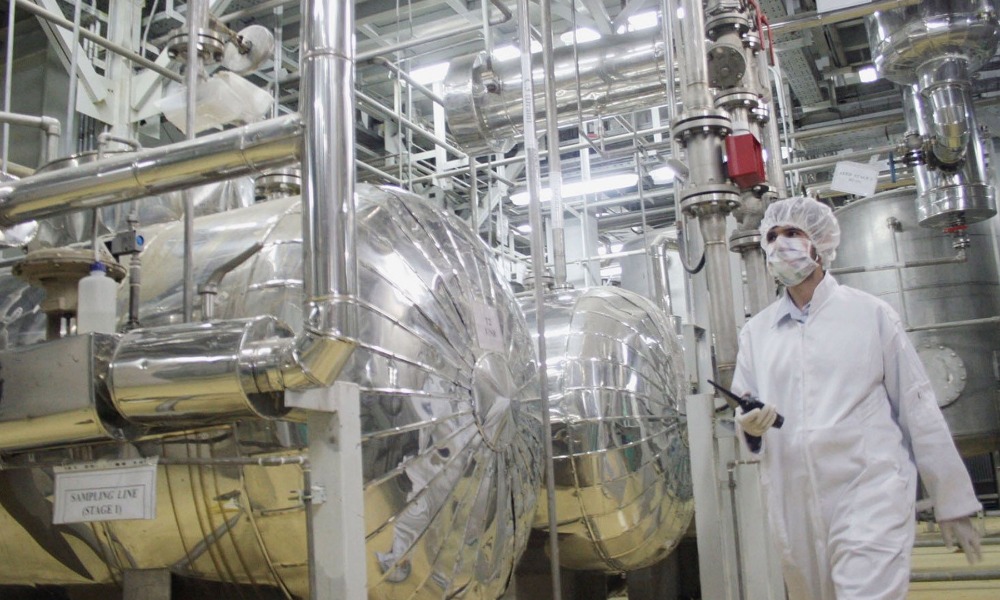
Iran has begun 60% uranium enrichment at its Natanz plant, the country’s nuclear chief said on Friday, days after an explosion at the site that Tehran blamed on Israel.
“We are producing about nine grams of 60% enriched uranium an hour,” Ali Akbar Salehi, head of the Atomic Energy Organization of Iran, told state television.
“But we have to work on arrangements… to drop it to 5 grams per hour. But then we will simultaneously produce 20% (uranium),” Salehi said.
Earlier, parliament speaker Mohammad Baqer Qalibaf said Iranian scientists had successfully started enriching 60 percent uranium at 12:40 a.m. local time (2010 GMT).
“The will of the Iranian nation makes miracles that thwart any conspiracy,” Qalibaf said on Twitter.
In Vienna, a spokesman for the United Nations nuclear watchdog IAEA declined to comment on the Iranian statements about 60% enrichment.
Iran has said its decision to increase enrichment to its highest level ever was in response to sabotage at its nuclear site at Natanz on Sunday by Israel.
Iran and global powers are meeting in Vienna to try to rescue a 2015 nuclear deal abandoned by Washington three years ago, in an effort potentially complicated by Tehran’s decision to ramp up uranium enrichment.
The 2015 agreement sought to make it harder for Iran to develop an atomic bomb – something it denies ever trying to do – in return for lifting sanctions.
Abbas Araqchi, Iran’s chief nuclear negotiator at nuclear talks in Vienna, said on Tuesday that Iran would activate 1,000 advanced centrifuge machines at Natanz.
An Iranian official told Reuters that “60% enrichment will be in small quantity” only.
Multiple Israeli media outlets have quoted unnamed intelligence sources as saying the country’s Mossad spy service carried out the sabotage operation at the Natanz complex. Israel – widely believed to be the only Middle Eastern country with a nuclear arsenal – has not formally commented on the incident.




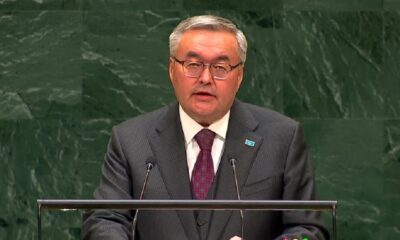




Kazakhstan’s Foreign Minister Mukhtar Tileuberdi has called for pragmatic and coordinated international engagement with Afghanistan, saying the country’s long-term stability is closely linked to the security and sustainable development of Central Asia.
Speaking during the general debate of the 81st session of the United Nations General Assembly in New York on Friday, Tileuberdi said humanitarian assistance to Afghanistan remains essential but alone cannot break the cycle of poverty, displacement and dependency.
He said Kazakhstan supports a “pragmatic, coordinated and step-by-step” approach to international engagement with Afghanistan, with the United Nations playing a central role.
Tileuberdi also said Kazakhstan is working with the UN to operationalize the United Nations Regional Centre for the Sustainable Development Goals for Central Asia and Afghanistan in Almaty.
He said the success of the centre should be measured by the results and assistance it delivers to the region.


Ariana Afghan Airlines increases Kabul-Delhi cargo flights

Khalilzad questions Pakistan’s commitment to Afghan welfare

India, UN envoy discuss Afghanistan’s humanitarian needs

Kazakhstan calls for coordinated international engagement with Afghanistan

Pakistan PM, UN chief discuss Afghanistan amid rising Kabul-Islamabad tensions

Saudi energy group signs major Afghanistan deals covering gas exploration and pipeline plans

Trump floats idea of renaming Atlantic or Pacific Ocean

US hits Egyptian bank branches with Iran sanctions as war marks six months

Nepal flood rescue mission enters critical phase as thousands remain missing

Iranian clubs to face Gulf opponents at neutral venues in Asian Champions League Elite

Exclusive interview with Abdul Latif Mansoor, Minister of MRRD

Tawsia: Overview of Afghanistan’s iron mines

Tahawol: Discussion on fresh Pakistani airstrikes on Afghanistan

Saar: Calls for international support for Afghanistan discussed

Tahawol: Opening of the 81st UN General Assembly Session
-

 Sport5 days ago
Afghanistan to face Japan and Nepal in Asian Games cricket group stage
-

 World4 days ago
CNN, MS NOW and Politico sue Trump, challenging White House ban
-

 Latest News3 days ago
Ariana Afghan Airlines ranks seventh among 45 Central Asian airlines
-

 Latest News4 days ago
UN reiterates call for respect for international law after Kunar airstrikes
-
 Latest News5 days ago
Khalilzad condemns Pakistan airstrikes, says current strategy is not working
-

 Regional3 days ago
US and Iran hold first talks since June after Trump’s ‘annihilation’ threat
-

 Latest News3 days ago
Silk Road highway in Wakhan corridor now reaches the China border
-

 Latest News4 days ago
Afghan Official: Pakistan’s airstrikes will not go unanswered