
Latest News
Key to war and peace lies with Pakistan: Karzai

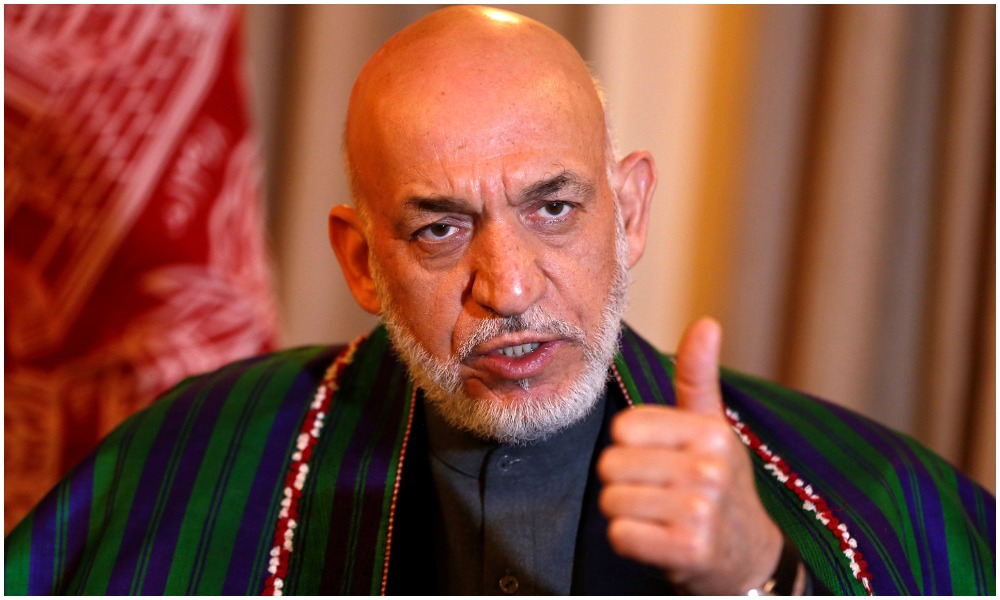
Former Afghan president Hamid Karzai said Afghans are being used against each other by external forces and that Pakistan wants to exert strategic influence in Afghanistan through the Taliban.
In an interview with Germany’s weekly news magazine Der Spiegel, Karzai said: “I realized early into my tenure as president that this war is not our conflict, and we Afghans are just being used against each other – the republic against the Taliban and the Taliban against us.
“Both the Afghan Republic and the Taliban are victims of these external forces. That is why we are suffering,” he said.
Giving background on the events of the past 20 years, Karzai said that after the September 11, 2001, terrorist attacks in the U.S., Washington took the historic opportunity to pursue its global ambitions in Afghanistan.
“Just look at our position on the map. Afghanistan is the most strategically important place in today’s global contest for supremacy. At the same time, Pakistan started using the Taliban to further its own agenda in Afghanistan.”
He noted that there are local and regional conflicts, but according to him what is of key importance is “geostrategic domination”.
Karzai said a key moment for him had been during a meeting with senior U.S. policymakers in Washington in 2013, including former president Jimmy Carter’s now-deceased national security adviser, Zbigniew Brzezinski.
“When I asked whether it was true that America was deliberately promoting radical Islamist forces in Afghanistan and the region, Brzezinski said, yes, they wanted to create as many conflict zones around the USSR as possible, a so-called ‘arc of crisis’, and that the Soviet invasion was a good opportunity to carry this out.
“I replied that Islamist extremism had been gravely strengthened as a result and had grown into the danger it is today. Brzezinski replied that from a historical perspective, the rise of a few Islamists was ‘irrelevant’ compared to the failure of communism,” he said.
Explaining what this contest of world powers has to do with the Taliban, Karzai said: “When things started to go wrong in Afghanistan – around 2005, 2006, when the extremist terrorist attacks started – we talked to the U.S. about the different causes of the violence. We knew that these attacks were being organized by intelligence in Pakistan and carried out by the Taliban.
“The U.S. confirmed this independently, telling us: Yes, the violence is coming from Pakistan, and yes, the Taliban’s sanctuaries are there. But instead of investigating the root cause of the violence and going after it, Washington started to fund Pakistan’s military,” he said.
Karzai said the U.S. was supporting both sides of the conflict at the same time.
“It was dropping bombs on Afghan villages in order to fight the Taliban, while at the same time, funding the very country accused of organizing Taliban terror campaigns.
“Former U.S. President Donald Trump once announced that America had paid $35 billion to Pakistan over these past 19 years. This contradictory policy cost thousands of Afghan lives – troops and civilians alike. Tell me, how was Afghanistan supposed to come to peace?,” he asked.
Asked how the U.S. responded to his take on this, Karzai said there has never been a satisfactory answer.
“Either the U.S. has really miscalculated strategically, or Pakistan, which is so closely linked to China and Great Britain, is simply more important than we are for achieving Washington’s global goals,” he said.
Karzai stated that Pakistan wants to exert strategic influence in Afghanistan through the Taliban adding that this traces back to fears related to the legacy of British colonial rule in the region.
He said however that Afghans want strong relations with Pakistan but that this can only exist if there is peace and stability in Afghanistan and “if the trust deficit is eliminated, and if Pakistan shows itself to be a good neighbor”.
On the disputed border issue – the Durand Line – between the two countries, Karzai said: “We want an open exchange between people on both sides, without border controls, and with freedom of movement, similar to what Europeans have achieved today between Germany and France.”
He went on to state that Pakistan would like Afghanistan to break off relations with India.
“That is impossible. If we give in to this, we would give up our sovereignty and independence. If we want to send our police or our army or our boys and girls to India for training because it is good for our country, we should do so. Conversely, India should not complain if we have friendly relations with Pakistan,” he said.
Asked why Pakistan should give up its fight now, Karzai said: “The Pakistani offensive is in full swing right now. There is fighting going on. But Pakistan must know that it cannot win by force.
“They may kill us. They may send us bombs, they may send us extremists, but that does not kill our spirit. Dominating Afghanistan from the outside has never worked. It didn’t work for the British, it didn’t work for the Soviets, and it didn’t work for the United States, even with all of its resources.
“And the Pakistanis will not succeed either. Right now, we are closing ranks in Afghanistan and organizing resistance. So my appeal to Pakistan is: Let’s be reasonable. Let’s start a civilized relationship between our two countries,” he said.
“We would welcome such a proposal with the utmost interest. At the same time, we have high hopes for the so-called Troika plus, a diplomatic initiative launched by Russia, which also includes China and the United States,” he said.
Karzai said however that both sides need to stop claiming to have the right to represent the Afghan people while holding the guns of a foreign power in their hands.
“My advice is this: Let the Taliban come back. Let them participate and prove themselves in public, whether in the Loya Jirga – the traditional representation of the people – in elections or in a referendum, as is customary around the world. Only then will it become clear who truly represents the people,” he said.
He also pointed out that after the Taliban’s agreement with the U.S. last year, there is no longer any religious or patriotic legitimacy for them to attack their own countrymen or to instigate conflict in Afghanistan.
“Additionally, we cannot preserve the achievements of the last 20 years without the full participation of Afghan women. I am particularly proud and happy about their return to public life, by the way, and so are the Afghan people. We cannot allow Afghan girls not to go to school. The Taliban know that,” he said.
In conclusion he said ultimately, the Taliban are also Afghans, and that he hopes they will stand up to foreign influences where necessary, such as in Pakistan.
“My appeal to Afghans, including the Taliban, is that we come together and finally take our fate into our own hands against all foreign powers,” he said.







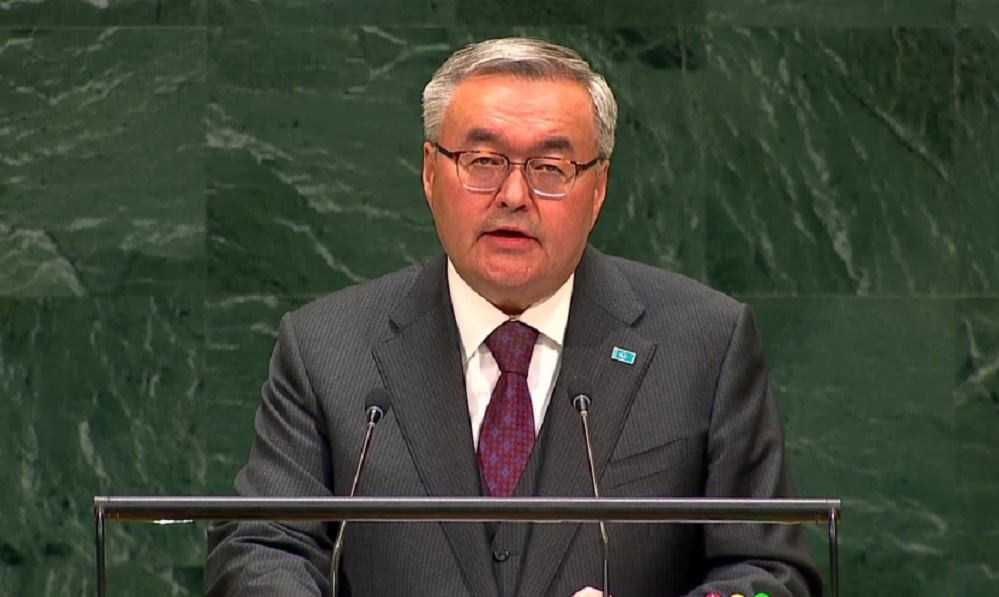
Kazakhstan’s Foreign Minister Mukhtar Tileuberdi has called for pragmatic and coordinated international engagement with Afghanistan, saying the country’s long-term stability is closely linked to the security and sustainable development of Central Asia.
Speaking during the general debate of the 81st session of the United Nations General Assembly in New York on Friday, Tileuberdi said humanitarian assistance to Afghanistan remains essential but alone cannot break the cycle of poverty, displacement and dependency.
He said Kazakhstan supports a “pragmatic, coordinated and step-by-step” approach to international engagement with Afghanistan, with the United Nations playing a central role.
Tileuberdi also said Kazakhstan is working with the UN to operationalize the United Nations Regional Centre for the Sustainable Development Goals for Central Asia and Afghanistan in Almaty.
He said the success of the centre should be measured by the results and assistance it delivers to the region.


Abu Muslim Farah defeat Khurasan Faryab 2-0 in ACL season six

Saar: Concerns over Pakistan’s political crisis discussed

Afghanistan Champions League: Omar Zawak Herat beat Toofan Herat 1-0

Blast in Pakistan’s Dera Ismail Khan kills 11, injures 30

Ariana Afghan Airlines increases Kabul-Delhi cargo flights

Saudi energy group signs major Afghanistan deals covering gas exploration and pipeline plans

Trump floats idea of renaming Atlantic or Pacific Ocean

US hits Egyptian bank branches with Iran sanctions as war marks six months

Nepal flood rescue mission enters critical phase as thousands remain missing

Iranian clubs to face Gulf opponents at neutral venues in Asian Champions League Elite
Saar: Concerns over Pakistan’s political crisis discussed

Exclusive interview with Abdul Latif Mansoor, Minister of MRRD

Tawsia: Overview of Afghanistan’s iron mines

Tahawol: Discussion on fresh Pakistani airstrikes on Afghanistan

Saar: Calls for international support for Afghanistan discussed
-

 World5 days ago
CNN, MS NOW and Politico sue Trump, challenging White House ban
-

 Latest News3 days ago
Ariana Afghan Airlines ranks seventh among 45 Central Asian airlines
-

 Latest News4 days ago
UN reiterates call for respect for international law after Kunar airstrikes
-

 Regional3 days ago
US and Iran hold first talks since June after Trump’s ‘annihilation’ threat
-

 Latest News3 days ago
Silk Road highway in Wakhan corridor now reaches the China border
-

 Latest News4 days ago
Afghan Official: Pakistan’s airstrikes will not go unanswered
-
 Sport4 days ago
Afghan boxing referee heads to China for international festival
-
 Regional5 days ago
G7 foreign ministers call on Iran to stop arming Houthis