
Latest News
Khalilzad opens up about Ghani and ‘selfish’ political elite

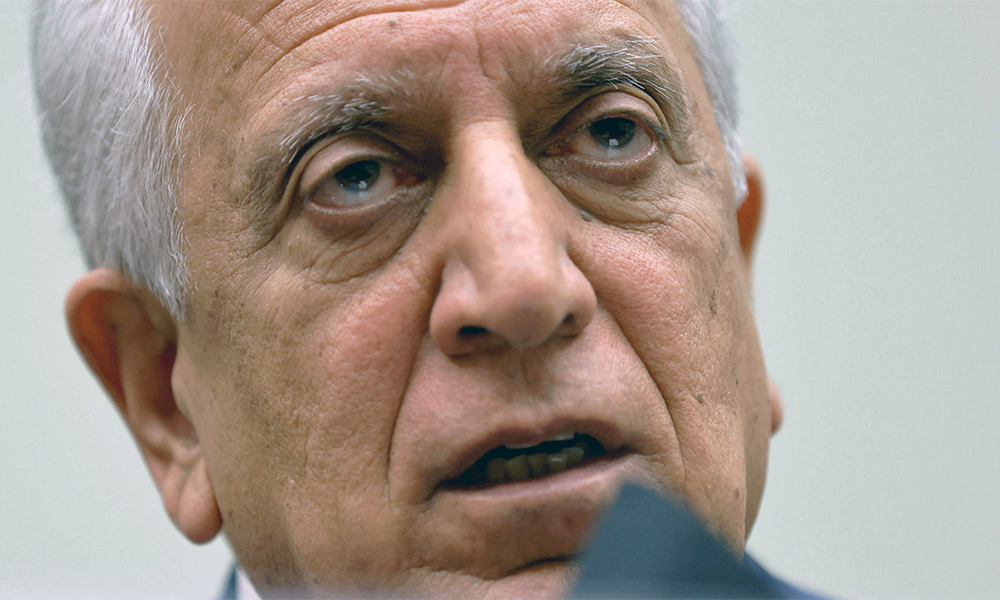
Former US special envoy for Afghanistan Zalmay Khalilzad said former president Ashraf Ghani’s “intransigence,” the Afghan elite’s “selfishness” and Afghan soldiers’ lack of will to fight was to blame for the rapid takeover of the Islamic Emirate of Afghanistan (IEA) in August.
On Ghani’s refusal to change his views, or agree to the formation of a new interim government, Khalilzad said: “We were all surprised by the intransigence of President Ghani in insisting on staying in power till his term ended, despite the fact that he had come out re-elected in a fraudulent election that very few Afghans participated in.”
Addressing a webinar organized by the Carnegie Endowment for International Peace, a Washington think tank, on Wednesday, Khalilzad also acknowledged for the first time publicly that the U.S. had discouraged Afghans from holding the presidential elections that led to Ghani’s winning a second term in office.
According to Khalilzad, the U.S. wanted to establish an interim administration that was acceptable to both sides while Afghan politicians and civil society negotiated a political settlement with the IEA.
Khalilzad said Ghani’s “grand miscalculation” was that he did not believe the U.S. would withdraw from the country.
According to Khalilzad, Ghani thought the U.S. forces and intelligence agencies would stay in Afghanistan as it gave them physical proximity to strategically important countries like China, Russia, Iran and Pakistan.
“I tried to persuade him that President [Donald] Trump was very serious, and he said, ‘No, the intelligence and military told me otherwise,’ ” Khalilzad said.
Khalilzad also stated that Ghani miscalculated his own military’s will to fight.
Once the U.S. announced its decision to withdraw, Ghani told Khalilzad, “now I am free to fight the war the Afghan way. In six months now I will defeat the Taliban because you were fighting it poorly.”
Khalilzad went on to say that the fact that an estimated 300,000-strong Afghan army melted away in front of 60,000 IEA fighters was the result of a lack of morale, corruption and poor treatment of the soldiers on the front lines.
He said this also might have been because the soldiers “didn’t believe” in the cause, while the IEA fighters felt otherwise.
Khalilzad also blasted what he called the Afghan elite’s “selfish, self-centered, corrupt” behavior.
“I am disappointed that the elite that we worked with; they didn’t rise to the occasion; this golden opportunity that the American engagement provided,” he said.
In terms of going forward, Khalilzad advocated a robust diplomatic engagement with the IEA that includes an agreement on a “road map that takes into account the trust or mistrust of each other and the behavior that needs to take place over a time period.”
He also said that many in the US want the IEA to suffer and their government to collapse, because “we did not succeed in defeating them, and that has left a bad taste in people’s mouths.”
But he warned that a collapse of government in Afghanistan would lead to a civil war and a humanitarian catastrophe that would provide space for terrorist groups to flourish.
He said the IEA had shown, in the 18 months after signing the Doha agreement, that they could keep their word by not killing a single American even though U.S. air attacks in defense of Afghan forces killed hundreds or even thousands of Taliban during that period.
Khalilzad also said the IEA could benefit from outside help on how to deal with Daesh in Afghanistan.







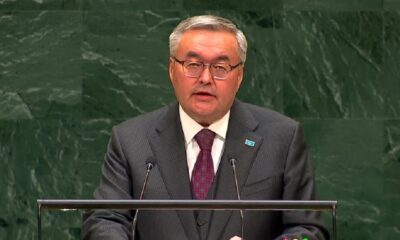




Kazakhstan’s Foreign Minister Mukhtar Tileuberdi has called for pragmatic and coordinated international engagement with Afghanistan, saying the country’s long-term stability is closely linked to the security and sustainable development of Central Asia.
Speaking during the general debate of the 81st session of the United Nations General Assembly in New York on Friday, Tileuberdi said humanitarian assistance to Afghanistan remains essential but alone cannot break the cycle of poverty, displacement and dependency.
He said Kazakhstan supports a “pragmatic, coordinated and step-by-step” approach to international engagement with Afghanistan, with the United Nations playing a central role.
Tileuberdi also said Kazakhstan is working with the UN to operationalize the United Nations Regional Centre for the Sustainable Development Goals for Central Asia and Afghanistan in Almaty.
He said the success of the centre should be measured by the results and assistance it delivers to the region.


Saar: Concerns over Pakistan’s political crisis discussed

Afghanistan Champions League: Omar Zawak Herat beat Toofan Herat 1-0

Blast in Pakistan’s Dera Ismail Khan kills 11, injures 30

Ariana Afghan Airlines increases Kabul-Delhi cargo flights

Khalilzad questions Pakistan’s commitment to Afghan welfare

Saudi energy group signs major Afghanistan deals covering gas exploration and pipeline plans

Trump floats idea of renaming Atlantic or Pacific Ocean

US hits Egyptian bank branches with Iran sanctions as war marks six months

Nepal flood rescue mission enters critical phase as thousands remain missing

Iranian clubs to face Gulf opponents at neutral venues in Asian Champions League Elite
Saar: Concerns over Pakistan’s political crisis discussed

Exclusive interview with Abdul Latif Mansoor, Minister of MRRD

Tawsia: Overview of Afghanistan’s iron mines

Tahawol: Discussion on fresh Pakistani airstrikes on Afghanistan

Saar: Calls for international support for Afghanistan discussed
-

 World5 days ago
CNN, MS NOW and Politico sue Trump, challenging White House ban
-

 Latest News4 days ago
UN reiterates call for respect for international law after Kunar airstrikes
-

 Latest News3 days ago
Ariana Afghan Airlines ranks seventh among 45 Central Asian airlines
-
 Latest News5 days ago
Khalilzad condemns Pakistan airstrikes, says current strategy is not working
-

 Regional3 days ago
US and Iran hold first talks since June after Trump’s ‘annihilation’ threat
-

 Latest News3 days ago
Silk Road highway in Wakhan corridor now reaches the China border
-

 Latest News4 days ago
Afghan Official: Pakistan’s airstrikes will not go unanswered
-

 Sport4 days ago
Afghan boxing referee heads to China for international festival