
Latest News
Khalilzad’s meetings continue, this time with peace advocates

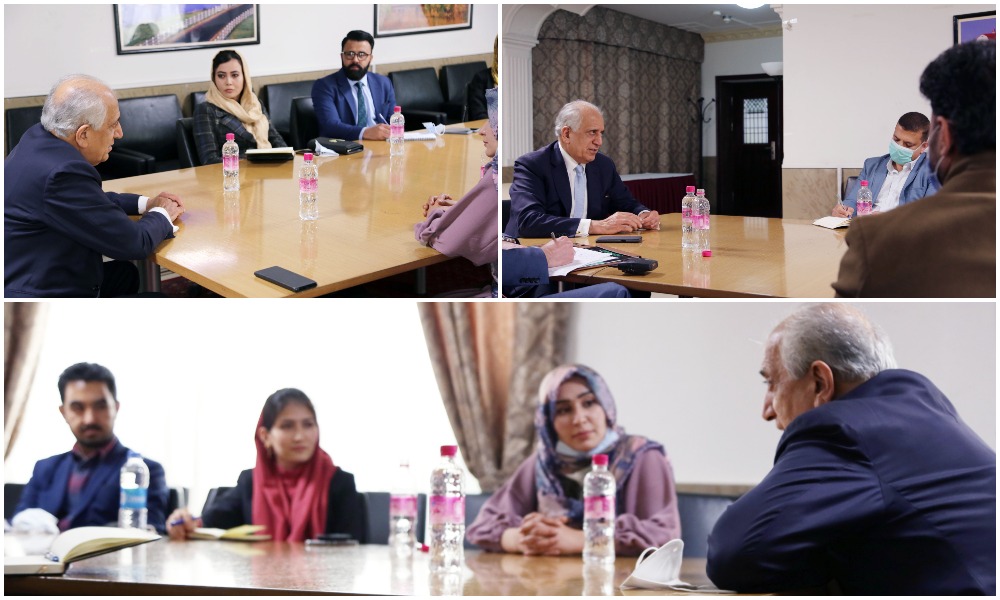
US Special Representative for Afghanistan Reconciliation Zalmay Khalilzad met with Afghan peace advocates on Tuesday to hear their views on the importance of men and youth working together with women to protect the gains of the last two decades.
They also discussed strategies to accelerate peace and reconciliation efforts in Afghanistan.
Khalilzad also met with Afghan civil society leaders to hear their views on how to protect girls’ and women’s rights in any future political agreement leading to peace in Afghanistan where he noted that women leaders are vital to peace and reconciliation in the country.
Khalilzad also met with media executives about recent assassinations and the impact on media reporting and press freedom.
On this issue, Khalilzad called for the expeditious investigation and prosecution of the perpetrators for all these targeted killings.
During the meeting with Afghan media leaders Khalilzad condemned the ongoing violence and threats and called for increased protection for journalists and media workers throughout Afghanistan.
Khalilzad’s meetings coincided with the release of a statement Tuesday by Amnesty International (AI) on the Afghan government’s failure to deliver on their pledge to establish a functional body dedicated to protecting human rights defenders in Afghanistan.
In the statement, the global rights watchdog said more than three months ago a Presidential Decree was issued on the establishment of a Joint Commission for the Protection of Human Rights Defenders.
However “no practical steps have been taken to make it an effective protection mechanism, with a lack of information forthcoming on any plan or strategy to address the escalating threat faced by members of Afghan civil society”, the statement read.
Citing UNAMA figures, AI pointed out that an already “dire situation for Afghanistan’s human rights community has significantly worsened over recent months”, with no fewer than 11 human rights defenders and media workers killed in targeted attacks between the start of peace negotiations on 12 September 2020 and 31 January 2021.
The delay in having established a functioning mechanism “has already cost lives and there is no sign of the violence abating,” their statement read.
Meanwhile, Yamini Mishra, Amnesty International’s Asia-Pacific Director, said: “The announcement of the Joint Commission was a vital step towards providing human rights defenders across the country with the support and security they so desperately need.
“But it’s a body that currently exists in name only. In more than three months, during which we have witnessed a frenzied escalation of killings, attacks and threats against activists, the Commission has made no tangible progress or taken any meaningful action,” said Mishra.
“This delay has already cost lives and there is no sign of the violence abating. The Joint Commission must urgently expedite its work and prioritize the immediate security needs of human rights defenders, investigate all cases of threats, attacks and other forms of intimidation, and hold those responsible to account.”
Amnesty International also called on the Joint Commission to ensure that, where necessary, human rights defenders are provided with adequate protection measures including relocation, relief and psychosocial support.
According to UNAMA figures, 14 human rights defenders were killed in Afghanistan in 2020. This includes Mohammad Yousuf Rasheed, CEO of Free and Fair Election Forum of Afghanistan, who was shot dead on 23 December 2020 in morning rush-hour traffic in Kabul along with his driver, days after the Joint Commission was established.
According to its mandate, the Joint Commission has been established ‘for the purpose of strengthening human rights advocacy and addressing the national and international concerns of human rights-related issues in Afghanistan’.
“To achieve its goals and become worthy of its name, the Joint Commission must be provided with the necessary human and financial resources, and be fully supported by both the Afghan government and the international community,” said Mishra.












Kazakhstan’s Foreign Minister Mukhtar Tileuberdi has called for pragmatic and coordinated international engagement with Afghanistan, saying the country’s long-term stability is closely linked to the security and sustainable development of Central Asia.
Speaking during the general debate of the 81st session of the United Nations General Assembly in New York on Friday, Tileuberdi said humanitarian assistance to Afghanistan remains essential but alone cannot break the cycle of poverty, displacement and dependency.
He said Kazakhstan supports a “pragmatic, coordinated and step-by-step” approach to international engagement with Afghanistan, with the United Nations playing a central role.
Tileuberdi also said Kazakhstan is working with the UN to operationalize the United Nations Regional Centre for the Sustainable Development Goals for Central Asia and Afghanistan in Almaty.
He said the success of the centre should be measured by the results and assistance it delivers to the region.


Abu Muslim Farah defeat Khurasan Faryab 2-0 in ACL season six

Saar: Concerns over Pakistan’s political crisis discussed

Afghanistan Champions League: Omar Zawak Herat beat Toofan Herat 1-0

Blast in Pakistan’s Dera Ismail Khan kills 11, injures 30

Ariana Afghan Airlines increases Kabul-Delhi cargo flights

Saudi energy group signs major Afghanistan deals covering gas exploration and pipeline plans

Trump floats idea of renaming Atlantic or Pacific Ocean

US hits Egyptian bank branches with Iran sanctions as war marks six months

Nepal flood rescue mission enters critical phase as thousands remain missing

Iranian clubs to face Gulf opponents at neutral venues in Asian Champions League Elite
Saar: Concerns over Pakistan’s political crisis discussed

Exclusive interview with Abdul Latif Mansoor, Minister of MRRD

Tawsia: Overview of Afghanistan’s iron mines

Tahawol: Discussion on fresh Pakistani airstrikes on Afghanistan

Saar: Calls for international support for Afghanistan discussed
-

 World5 days ago
CNN, MS NOW and Politico sue Trump, challenging White House ban
-

 Latest News3 days ago
Ariana Afghan Airlines ranks seventh among 45 Central Asian airlines
-

 Latest News4 days ago
UN reiterates call for respect for international law after Kunar airstrikes
-

 Regional3 days ago
US and Iran hold first talks since June after Trump’s ‘annihilation’ threat
-

 Latest News3 days ago
Silk Road highway in Wakhan corridor now reaches the China border
-

 Latest News4 days ago
Afghan Official: Pakistan’s airstrikes will not go unanswered
-

 Sport4 days ago
Afghan boxing referee heads to China for international festival
-

 Regional5 days ago
G7 foreign ministers call on Iran to stop arming Houthis