
World
Ukrainians put out fire at nuclear complex after Russian attack

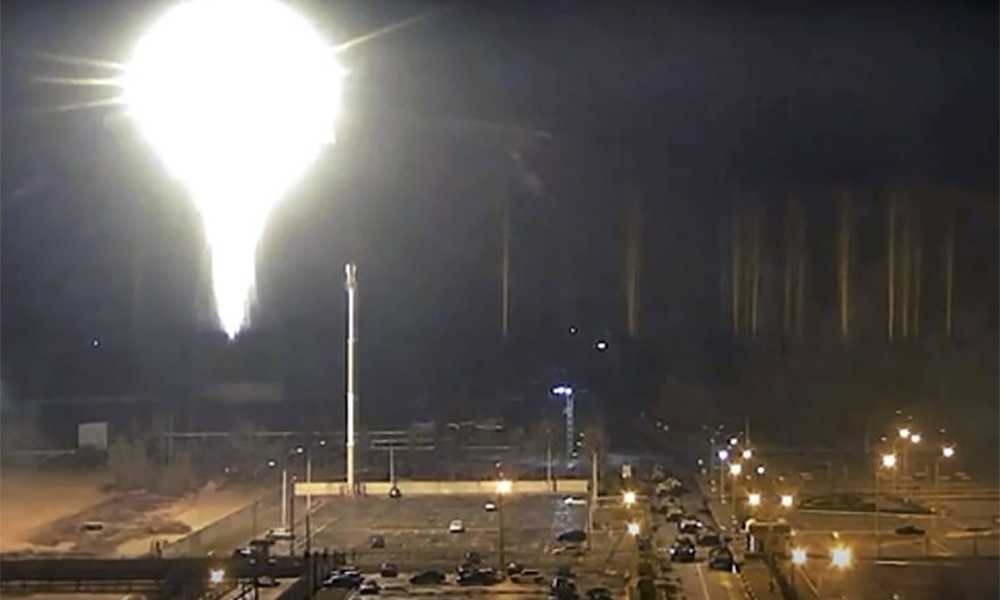
A fire that broke out in a training building near the largest nuclear power plant in Europe during intense fighting between Russian and Ukrainian forces has been extinguished, Ukraine’s state emergency service said on Friday.
US Energy Secretary Jennifer Granholm said there was no indication of elevated radiation levels at the Zaporizhzhia plant, which provides more than a fifth of total electricity generated in Ukraine.
Earlier, a video feed from the plant verified by Reuters showed shelling and smoke rising near a five-story building at the plant compound, Reuters reported.
The footage shot at night showed one building aflame, and a volley of incoming shells, before a large candescent ball lit up the sky, exploding beside a car park and sending smoke billowing across the compound. It was not immediately clear who was in control of the plant.
“Europeans, please wake up. Tell your politicians – Russian troops are shooting at a nuclear power plant in Ukraine,” Ukrainian leader Volodymyr Zelenskiy said in a video address.
Zelenskiy said Russian tanks had shot at the nuclear reactor plants, though there was no evidence cited that they had been hit.
The mayor of the nearby town of Energodar about 550 km southeast of Kyiv said fierce fighting and “continuous enemy shelling” had caused casualties in the area, without providing details.
Thousands of people are believed to have been killed or wounded and more than one million refugees have fled Ukraine since Russian President Vladimir Putin last Thursday launched the biggest attack on a European state since World War Two, Reuters reported.
Early reports of the incident at the power plant sent financial markets in Asia spiralling, with stocks tumbling and oil prices surging further.
“Markets are worried about nuclear fallout. The risk is that there is a miscalculation or over-reaction and the war prolongs,” said Vasu Menon, executive director of investment strategy at OCBC Bank.
Russia has already captured the defunct Chernobyl plant, about 100 km north of Kyiv, which spewed radioactive waste over much of Europe when it melted down in 1986. The Zaporizhzhia plant is a different and safer type, some analysts said.
On Thursday, Russia and Ukraine negotiators agreed to the need for humanitarian corridors to help civilians escape and to deliver medicines and food to the areas where fighting was the fiercest.
Ukrainian presidential adviser Mykhailo Podolyak said a temporary halt to fighting in select locations was also possible.
The negotiators will meet again next week, the Belarusian state news agency Belta quoted Podolyak as saying.
Only one Ukrainian city, the southern port of Kherson, has fallen to Russian forces since the invasion was launched on February 24, but Russian forces continue to surround and attack other cities.







World
Trump took secret flight out of Turkey due to Iran threat, the Washington Post reports
The trip to NATO was the first international travel for the new plane, whose speedy upgrades triggered questions over its cost and security, and took place as hostilities escalated with Iran, which borders Turkey.

U.S. President Donald Trump departed on a secret military flight from Turkey last month when the White House said he was flying aboard Air Force One, an extraordinary move prompted by an Iranian assassination threat, the Washington Post reported Monday.
Trump had taken the newly renovated Qatari-donated jet to Ankara for the NATO summit but he unexpectedly used an older Air Force One when departing the country, a move that prompted questions about the newer plane’s security, Reuters reported.
The trip to NATO was the first international travel for the new plane, whose speedy upgrades triggered questions over its cost and security, and took place as hostilities escalated with Iran, which borders Turkey.
Before departing Ankara, Trump said on Truth Social that he would use an older baby blue Air Force One plane “for old time’s sake” to RAF Mildenhall in Britain while the new plane stopped at the same base so U.S. service members stationed there could tour the aircraft.
After Trump boarded the old Air Force One in front of cameras in Ankara, he was secretly shuttled by an airport catering truck to a smaller plane, an Air Force C-32A, the Post reported citing a U.S. official familiar with the operation and corroborating material it reviewed.
The deception operation was triggered by a credible threat to Trump, the Post reported. A similar operation had taken place in 2000, when President Bill Clinton used an unmarked executive jet to fly into Pakistan while sending his formal Air Force One as decoy.
On this occasion, the journalists who thought they were traveling with Trump on the older Air Force One, which was effectively used as a decoy, reported being advised to keep their window shades in the press cabin closed. The Post said aside from reporters, some White House staff also believed that the president was on board.
When asked later by reporters why they had to keep their shades shut during the flight, Trump said it was because they were “probably on a dangerous flight.” He went onto say: “But if I go, you go. Right?”
The C-32A carrying Trump flew to Britain and arrived at around 10:20 p.m. while the older Air Force One and media, arriving minutes later, the Post reported. It was not clear, the paper said, how Trump was moved from the C-32A back to the older Air Force One.
Trump’s traveling press pool reported he climbed down the stairs of the older Air Force One at 10:56 p.m. UK local time.
He gave press a peace sign but didn’t walk over to talk to them. He then spent some time greeting service members before walking to the new, Qatar-donated plane.
When asked for comment on the revelation of a secret flight on a third plane, the White House provided a statement from Communications Director Steve Cheung saying the Qatari-donated jet has been fitted with high-level security protocols that ensure the safety of the president and his staff.
“As the President has said recently, there are many enemies of America who have their sights on him, and we use every tool at our disposal to address those threats,” Cheung said. It was the same statement provided to the Post.
The Pentagon did not immediately respond to a request for comment.
The new plane, with red, white, dark blue and gold livery chosen by Trump, is a Boeing 747 gifted to the United States by Qatar last year and refitted by defense contractor L3Harris Technologies. It was intended to serve as a temporary placement while Boeing (BA.N) struggled to deliver long-delayed next-generation Air Force One planes.
World
More than 100 killed after strongest quake this century hits western Colombia
The U.S. Geological Survey said the 7.4-magnitude quake struck at a depth of 107 km (66 miles). Colombia’s Geological Service said it was the strongest earthquake recorded in the country in the 21st century.
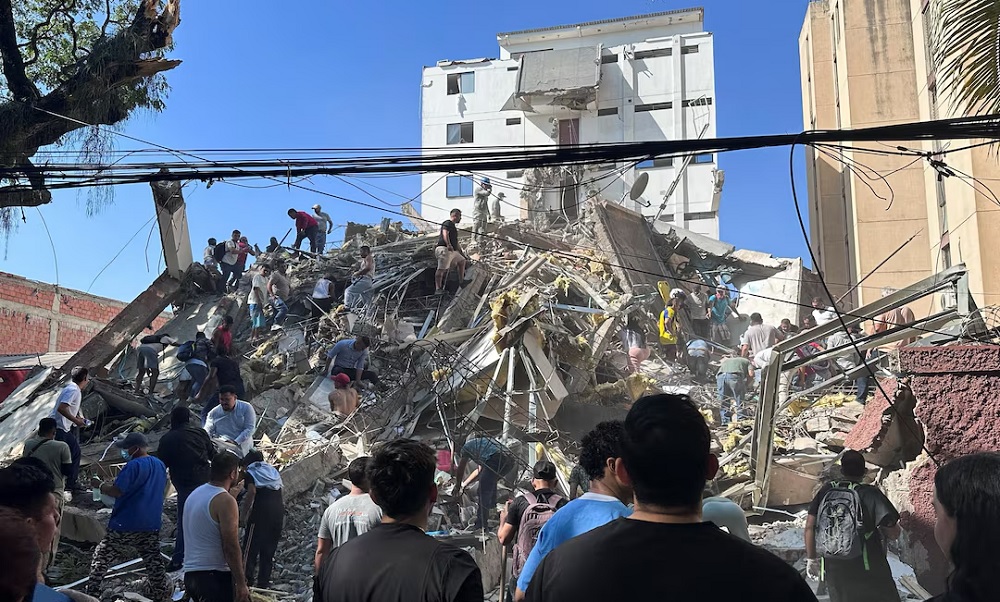
More than 100 people were killed after a powerful earthquake struck western Colombia on Monday, toppling buildings, damaging hospitals and infrastructure and trapping people beneath the rubble in the country’s strongest earthquake this century.
The quake struck just days after Abelardo De La Espriella was sworn in as president, thrusting the new administration into its first major crisis, with memories still fresh of devastating twin earthquakes in neighboring Venezuela in June, Reuters reported.
“The national government has all of its capabilities deployed to protect lives, assist affected communities and deliver aid wherever it is needed,” he said in a national address around 1 p.m. local time, upon declaring a national state of emergency and giving a death toll of 111. “The first priority is rescuing the people trapped under the rubble.”
De La Espriella visited Quibdo, the capital of coastal Choco province, where he promised rent subsidies for those who have lost homes, and then traveled to Cali, western Colombia’s largest city.
Though he had been expected to give an updated national death toll on Monday evening, De La Espriella offered only figures for Valle del Cauca province, where Cali is located, saying 35 people had died there, while 700 had been injured. Some local media have cited a national total of 132 deaths, though the origin of the figure is unclear.
The U.S. Geological Survey said the 7.4-magnitude quake struck at a depth of 107 km (66 miles). Colombia’s Geological Service said it was the strongest earthquake recorded in the country in the 21st century.
As night fell, rescue workers and volunteers with headlamps hurried to find people still trapped under rubble.
Authorities in Cali, Armenia and Manizales announced curfews, with Cali’s mayor saying threats of looting had forced him to deploy police and military personnel to the streets. De La Espriella promised 1,000 additional security personnel for the city.
Cali authorities said the Petronio Alvarez festival, an annual celebration of Pacific music which was due to start on Wednesday, has been postponed.
Video broadcast by Caracol Television showed a group of people pulling a small baby covered in dust from under a pile of rubble. Caracol reported the six-month-old girl and her mother were rescued from under a five-story building in Cali.
Video from Cali also showed rescue workers rappelling people out from the windows of a local hospital.
BUILDINGS CRUMBLE, AIRPORTS CLOSED
In the hard-hit city of Pereira, rescue workers told local television they were in contact with a young boy trapped under a bakery, and crane operators were working to remove badly damaged parts of buildings.
A four-story building crumbled in Pereira during the quake, according to Reuters-verified video, while footage from Manizales showed one of the side towers of the city’s landmark neo-Gothic cathedral collapsing and scattering debris onto nearby streets.
Reuters video showed rescue workers, police and volunteers shoveling debris by hand and loading rubble into trucks as they searched for survivors trapped beneath collapsed buildings. Other footage showed damage to residential towers and emergency-service facilities, with debris crashing onto ambulances parked below.
Mauricio Andrade, a firefighter in Cali, said his team had rescued two adult women and two children from a collapsed building. As he spoke to Reuters, his team was preparing to rescue more people from the rubble.
“They are alive,” he said. “We are making space so we can free them and get them out.”
Carmen Yasmin Garcia, 43, a Cali resident and rescue volunteer, said her group had helped seven people out of a fallen building but there were still four people and a dog trapped underneath.
“A moment ago there was scratching but now we can’t hear anything, we still have faith that the dog is alive and we can get these people out,” she said. “The more people lending a hand the better.”
Saul Paz, 69, a resident of a Cali residential complex that partially collapsed, told Reuters he had been in the dining room with his son and wife when the shaking began.
“I think if it had lasted five seconds more there would be nothing left,” he said. “There are people who went to bed last night with a house and a car and today they won’t have anything.”
Colombia’s civil aviation authority suspended operations at several airports in the region, including Pereira, Manizales, Quibdo, Armenia, Cartago and Buenaventura, while engineers carried out structural inspections.
RING OF FIRE
Colombia sits along the seismically active Pacific Ring of Fire and records thousands of mostly minor earthquakes each month.
Northwestern University seismologist Suzan van der Lee said the quake’s powerful magnitude, inland location and strike-slip motion may have amplified damage in populated valleys despite its considerable depth.
“This one was far below the crust, and in theory it shouldn’t cause as much shaking. At this magnitude, it did actually cause a lot of shaking,” she said, adding Colombia is particularly difficult for seismologists to analyze due to the interaction of several major tectonic plates.
The Colombian Geological Service said it had recorded 21 aftershocks by late Monday and warned that additional tremors were likely.
Colombia’s coffee region was devastated by a magnitude 6.2 earthquake in 1999 that killed more than 1,000 people, particularly around Armenia and Pereira.

A major fire at a sofa manufacturing factory in Riyadh, the Saudi capital, killed 16 Bangladeshi migrant workers, officials in Dhaka said on Monday.
The fire broke out on Sunday in the Musa Sanaiya industrial area, Reuters reported.
Bangladesh’s Ministry of Foreign Affairs is monitoring the situation, while officials from the Bangladesh Embassy in Riyadh are working with Saudi authorities to complete the repatriation formalities.
Expatriates’ Welfare and Overseas Employment Minister Ariful Haque Choudhury has instructed officials to bring back the bodies as soon as possible and ensure necessary government assistance and compensation for the bereaved families.
With around 3.5 million Bangladeshis living in Saudi Arabia, the country remains the largest destination for Bangladeshi migrant workers, who sent home more than $2.7 billion in remittances last year.


UNESCO: 2.4 million Afghan girls denied education since 2021

New attacks on shipping as Iran war talks hit fresh impasse

Tahawol: Hamid Karzai’s call for Afghan reconciliation discussed

Saar: Preparations for IEA’s fifth anniversary discussed

Russian firm eyes investment in Afghanistan’s power plants

Pakistan’s governance system has ‘collapsed’: Mohsin Naqvi

Spain sweep FIFA World Cup player awards after historic triumph

Mango growers suffer heavy losses as exports fall and climate takes its toll

Countdown begins for inaugural Afghanistan Wrestling Premier League

Iran, Afghanistan and Tajikistan discuss expanding regional transit cooperation
Tahawol: Hamid Karzai’s call for Afghan reconciliation discussed
Saar: Preparations for IEA’s fifth anniversary discussed

Tahawol: Iran’s acknowledgment of Afghanistan’s cooperation discussed

Saar: Five years of Islamic Emirate rule in Afghanistan reviewed

Tahawol: Afghanistan: An Alternative to the Strait of Hormuz?
-

 Sport3 days ago
Afghanistan secure direct qualification for 2027 Men’s ODI World Cup
-
 Regional4 days ago
Goods transporters to go on strike from Saturday after talks with Pakistan govt fail
-
 Latest News3 days ago
Pakistan-backed armed groups in Balochistan using former Afghan government forces: report
-

 Sport4 days ago
Rashid Khan takes six as Afghanistan thrash Ireland by 92 runs
-
 World4 days ago
US Senate passes Russia sanctions championed by Graham; US House next
-

 Sport5 days ago
Afghanistan ends continental futsal championship with dominant win over New Zealand
-

 Business5 days ago
Uzbekistan, Kazakhstan target Afghanistan in push to expand regional trade
-

 Regional5 days ago
Trump says he thinks war with Iran will end ‘pretty soon’