
Latest News
US intelligence chief warns of ‘direct threat’ from suspected terrorists inside the country


The U.S. director of national intelligence has warned of what she described as a “direct threat” from suspected terrorists living inside the country, accusing the Biden administration of failing to properly vet thousands of individuals who entered the United States in recent years.
Speaking to Fox News on Saturday, Tulsi Gabbard claimed that around 18,000 known or suspected terrorists were allowed into the country, alleging serious shortcomings in vetting procedures. “The Biden administration did not take their vetting responsibilities seriously,” she said, adding that authorities may still be unaware of additional cases.
Citing figures from the National Counterterrorism Center, Gabbard said approximately 2,000 of those individuals are Afghan nationals who entered the U.S. following the 2021 withdrawal from Afghanistan.
She said alleged whistleblowers told her that screening processes were rushed during that period. According to her account, officials were instructed to accelerate admissions and forego the thorough vetting normally required.
Gabbard described the situation as “devastating,” arguing that it has created security risks for Americans. She referenced a shooting just before Thanksgiving in which two U.S. National Guard members were shot, one fatally, with the suspect identified as an Afghan national.
However, reports and official reviews have previously pointed to broader circumstances surrounding the evacuation and resettlement effort. Following the chaotic U.S. withdrawal from Afghanistan, a review conducted under then-President Joe Biden concluded that the administration was constrained by a withdrawal agreement negotiated during President Donald Trump’s first term, as well as by inadequate planning for evacuations. The report cited a lack of preparation for removing remaining troops and assisting U.S. allies, despite an approaching deadline.
Media reports have also noted that the Trump administration had several years to expand Special Immigrant Visa programs for Afghan allies but instead slowed processing and weakened systems designed to support refugee admissions. Many Afghans who entered the U.S. after 2021 had worked alongside American forces and feared retaliation if they remained in Afghanistan.
Despite heightened political rhetoric following last month’s shooting, there is no evidence that the vast majority of Afghans resettled in the United States since 2021 pose a security threat, with most described by officials and community leaders as law-abiding.
Separately, authorities in the U.S. state of Rhode Island are investigating a mass shooting near Brown University in Providence that left at least two people dead and several others injured. Officials said the incident occurred shortly after 4 p.m. local time on Saturday, prompting a large-scale emergency response involving local police, state authorities, and federal agencies including the FBI and the Bureau of Alcohol, Tobacco, Firearms and Explosives.
Providence Mayor Brett Smiley said seven victims remain hospitalized in stable condition, one is in critical but stable condition, and another has been released. A suspect linked to the shooting was detained on Sunday, and the investigation remains ongoing.






Afghanistan’s economy continued to grow modestly in June 2026, supported by resilient domestic demand, stable prices and stronger revenue collection, but the pace of growth remains insufficient to improve living standards, according to the World Bank’s latest Afghanistan Economic Monitor.
The report said economic growth has failed to keep pace with rapid population growth, driven in part by the return of millions of Afghans, resulting in a 5.6% decline in per capita income and mounting pressure on household welfare.
Headline inflation eased to 7.6% in June from 8.0% in May, as food prices fell with the start of the domestic harvest season and continued imports. However, core inflation rose to 8.3%, reflecting persistent pressures from housing and healthcare costs.
The World Bank said the Afghan currency depreciated modestly to AFN 64.4 per U.S. dollar in June, although it remained stronger than a year earlier. It noted that improved inflation differentials with neighboring countries enhanced Afghanistan’s external price competitiveness.
The report also highlighted continued disruptions to regional trade caused by the closure of key Durand Line crossings with Pakistan and geopolitical tensions in the Middle East. While businesses increasingly relied on Central Asian transit routes, Afghanistan’s trade deficit widened 11% from the previous month and 19% year-on-year to $984.3 million in June.
Exports totaled $77.7 million in June, down 2% from May but up 19% compared with a year earlier. Textile exports surged 304% year-on-year, while food exports declined month-on-month and coal exports remained negligible. India remained Afghanistan’s largest export destination, accounting for 33.6% of total exports.
Imports rose to $1.06 billion, up 10% from May and 19% from a year earlier, driven by stronger demand and a shift toward Central Asian transit corridors, which accounted for 48% of imports. Iran remained Afghanistan’s largest import source, supplying 31% of total imports.
On public finances, domestic revenue reached AFN 17.3 billion in June, down from the previous month but 8.7% higher for the fiscal year to date, supported by improved tax administration and higher non-tax revenues. Public expenditure declined to AFN 17.5 billion, while the fiscal position remained in surplus as spending continued to be limited by available domestic revenues.
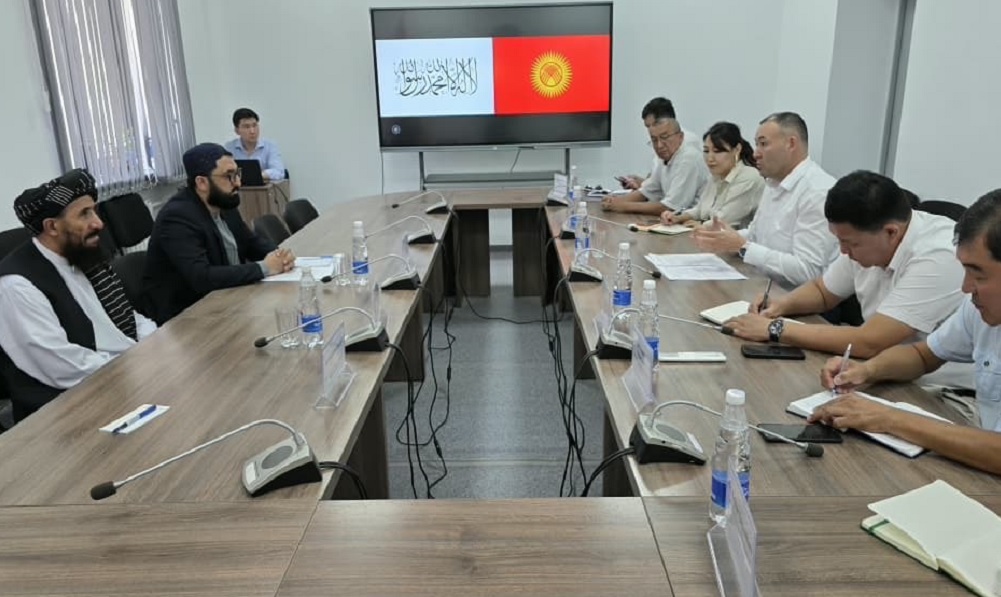
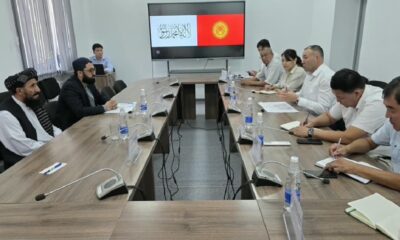
Officials from Afghanistan and Kyrgyzstan have discussed expanding bilateral cooperation in strategic studies, economic relations and academic exchanges during a meeting in Bishkek.
Abdulhai Qanit, head of the Islamic Emirate’s Center for Strategic Studies, met with Adilbek Uulu Shomkarbek, director of Kyrgyzstan’s National Institute for Strategic Initiatives, in a meeting attended by the acting head of the Afghan Embassy in Bishkek, Abdul Shukoor Haqqani.
According to Afghanistan’s Center for Strategic Studies, the talks focused on strengthening political, economic, academic and research cooperation between the two countries. The two sides also discussed expanding exchanges between their research institutions, regional developments and other issues of mutual interest.
Qanit briefed the Kyrgyz delegation on recent developments in Afghanistan, the Islamic Emirate’s foreign policy priorities, efforts to expand economic cooperation and initiatives aimed at strengthening scientific and academic ties. He emphasized the importance of promoting joint research projects and deepening strategic collaboration between the two countries.
Shomkarbek expressed support for enhancing academic, economic and intellectual cooperation with Afghanistan, saying sustained engagement between research institutions would help foster mutual understanding and contribute to greater regional cooperation.
Both sides reaffirmed their commitment to further strengthening bilateral relations and maintaining close cooperation on issues of shared interest.
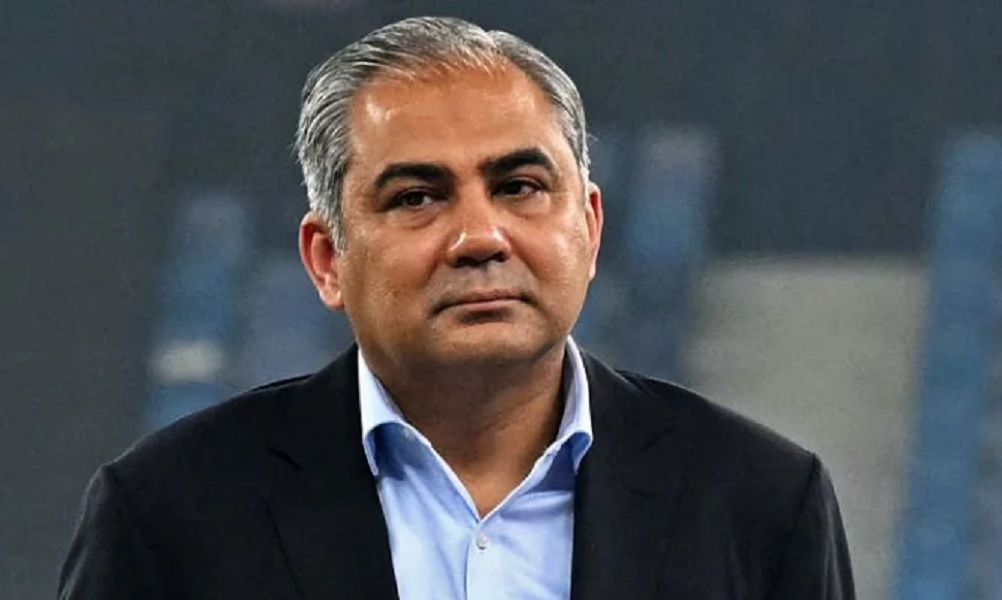
Pakistan’s Interior Minister Mohsin Naqvi said on Thursday that the country’s existing governance system has “collapsed” and is no longer capable of addressing national challenges, urging sweeping administrative reforms, including the creation of new administrative units.
Speaking at the Pakistan Economic Summit in Islamabad, Naqvi said the current system was unable to solve the country’s problems and warned that Pakistan would continue facing the same issues over the next decade without structural reforms.
“The system we are living under has collapsed. Problems cannot be solved through it,” he said. “If this system continues, we will still be sitting here 10 years from now discussing the same issues.”
Naqvi said Pakistan needed to address its underlying governance challenges by decentralizing authority and creating new administrative units, whether designated as provinces or under another name.


Trump says deal reached to disarm Hamas, Israeli support for plan remains uncertain

World Bank: Afghanistan’s economic growth too weak to improve living standards

Afghanistan, Kyrgyzstan discuss boosting strategic, economic and academic cooperation

Pakistan’s governance system has ‘collapsed’: Mohsin Naqvi

Drone strike at Egypt port near Suez Canal ignites new shipping risks

India offers 1,000 online scholarships for Afghan students for 2026-27 academic year

Cricket world pays tribute to Afghanistan fast bowler Shapoor Zadran

Turkey spent over $120 million to prepare airport for Qatar-donated U.S. presidential aircraft

Thousands pay final respects as Afghan cricketer Shapoor Zadran buried in Kabul

Shapoor Zadran’s body returns to Kabul as family, teammates and officials pay tribute

Tahawol: Germany’s deportation of non-criminal Afghan refugees

Saar: Discussion on ongoing US-Iran tensions

Tahawol: Calls for implementation of development projects in Afghanistan

Saar: Deporting Afghan refugees from Germany discussed

Tahawol: Iran–US relations amid recent developments
-
 Business4 days ago
Iran seeks to establish free trade zone with Afghanistan and China
-
 Latest News4 days ago
Uzbekistan issues 5,000 visas to Afghan citizens this year
-
 Latest News4 days ago
Afghanistan’s Swiss fund grows to $4.2 billion: Ahadi
-
 Latest News5 days ago
Afghan PM, Uzbek Deputy PM hold talks on expanding economic and political cooperation
-

 Sport5 days ago
Afghan team arrives in England for training camp ahead of Ireland ODI series
-

 Latest News3 days ago
Badakhshan information chief killed in armed attack; tribal elder also slain in Nimroz
-
 Latest News4 days ago
Islamic Emirate launches media initiative, says Badakhshan security situation under control
-
 Latest News3 days ago
UNAMA: 57 civilians killed in Pakistan attacks in three months