
Latest News
Arrival of ‘sticky bombs’ in Indian Kashmir sets off alarm bells

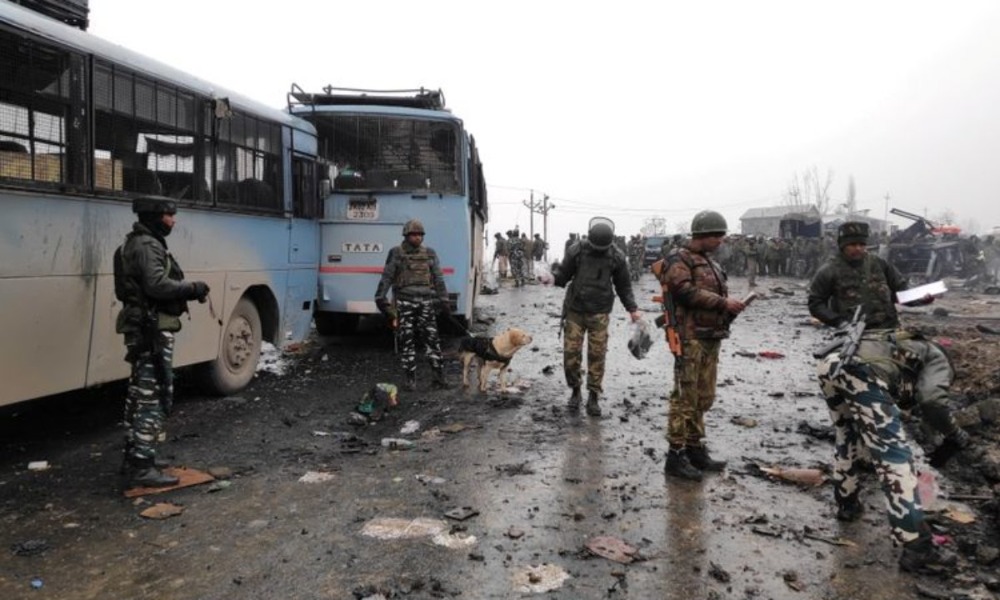
Security forces battling a decades-long insurgency in Indian-controlled Kashmir have raised concerns about the recent arrival in the disputed region of small, magnetic bombs that have wreaked havoc in Afghanistan.
“Sticky bombs”, which can be attached to vehicles and detonated remotely, have been seized during raids in recent months in the federally administered region of Jammu and Kashmir, three senior security officials told Reuters.
“These are small IEDs and quite powerful,” said Kashmir Valley police chief Vijay Kumar, referring to improvised explosive devices (IEDs).
“It will certainly impact the present security scenario as volume and frequency of vehicular movements of police and security forces are high in Kashmir Valley,” Reuters quoted him as saying.
The Indian government flooded Kashmir, already one of the world’s most militarised regions, with more troops in August 2019, when it split the country’s only Muslim-majority state into two federally administered territories.
According to Reuters, the arrival of the sticky bombs in India-controlled Kashmir – including 15 seized in a February raid – raises concerns that an unnerving tactic attributed to the Taliban insurgents in Afghanistan could be spreading to the India-Pakistan conflict.
Afghanistan in recent months has seen a series of sticky-bomb attacks targeting security forces, judges, government officials, civil society activists and journalists. The attacks – some as victims sat in traffic – have sown fear, while avoiding substantial civilian casualties.
Reuters reported that none of the devices seized in Kashmir was produced there, a senior security official said, suggesting they were being smuggled from Pakistan. “All of them have come via drone drops and tunnels,” he said.
Kashmir has long been a flashpoint between nuclear-armed neighbours India and Pakistan, which each claim all of the Himalayan region but rule only parts of it.







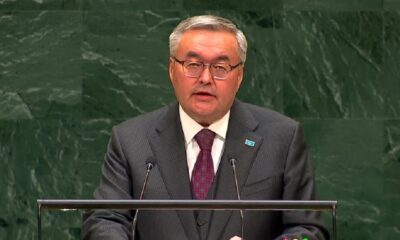




Kazakhstan’s Foreign Minister Mukhtar Tileuberdi has called for pragmatic and coordinated international engagement with Afghanistan, saying the country’s long-term stability is closely linked to the security and sustainable development of Central Asia.
Speaking during the general debate of the 81st session of the United Nations General Assembly in New York on Friday, Tileuberdi said humanitarian assistance to Afghanistan remains essential but alone cannot break the cycle of poverty, displacement and dependency.
He said Kazakhstan supports a “pragmatic, coordinated and step-by-step” approach to international engagement with Afghanistan, with the United Nations playing a central role.
Tileuberdi also said Kazakhstan is working with the UN to operationalize the United Nations Regional Centre for the Sustainable Development Goals for Central Asia and Afghanistan in Almaty.
He said the success of the centre should be measured by the results and assistance it delivers to the region.


Saar: Concerns over Pakistan’s political crisis discussed

Afghanistan Champions League: Omar Zawak Herat beat Toofan Herat 1-0

Blast in Pakistan’s Dera Ismail Khan kills 11, injures 30

Ariana Afghan Airlines increases Kabul-Delhi cargo flights

Khalilzad questions Pakistan’s commitment to Afghan welfare

Saudi energy group signs major Afghanistan deals covering gas exploration and pipeline plans

Trump floats idea of renaming Atlantic or Pacific Ocean

US hits Egyptian bank branches with Iran sanctions as war marks six months

Nepal flood rescue mission enters critical phase as thousands remain missing

Iranian clubs to face Gulf opponents at neutral venues in Asian Champions League Elite
Saar: Concerns over Pakistan’s political crisis discussed

Exclusive interview with Abdul Latif Mansoor, Minister of MRRD

Tawsia: Overview of Afghanistan’s iron mines

Tahawol: Discussion on fresh Pakistani airstrikes on Afghanistan

Saar: Calls for international support for Afghanistan discussed
-

 World5 days ago
CNN, MS NOW and Politico sue Trump, challenging White House ban
-

 Latest News3 days ago
Ariana Afghan Airlines ranks seventh among 45 Central Asian airlines
-

 Latest News4 days ago
UN reiterates call for respect for international law after Kunar airstrikes
-
 Latest News5 days ago
Khalilzad condemns Pakistan airstrikes, says current strategy is not working
-

 Regional3 days ago
US and Iran hold first talks since June after Trump’s ‘annihilation’ threat
-

 Latest News3 days ago
Silk Road highway in Wakhan corridor now reaches the China border
-

 Latest News4 days ago
Afghan Official: Pakistan’s airstrikes will not go unanswered
-

 Sport4 days ago
Afghan boxing referee heads to China for international festival