
Latest News
Ten killed in suicide bomb attack in Somali capital

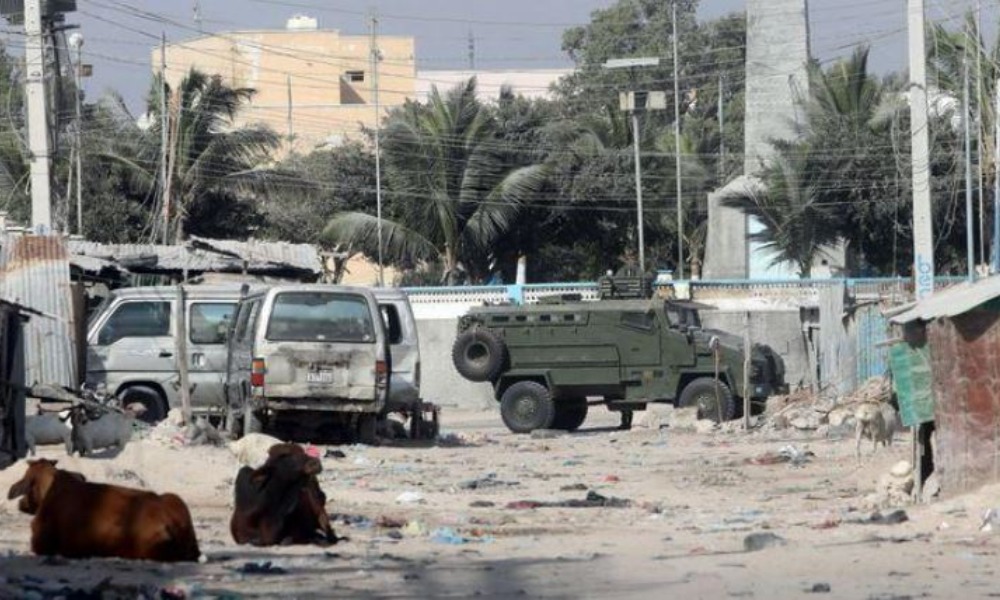
At least 10 people were killed on Saturday when a suicide bomber struck makeshift kiosks in the Somali capital, hitting hours after al Shabaab Islamist militants attacked two National Army bases outside the city, the government said.
“A suicide bomber blew up himself under trees where poor mothers sold tea, milk and (narcotic leaf) khat,” Information Ministry spokesman Ismail Mukhtar Omar told Reuters, adding that more people were wounded in the attack.
There was no immediate comment from the al Shabaab, which had earlier claimed responsibility for the attacks on the Bariire and Awdhigle army bases.
The army said earlier that there had been casualties on both sides in those attacks, but it was now in control.
The bases, located about 100 km (60 miles) southwest of Mogadishu, were struck by two explosions, witnesses said. A third explosion targeted a convoy of troops rushing to the bases from the capital after the attack, they added.
Militants from al Shabaab, which is linked to al-Qaeda, have waged years of attacks and levied tolls on trade in a campaign to introduce strict religious law.
Saturday’s attacks come amid heightened fears that the group could seek to exploit vulnerabilities created by failure to hold a parliamentary and presidential election, which was due in February.
Hussein Nur, a military officer, said the army lost “several” soldiers in the attack on the bases, without giving a precise number.
The army sent in reinforcements from other stations, who killed an unidentified number of attackers in the ensuing fight, he told Reuters.
The army had taken control of both bases and the surrounding area and “We are pursuing the militants in the surrounding jungle”, he said.
Al Shabaab said it had launched a vehicle-borne suicide bomb attack on the Bariire base while simultaneously attacking the nearby Awdhigle base with a car bomb and fighters, to prevent troops stationed there from reinforcing Bariire.
“We overran Bariire base, burnt three military vehicles and took two vehicles,” Abdiasis Abu Musab, al Shabaab’s spokesman for military operations, told Reuters, referring to a brief occupation of Bariire.
A third vehicle-borne explosive device hit a convoy of government troops racing from Mogadishu with reinforcements, he said. He also said there had been casualties on both sides in the attacks.











Kazakhstan’s Foreign Minister Mukhtar Tileuberdi has called for pragmatic and coordinated international engagement with Afghanistan, saying the country’s long-term stability is closely linked to the security and sustainable development of Central Asia.
Speaking during the general debate of the 81st session of the United Nations General Assembly in New York on Friday, Tileuberdi said humanitarian assistance to Afghanistan remains essential but alone cannot break the cycle of poverty, displacement and dependency.
He said Kazakhstan supports a “pragmatic, coordinated and step-by-step” approach to international engagement with Afghanistan, with the United Nations playing a central role.
Tileuberdi also said Kazakhstan is working with the UN to operationalize the United Nations Regional Centre for the Sustainable Development Goals for Central Asia and Afghanistan in Almaty.
He said the success of the centre should be measured by the results and assistance it delivers to the region.


Abu Muslim Farah defeat Khurasan Faryab 2-0 in ACL season six

Saar: Concerns over Pakistan’s political crisis discussed

Afghanistan Champions League: Omar Zawak Herat beat Toofan Herat 1-0

Blast in Pakistan’s Dera Ismail Khan kills 11, injures 30

Ariana Afghan Airlines increases Kabul-Delhi cargo flights

Saudi energy group signs major Afghanistan deals covering gas exploration and pipeline plans

Trump floats idea of renaming Atlantic or Pacific Ocean

US hits Egyptian bank branches with Iran sanctions as war marks six months

Nepal flood rescue mission enters critical phase as thousands remain missing

Iranian clubs to face Gulf opponents at neutral venues in Asian Champions League Elite
Saar: Concerns over Pakistan’s political crisis discussed

Exclusive interview with Abdul Latif Mansoor, Minister of MRRD

Tawsia: Overview of Afghanistan’s iron mines

Tahawol: Discussion on fresh Pakistani airstrikes on Afghanistan

Saar: Calls for international support for Afghanistan discussed
-

 World5 days ago
CNN, MS NOW and Politico sue Trump, challenging White House ban
-

 Latest News3 days ago
Ariana Afghan Airlines ranks seventh among 45 Central Asian airlines
-

 Latest News5 days ago
UN reiterates call for respect for international law after Kunar airstrikes
-

 Regional4 days ago
US and Iran hold first talks since June after Trump’s ‘annihilation’ threat
-

 Latest News4 days ago
Silk Road highway in Wakhan corridor now reaches the China border
-

 Regional3 days ago
Iran airlines cancel flights as US sanctions hit
-

 Latest News5 days ago
Afghan Official: Pakistan’s airstrikes will not go unanswered
-

 Sport5 days ago
Afghan boxing referee heads to China for international festival