Connect with us

Latest News

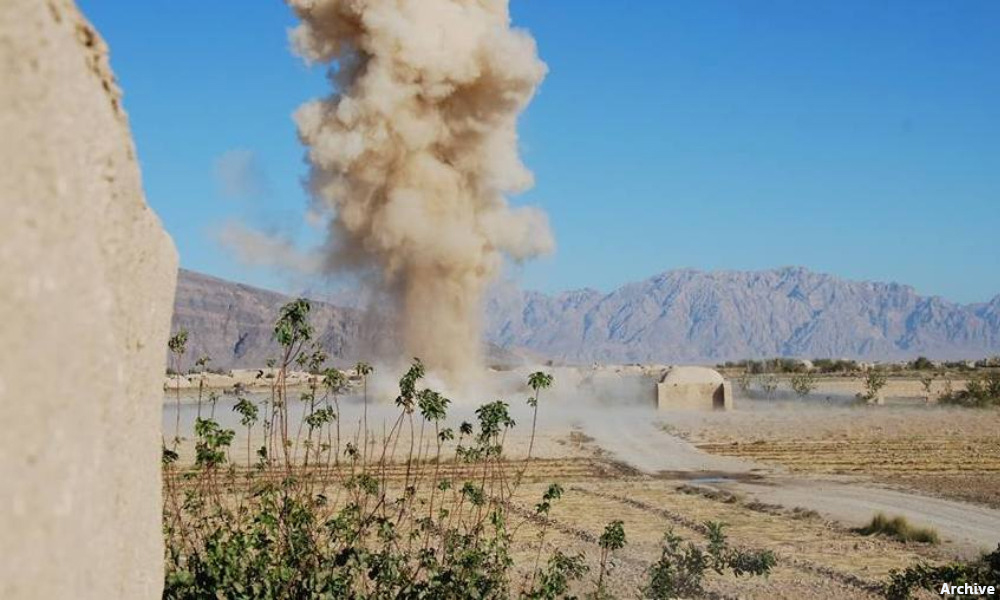
Four killed in Paktia roadside IED explosion

Published

on

At least four civilians were killed Sunday in a roadside IED explosion in Paktia province, local officials confirmed.

Provincial governor Halim Fedaee said the blast occurred in the Ibrahimkhel area of Gardez, the provincial capital.

“Two women and a child and the driver were killed in the blast,” Fedaee said.

According to Fedaee the civilians were on their way to a wedding party.

So far no group has claimed responsibility for the attack.

This comes after Afghan National Security Council’s (NSC) spokesman Ramatullah Andar said on Friday that last week, the Taliban killed 63 civilians, including women and children, and wounded 126 others in 27 provinces.

Andar said that since the start of the foreign troops’ withdrawal process, on May 1, the Taliban has conducted 1,455 attacks across the country.

The Taliban has not commented.

Latest News

ILT20: Nissanka fires Gulf Giants to four-wicket win over Dubai Capitals

Azmatullah Omarzai dented the innings at crucial moments, finishing with 3/46 and tightening his grip on the White Belt for leading wicket-taker.

Published

on

Pathum Nissanka produced his second consecutive half-century of the season on Saturday to guide Gulf Giants to a convincing four-wicket victory over Dubai Capitals, taking them to the top of the DP World ILT20 Season 4 standings.

Nissanka smashed 67 off just 31 deliveries in a dominant display that included six fours and five sixes. His 97-run stand with James Vince (50* off 45) proved decisive in the Giants’ chase of 161, which they completed with seven balls to spare at Dubai International Stadium.

Earlier, the Capitals posted 160/6 thanks to useful contributions from Sediqullah Atal (35), David Willey (29) and Jordan Cox (31). Captain Dasun Shanaka added late impetus with an unbeaten 23 off 9 balls, including two sixes in the final over.

But Azmatullah Omarzai dented the innings at crucial moments, finishing with 3/46 and tightening his grip on the White Belt for leading wicket-taker.

The Giants’ reply wobbled briefly after the early loss of Rahmanullah Gurbaz (9) but Nissanka took charge, hammering James Neesham for three sixes in the fourth over as the Giants cruised to 60/1 by the end of the powerplay. He reached his half-century in just 23 balls.

Mustafizur Rahman and Shanaka struck in back-to-back overs to remove Nissanka and Moeen Ali, but Vince held the chase together with a composed knock. Cameos from Omarzai (14 off 12) and Tom Moores (13 off 8) ensured the required rate never spiralled out of reach, and Vince sealed victory with a well-paced fifty.

In the first innings, after Omarzai removed Shayan Jahangir early, Atal and Willey stabilised the Capitals with a 61-run partnership. But the middle overs proved costly, producing only 18 runs between the 10th and 14th overs as wickets fell to Moeen Ali, Liam Dawson and Aayan Afzal Khan. Cox and Neesham revived the innings before Omarzai returned to snuff out the momentum by dismissing Cox and Rovman Powell in the 18th over.

Speaking after the match, Giants captain Moeen Ali praised his side’s all-round display: “Getting the points while knowing we can still play better is a good sign. We squeezed them well in the middle with the ball. Nissanka is a brilliant player, and Vince controlled the chase perfectly.”

Dubai Capitals skipper Dasun Shanaka admitted his team lost control through the middle overs: “Nissanka is in the form of his life — small guy, massive hitting. We lacked intent in the middle period. We waited too long to rotate strike. Powell and I probably should have gone earlier.”

Brief Scores:

Gulf Giants beat Dubai Capitals by 4 wickets

Dubai Capitals 160/6 (20 overs): Sediqullah Atal 35, Jordan Cox 31, David Willey 29, Dasun Shanaka 23*; Azmatullah Omarzai 3/46, Aayan Afzal Khan 1/3, Moeen Ali 1/23

Gulf Giants 161/6 (18.5 overs): Pathum Nissanka 67, James Vince 50*, Azmatullah Omarzai 14; Dasun Shanaka 2/16, Mustafizur Rahman 2/26

Player of the Match: Pathum Nissanka

Continue Reading

Latest News

Doha Forum spotlights Afghanistan’s emerging role in regional connectivity

The annual gathering, which has drawn around 5,000 participants from 160 countries, is once again positioning Doha as a key platform for global dialogue.

Published

on

The second day of the Doha Forum 2025 has brought renewed global attention to Afghanistan’s evolving role in regional connectivity, as policymakers, diplomats, and experts discuss the country’s shifting place in international cooperation and development.

The annual gathering, which has drawn around 5,000 participants from 160 countries, is once again positioning Doha as a key platform for global dialogue.

Zakir Jalali, Director of the second Political Department at the Ministry of Foreign Affairs of the Islamic Emirate, said in a post on X that the forum’s opening day focused heavily on major global crises and on Qatar’s increasing influence as an international mediator — from the conflict in Gaza and the war in Ukraine to crises in Sudan, Syria, and other hotspots.

Jalali confirmed that a dedicated panel on Afghanistan’s role in regional connectivity is scheduled for today. The session will feature Dr. Abdulhai Qanit representing Afghanistan, along with Esmatullah Ergashev, the Special Representative of the President of Uzbekistan, and Faisal bin Abdullah, Qatar’s Special Envoy from the Ministry of Foreign Affairs.

He noted that Qatar has established itself as a successful mediator in recent years, with Afghanistan being one of its prominent examples.

This year’s forum, he said, marks a shift in how the international community engages with Afghanistan: moving away from a security-dominated narrative toward one that increasingly recognizes the country’s potential as a hub for integration, trade, and economic development.

According to Jalali, this evolving perspective offers a new window of opportunity for Afghanistan and its neighbours — one that requires thoughtful engagement, strategic planning, and a deeper understanding of the region’s long-term connectivity ambitions.

Continue Reading

Latest News

US sets 2027 deadline for Europe-led NATO defense, officials say

Some officials on Capitol Hill are aware of and concerned about the Pentagon’s message to the Europeans, one U.S. official said.

Published

on

The United States wants Europe to take over the majority of NATO’s conventional defense capabilities, from intelligence to missiles, by 2027, Pentagon officials told diplomats in Washington this week, a tight deadline that struck some European officials as unrealistic, Reuters reported.

The message, recounted by five sources familiar with the discussion, including a U.S. official, was conveyed at a meeting in Washington this week of Pentagon staff overseeing NATO policy and several European delegations.

The shifting of this burden from the U.S. to European members of the North Atlantic Treaty Organization would dramatically change how the United States, a founding member of the post-war alliance, works with its most important military partners.

In the meeting, Pentagon officials indicated that Washington was not yet satisfied with the strides Europe has made to boost its defense capabilities since Russia’s expanded invasion of Ukraine in 2022.

The U.S. officials told their counterparts that if Europe does not meet the 2027 deadline, the U.S. may stop participating in some NATO defense coordination mechanisms, said the sources, who requested anonymity to discuss private conversations.

Some officials on Capitol Hill are aware of and concerned about the Pentagon’s message to the Europeans, one U.S. official said.

Conventional defense capabilities include non-nuclear assets from troops to weapons and the officials did not explain how the U.S. would measure Europe’s progress toward shouldering most of the burden, read the report.

It was also not clear if the 2027 deadline represented the Trump administration position or only the views of some Pentagon officials. There are significant disagreements in Washington over the military role the U.S. should play in Europe.

Several European officials said that a 2027 deadline was not realistic no matter how Washington measures progress, since Europe needs more than money and political will to replace certain U.S. capabilities in the short term.

Among other challenges, NATO allies face production backlogs for military equipment they are trying to purchase. While U.S. officials have encouraged Europe to buy more U.S.-made materiel, some of the most prized U.S.-made weapons and defense systems would take years to be delivered if ordered today.

The U.S. also contributes capabilities that cannot simply be purchased, like unique intelligence, surveillance and reconnaissance that have proven key to the Ukrainian war effort.

Asked for comment, a NATO official speaking for the alliance said European allies had begun taking more responsibility for the continent’s security, but did not comment on the 2027 deadline.

“Allies have recognized the need to invest more in defense and shift the burden on conventional defense” from the U.S. to Europe, the official said.

The White House did not immediately respond to requests for comment.

Pentagon press secretary Kingsley Wilson said: “We’ve been very clear in the need for Europeans to lead in the conventional defense of Europe. We are committed to working through NATO coordination mechanisms to strengthen the alliance and ensure its long-term viability as European allies increasingly take on responsibility for conventional deterrence and defense in Europe.”

European nations have broadly accepted U.S. President Donald Trump’s demand they take more responsibility for their own security and have pledged big increases in defense spending, Reuters reported.

The European Union has set a target of making the continent ready to defend itself by 2030 and says it must fill gaps in its air defenses, drones, cyber warfare capabilities, munitions and other areas. Officials and analysts said even that deadline is highly ambitious.

The Trump administration has consistently argued that European allies need to contribute more to the NATO alliance, but it’s not always clear where the president stands on NATO.

On the campaign trail in 2024, Trump frequently bashed European allies, and he said he would encourage Russian President Vladimir Putin to invade NATO countries that did not spend their fair share on defense.

But at the annual NATO leaders’ summit in June, Trump effusively praised European leaders for agreeing to a U.S. plan to boost the annual defense spending target for member states to 5% of gross domestic product.

In the months since, Trump has vacillated between a harder line on Russia – the bloc’s main opponent – and, more recently, a willingness to negotiate with Moscow over the Ukraine conflict. European officials have complained that they were largely cut out of those negotiations, read the report.

At a meeting of NATO foreign ministers this week, U.S. Deputy Secretary of State Christopher Landau said it was “obvious” NATO allies should take responsibility for Europe’s defense.

“Successive US Administrations have been saying this in one form or another pretty much my whole life…but our Administration means what it says,” Landau wrote on X.

Continue Reading
Advertisement
Advertisement
Advertisement
Advertisement

Trending

Copyright © 2025 Ariana News. All rights reserved!