
Latest News
Watchdog reports a dramatic increase in civilian casualties


The Afghanistan Independent Human Rights Commission (AIHRC) on Sunday said in a new report that in the first six months of this year, 5,321 civilians have been killed or injured, a substantial increase against the same period last year.
According to the report, the AIHRC said in 1,594 different security incidents, a total of 5,321 civilians have been killed or injured in the first six months of 2021. Among these civilian casualties, 1,677 were killed, and 3,644 were injured.
This was in comparison to 2,957, including 1,213 killed and 1,744 injured, in the first six months of last year.
The AIHRC stated that a total of 154 women were killed and 350 wounded between January and June this year.
The number of women civilian casualties in the first six months of 2020 was 297 in total which included 126 killed, and 171 injured.
The watchdog reported that this meant there was a 69 percent rise in women civilian casualties in the first six months of 2021 in comparison with the first six months of 2020.
In the first half of 2021, the number of child casualties was 1,456 – 373 children were killed, and 1,083 others were injured.
The number of child casualties in the first six months of 2020 was 630 (225 killed, and 405 injured).
The comparison of the above figures clearly shows that war principles and International Humanitarian Law have been violated. The number of child casualties increased by 131% in the first six months of 2021 compared to the first six months of 2020.
AIHRC stated that according to its findings, out of the total number of civilian casualties in Afghanistan in the first six months of 2021, the Taliban is responsible for 56 percent, pro-government forces are responsible for 15 percent, Daesh is responsible for seven percent, and unknown perpetrators are responsible for 22 percent.
The Taliban is responsible for 2,978 civilian casualties (917 killed, and 2,061 injured) in the first six months of 2021, read the statement.
Unknown perpetrators were responsible for another 1,190 civilian deaths and injuries in the first half of this year, including 425 civilians killed and 765 civilians injured. These attacks have not been claimed by any groups or individuals.
In addition, 16 civilians have been harmed due to rocket attacks from Pakistan to Afghanistan territory in the first six months of 2021. This includes two civilians killed, and 14 others injured.
Daesh meanwhile was responsible for 343 civilian casualties (104 killed, 239 killed) in the first six months of 2021. In the first six months of last year, Daesh was responsible for 429 civilian casualties (145 killed, 284 injured).
A comparison of both periods shows 20 percent reduction in 2021.
The watchdog found that the use of IEDs, roadside mines and car bombs in the first half of the year accounted for 37 percent of the total civilian casualties.
The number of civilian casualties caused by explosions tripled in the first six months of 2021 compared with the same period in the previous year.
Targeted killings also increased sharply in the first six months compared to last year.
This year it accounted for 30 percent of the total number of civilian casualties. This includes 1,634 civilian casualties (696 killed, 938 injured).
The number of civilian casualties caused by targeted killings during the same period in 2020 was 945 in total which included 533 killed and 412 injured.
This shows a 110 percent increase in the number of civilian casualties caused by targeted killing in the first six months of this year compared with the same period in the previous year.
Rocket fire, sucide attacks, airstrikes, night raids and ground engagements were other key types of war tactics used, which led to civilian casualties.
This was followed by the Central Zone, Kabul, Wardak, Kapisa, Parwan, Panjsher, Ghazni, Bamiyan, Daikundi.
In addition to this, the AIHRC found that 39 power pylons were destroyed by unknown people in the first six months of 2021 in different provinces including Kabul, Parwan, Baghlan, and Kunduz.
In addition, the ongoing armed conflict in the current year has resulted in destruction of 130 bridges and culverts, 13 schools, and three clinics only in the first six months of 2021.
“The above statistics are alarming and obvious examples of violating war principles,” the watchdog said in the statement.
The AIHRC once again called on all parties to the conflict to respect the demands of the AIHRC and to implement its recommendations; otherwise, the responsibilities and consequences of violations will lie with the violators, causing civilians casualties and destruction of public facilities and the personal properties.
Their list of recommendations were as follows:
1. AIHRC believes that dialogue and negotiations are the most humane, logical, and effective ways to resolve conflicts and we are reiterating it more seriously and stressing our previous stances in this regard. The country’s problems can be solved behind the negotiating table, not on the battlefield;
2. The Commission once again calls on the United Nations, domestic and international organizations and institutions influencing the war and peace in Afghanistan, as well as the international community, to use all their resources, opportunities, and capacities to end the current violence and devastating war before it leads to more human catastrophes;
3. We call on the Taliban, more specifically and emphatically, to care the suffering of the Afghan people, respect the interests of the country, the collective rights and aspirations of its citizens; in order to resolve disputed issues and achieve a just peace, they should return to the negotiation table and meaningful dialogue and pave the way for a long-term ceasefire and peace;
4. All parties to the Afghan war are required to respect international humanitarian law and standards, as well as not diverge from the laws and regulations of war during armed conflict. Any infringement of these regulations will result in severe penalties for the violators, who will be tried fairly and judicially in all circumstances;
5. According to international humanitarian law, the deliberate and systematic killing and harming of civilians is a clear example of war crimes and crimes against humanity, and if such approaches are motivated by hatred of certain ethnic, religious, or social groups, they are considered genocide and cannot be forgiven. The Government of Afghanistan and the relevant international organizations must seriously prosecute the perpetrators of such crimes;
6. The use of people as human shield as well as war in residential areas, clearly causes enormous harm to civilians, particularly children and women, and is an evident violation of international humanitarian law. Neither side in the fight should employ such cruel and brutal tactics. Furthermore, hostage-taking, assassination, targeted killings, and extrajudicial trials cannot be justified, and no military unit should engage in such tactics;
7. We specifically call on the Taliban to treat detainees and prisoners in accordance with international humanitarian law, and to guarantee that no captives or detainees are punished or brutally killed as a result of the extrajudicial measures, and prevent retaliatory actions by their men;
8. Emotional remarks and the issuance of instructions contrary to international human rights and humanitarian principles by some Afghan government officials have raised serious concerns among civil society organizations, the AIHRC, and the country’s intellectual community; we urge the leadership of the Government of Afghanistan to refrain from such destructive and extra-legal approaches;
9. The Taliban leadership is strongly urged to investigate all cases of violations of international humanitarian law in areas under their control and to prevent further harm to the country’s civilian people by stopping anti-human rights actions by their militants and commanders. The leadership of the Taliban must explain to the Afghan people the results of its work in this regard;
10. We urge the government’s armed opposition to align its definition of civilians with international humanitarian law principles and to refrain from attacking Afghan government civil servants, civil society activists, human rights defenders, aid organizations, journalists, religious scholars, and dissidents. The armed opposition’s leadership must understand that continuing to violate international human rights and humanitarian standards would have major consequences for them;
11. We urge the armed opposition’s leadership, particularly the Taliban, to prevent the destruction of specially protected facilities in regions under their control, such as hydroelectric dams, historical and cultural sites, power generation sources, and hazardous energy sources. In addition to preventing the destruction and looting of public and private assets, the dominant groups in the region must also prohibit third-party looting and destruction of these resources;
12. According to AIHRC and international organizations, the Taliban’s use of roadside bombs and improvised explosive devices is a major cause of civilian casualties. Therefore, we urge the Taliban to stop this military tactics;
13. We urge the Afghan government to review its war policies and procedures, resolve the issues that result in civilian casualties, and hold the government’s military perpetrators accountable;
14. We call on responsible organs in the Afghan government to take planned, continuous, and systematic measures to improve the security of all citizens of the country, particularly ethnic-religious minorities, religious scholars, human rights defenders, media activists, and civil activists;
15. We urge the government and aid agencies to provide additional support to the injured, displaced people, and victims’ relatives. We further urge the Taliban to permit the presence and activity of aid organizations in areas under their control, so that the impoverished people and displaced persons affected by the fighting can be helped;
16. Afghanistan is a member of the International Criminal Court (ICC). The Commission urges the International Criminal Court not to be swayed by political pressures from any authority in undertaking a serious and comprehensive investigation into the international crimes committed in Afghanistan. It also calls on the United Nations to send a UN fact-finding mission to investigate the recent horrific incidents against civilians in Afghanistan in a fair and non-political manner, as requested by the AIHRC. We also call on the Government of Afghanistan to welcome the presence of this delegation and to pave the way for a more thorough investigation.







Afghanistan’s Ministry of Defense says a Pakistani military post near Spin Boldak was targeted and destroyed after Pakistani forces opened fire toward Afghanistan.
Ministry spokesperson Enayatullah Khwarazmi said in a post on X that Afghan forces suffered no casualties or damage in the clash.
Khwarazmi also rejected claims made by the Pakistani side about the incident, describing them as “propaganda.”
Latest News
Mujahid: Pakistan attacking Afghanistan to evade Mecca Pact responsibilities
He warned that the Islamic Emirate would give an “appropriate response” to what he called the Pakistani military regime’s “bullying.”
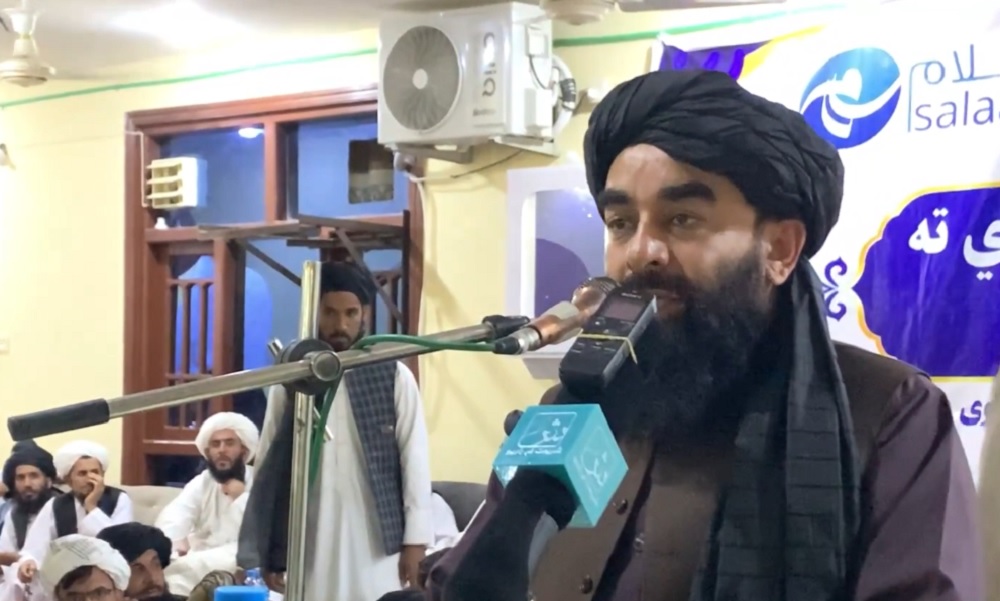
Islamic Emirate spokesperson Zabihullah Mujahid has accused Pakistan of carrying out attacks on Afghanistan to divert attention from its domestic problems and to evade responsibilities under the “Mecca Pact.”
Speaking at a religious seminary in Kandahar, Mujahid said Pakistan was facing political and economic challenges at home and was using attacks on Afghanistan to shift public attention away from protests and its internal problems.
“Pakistan, by violating the territory of its neighboring Islamic country, wants to divert attention from its failures,” he said.
Mujahid also criticized Pakistan’s political situation, claiming that political space had been restricted and that freedoms guaranteed under the country’s laws were not being allowed.
He said Pakistan’s economic problems had also increased significantly and accused the country of seeking to distract the public from those problems by engaging in conflict with Afghanistan.
Mujahid further accused Pakistan’s military leadership of putting the Pakistani people at risk through what he described as its “false position.”
He warned that the Islamic Emirate would give an “appropriate response” to what he called the Pakistani military regime’s “bullying.”
His remarks followed Pakistani airstrikes on Kandahar, Paktia and Khost provinces on Thursday, which Afghan authorities said killed four civilians.
The strikes came three days after attacks on Kunar and Paktika provinces, in which Afghan authorities said three civilians were killed.
Latest News
Kabul rejects U.S. claim that meth seized in Pakistan was of Afghan origin
Balkhi said the Islamic Emirate of Afghanistan (IEA) has imposed an absolute ban on the production, trafficking and use of all types of narcotics in Afghanistan.
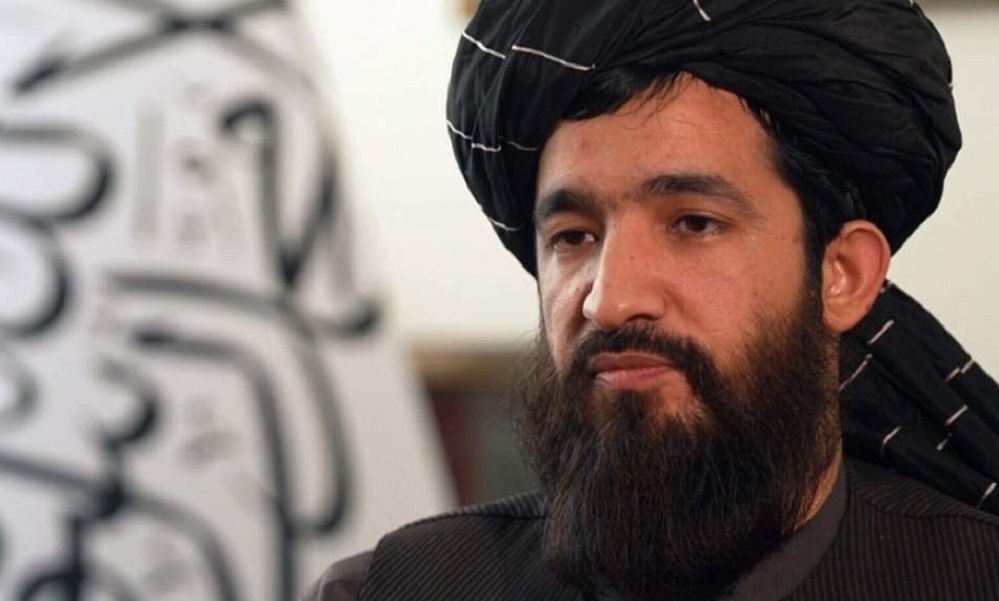
Afghanistan’s Foreign Ministry spokesperson Abdul Qahar Balkhi has rejected a U.S. claim that 463 kilograms of synthetic drugs seized in Pakistan were of Afghan origin, calling the attribution “unfounded and politically motivated.”
Balkhi said the U.S. Embassy in Islamabad should investigate the origin of the seized drugs in Pakistan rather than attributing them to Afghanistan.
“The attribution by the U.S. Embassy in Islamabad of the synthetic drugs bound for Sri Lanka and intercepted in Pakistan through joint U.S.-Pakistani efforts as ‘Afghan-origin’ is an unfounded and politically motivated allegation,” Balkhi said.
He said the Islamic Emirate of Afghanistan (IEA) has imposed an absolute ban on the production, trafficking and use of all types of narcotics in Afghanistan.
Balkhi also claimed that following the ban in Afghanistan, the cultivation, production and trafficking of narcotics have increased “on the other side of the Durand Line.”
He further argued that Afghanistan does not have the capacity to produce synthetic drugs and said crossing points along the Durand Line have been completely closed to all movement for nearly a year.
His remarks came after the U.S. Embassy in Islamabad said U.S. and Pakistani anti-narcotics authorities had seized 463 kilograms of crystal methamphetamine worth an estimated $21 million and bound for Sri Lanka.
The embassy said the operation led to multiple arrests and highlighted ongoing U.S. cooperation and training with Pakistani authorities to disrupt international drug-trafficking networks.


Exclusive interview with Abdul Latif Mansoor, Minister of MRRD

Sorkh Poshan Khafi rout Istiqlal Kabul 6-0 in ACL season six

Tawsia: Overview of Afghanistan’s iron mines

Afghanistan Champions League: Arman FC and Aino Mina play out goalless draw

Afghanistan says Pakistani military post destroyed near Spin Boldak

Saudi energy group signs major Afghanistan deals covering gas exploration and pipeline plans

ATN secures exclusive rights to broadcast T20I series in India across Afghanistan

Trump floats idea of renaming Atlantic or Pacific Ocean

US hits Egyptian bank branches with Iran sanctions as war marks six months

Nepal flood rescue mission enters critical phase as thousands remain missing
Exclusive interview with Abdul Latif Mansoor, Minister of MRRD
Tawsia: Overview of Afghanistan’s iron mines

Tahawol: Discussion on fresh Pakistani airstrikes on Afghanistan

Saar: Calls for international support for Afghanistan discussed

Tahawol: Opening of the 81st UN General Assembly Session
-

 Sport4 days ago
Afghanistan to face Japan and Nepal in Asian Games cricket group stage
-
 Regional5 days ago
Iran and US trade threats after Houthi attacks escalate regional conflict
-

 World4 days ago
CNN, MS NOW and Politico sue Trump, challenging White House ban
-
 Health4 days ago
Four-day polio vaccination campaign begins across Afghanistan
-
 Latest News4 days ago
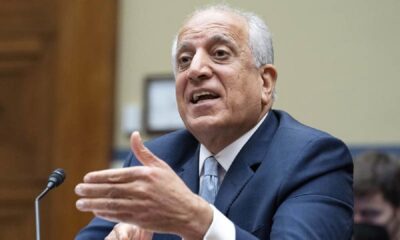
Khalilzad condemns Pakistan airstrikes, says current strategy is not working
-

 Latest News3 days ago
UN reiterates call for respect for international law after Kunar airstrikes
-

 Latest News2 days ago
Ariana Afghan Airlines ranks seventh among 45 Central Asian airlines
-

 Latest News4 days ago
Afghan Official: Pakistan’s airstrikes will not go unanswered