
Latest News
Haqqani calls for nation to be ‘more united’

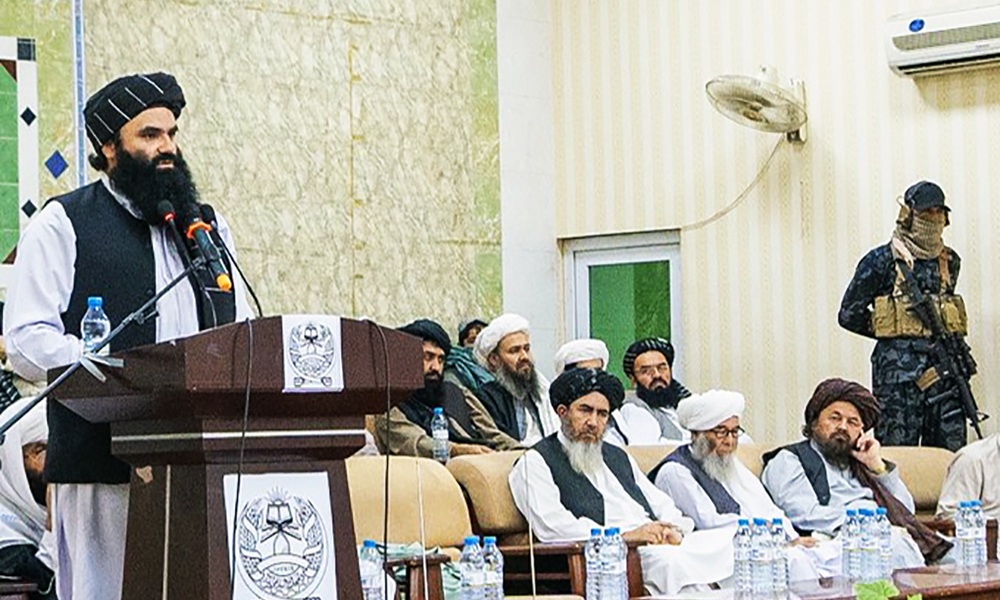
The Islamic Emirate of Afghanistan’s (IEA) Minister of Interior Sirajuddin Haqqani, called on Afghans living abroad to return home and on the nation to become more united.
Speaking in Mazar-e-Sharif city of Balkh province, the ministry said: “Enemies are making many conspiracies to divide Afghans, but the roots of prejudice here were never civil but brought by foreigners and only had a political aspect.
“The enemies of Afghanistan tried to divide the country, but the Mujahideen of the North proved the deep roots of national unity, that we are a united nation. Our real situation is that from Panjshir to the earthquake victims of Paktika and from Uruzgan to the people affected by the natural disaster of Badakhshan, the hands of help were extended. Our unity is natural, it has deep roots in our beliefs,” Haqqani said.
Governor of Balkh, Haji Muhammad Yusuf Wafa, welcomed his visit to Balkh province and said Haqqani’s trip was a “good step”.
After voting Hazrat Ali shrine, Haqqani also visited the tomb of Wazir Muhammad Akbar Khan and other historical figures. He prayed for their souls and met with the administrators of the shrine, the ministry said.
Haqqani said he will help in the reconstruction of Hazart Ali’s shrine and the construction of a library for the religious seminary in the compound of the shrine. He shared some advice to solve some problems.
According to the ministry, these visits were conducted on Sunday. On Monday, Haqqani met with officials, scholars and tribal leaders of Balkh province.
Mawlawi Abu Edris, the deputy of Balkh province, said the people of the north were honored by Haqqqani’s visit.
“This is the result of the sacrifices of the Mujahideen of Balkh Province and the great grace and mercy of Allah, that we see leaders among us,” Edris said.
Edris further added that: “We have made great sacrifices in bringing the Islamic system and now the survival of the system requires the sacrifices of honesty, integrity and unity. We are one nation and we must be more united.”
Sheikh Muhammad Saad Hashemi, Chairman of Balkh’s Ulema Council also made a speech at the event and said: “Security has been given priority in all religions, states and nations. The current security privileges are attributed to the Islamic Emirate, the efforts of the Islamic Emirate should be praised at the national and international level.”
At the end of the meeting, Haqqani spoke and said: “We got the power of the government when everything was chaotic and the situation kept me busy, so please accept my excuse for the delay [in visiting Balkh].”
Calling on Afghans who left the country, Haqqani said: “Those Afghans who were frightened by propaganda and left their homeland, should return; this country is a common and peaceful home for all.”
He raised the issue of Jihad and said at the start, many people pointed out that conspiracy methods were being used instead of armed struggle, but due to the sacrifice and perseverance of the Mujahideen, they succeeded in all their “trials”.
The interior minister once again reminded the public of the general amnesty.
“Amir al Mum’ninin [the IEA’s supreme leader] announced general amnesty for peace, and after the amnesty, if someone violated it, they were dealt with according to Sharia law,” he added.
The interior minister also advised the security forces to remain disciplined and said he believes that the survival of the system lies in good morals.
“The survival of the system lies in good morals. Power and status sometimes creates arrogance in a person, with arrogance, the intellect and thinking of a person is destroyed. The leader used to tell me that we have nothing but good manners, and we should treat our subordinates well,” Haqqani said.
Haqqani also passed the IEA leader’s message on to the forces and Balkh officials.
“The leader has sent a message of greetings and good manners to his subjects. My message to the Mujahideen is to be in the service of the people day and night, and even those Mujahideen who are not officially on duty, are responsible to Allah and the Prophet (PBUH) for good deeds, to remain committed to the noble qualities of endeavor through high morals,” he added.
He once again emphasized that the system is all-inclusive and has provided services to tribal leaders, scholars and other professional staff.
“Scholars are our spiritual leaders and the success of this world and the hereafter lies in their guidance. The people share in our profits and losses, as our system is all-inclusive, providing service to tribal leaders, scholars and other professional staff,” Haqqani said.
Haqqani, said: “In order to save the youth from the domination of this foreign culture, we must develop our Islamic and Afghan culture and thought and make it so beloved that people themselves accept it.”












Kazakhstan’s Foreign Minister Mukhtar Tileuberdi has called for pragmatic and coordinated international engagement with Afghanistan, saying the country’s long-term stability is closely linked to the security and sustainable development of Central Asia.
Speaking during the general debate of the 81st session of the United Nations General Assembly in New York on Friday, Tileuberdi said humanitarian assistance to Afghanistan remains essential but alone cannot break the cycle of poverty, displacement and dependency.
He said Kazakhstan supports a “pragmatic, coordinated and step-by-step” approach to international engagement with Afghanistan, with the United Nations playing a central role.
Tileuberdi also said Kazakhstan is working with the UN to operationalize the United Nations Regional Centre for the Sustainable Development Goals for Central Asia and Afghanistan in Almaty.
He said the success of the centre should be measured by the results and assistance it delivers to the region.


Abu Muslim Farah defeat Khurasan Faryab 2-0 in ACL season six

Saar: Concerns over Pakistan’s political crisis discussed

Afghanistan Champions League: Omar Zawak Herat beat Toofan Herat 1-0

Blast in Pakistan’s Dera Ismail Khan kills 11, injures 30

Ariana Afghan Airlines increases Kabul-Delhi cargo flights

Saudi energy group signs major Afghanistan deals covering gas exploration and pipeline plans

Trump floats idea of renaming Atlantic or Pacific Ocean

US hits Egyptian bank branches with Iran sanctions as war marks six months

Nepal flood rescue mission enters critical phase as thousands remain missing

Iranian clubs to face Gulf opponents at neutral venues in Asian Champions League Elite
Saar: Concerns over Pakistan’s political crisis discussed

Exclusive interview with Abdul Latif Mansoor, Minister of MRRD

Tawsia: Overview of Afghanistan’s iron mines

Tahawol: Discussion on fresh Pakistani airstrikes on Afghanistan

Saar: Calls for international support for Afghanistan discussed
-

 World5 days ago
CNN, MS NOW and Politico sue Trump, challenging White House ban
-

 Latest News3 days ago
Ariana Afghan Airlines ranks seventh among 45 Central Asian airlines
-

 Latest News4 days ago
UN reiterates call for respect for international law after Kunar airstrikes
-

 Regional4 days ago
US and Iran hold first talks since June after Trump’s ‘annihilation’ threat
-

 Latest News3 days ago
Silk Road highway in Wakhan corridor now reaches the China border
-

 Latest News5 days ago
Afghan Official: Pakistan’s airstrikes will not go unanswered
-

 Sport4 days ago
Afghan boxing referee heads to China for international festival
-
 Regional5 days ago
G7 foreign ministers call on Iran to stop arming Houthis