
Latest News
Afghanistan, Kyrgyzstan discuss expanding trade and economic cooperation
Azizi welcomed the Kyrgyz delegation and thanked them for visiting Kabul, underscoring the importance of closer economic engagement between the two countries.

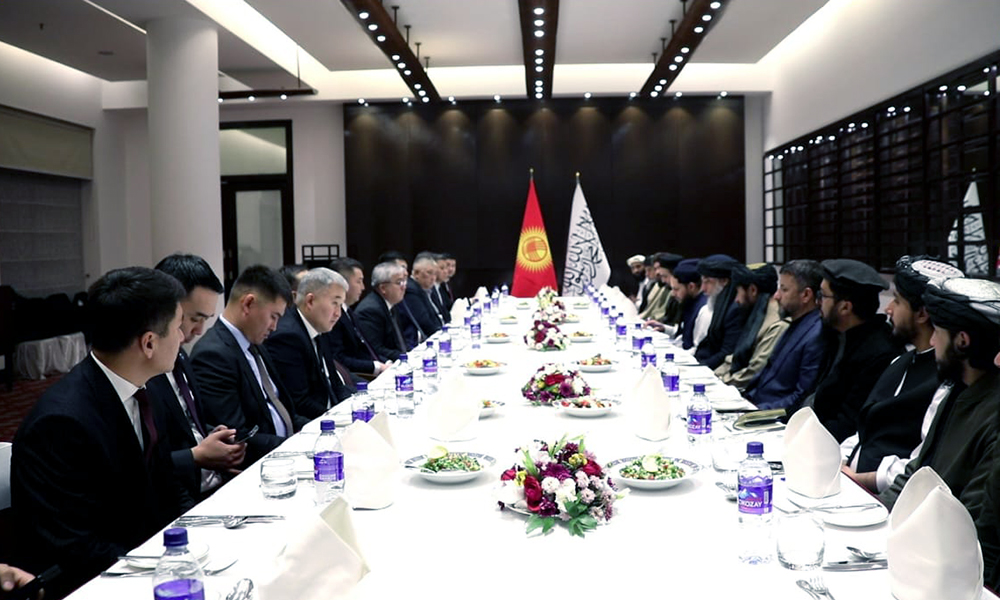
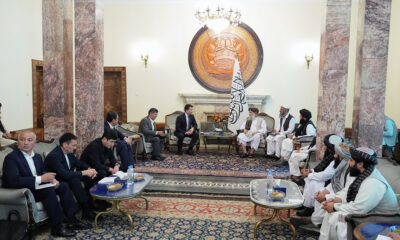
Afghanistan and Kyrgyzstan held high-level talks in Kabul aimed at strengthening bilateral economic and trade relations, officials said.
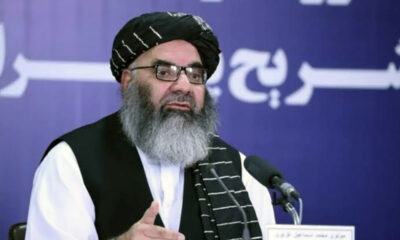
The meeting brought together Nooruddin Azizi, Minister of Industry and Commerce of the Islamic Emirate of Afghanistan, and Bakyt Sadykov, Minister of Economy and Trade of the Kyrgyz Republic, who is leading a visiting delegation to the Afghan capital.
Azizi welcomed the Kyrgyz delegation and thanked them for visiting Kabul, underscoring the importance of closer economic engagement between the two countries.
During the talks, both sides discussed ways to boost bilateral trade by making better use of existing capacities and identifying priority export commodities.
The discussions also focused on developing transit routes, signing transit agreements, attracting joint domestic and foreign investment, and expanding cooperation through trade exhibitions, business conferences and regular meetings.
The two ministers stressed the need to implement earlier agreements, particularly the economic and trade cooperation roadmap signed during a previous visit by an Afghan delegation to Kyrgyzstan.
They said effective follow-up on these commitments would be key to translating discussions into tangible results.
Officials from both countries said the meeting was intended to deepen economic, trade and investment ties, while opening new avenues for partnership between Afghanistan and Kyrgyzstan in the coming period.

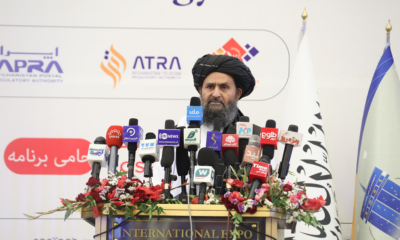



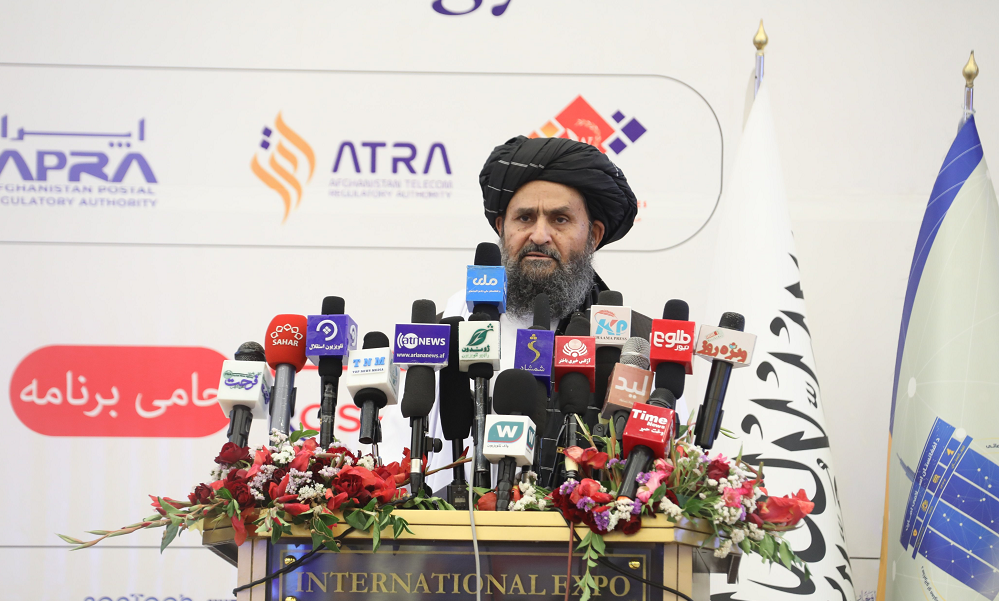
Mullah Abdul Ghani Baradar, the Deputy Prime Minister for Economic Affairs, said on Sunday Afghanistan has the potential to connect South Asia with Central Asia through data transit.
Speaking at the opening of a communications and information technology exhibition in Kabul, Baradar described the development of the communications and IT sectors as one of the Islamic Emirate’s key priorities.
“Advancing the communications and technology sector in line with the demands of the modern era is our responsibility,” Baradar said. “The Islamic Emirate of Afghanistan seeks to gradually use existing resources to become competitive with countries in the region and around the world.”
Baradar added that since the Islamic Emirate returned to power, Afghanistan has made progress in communications and information technology, while also achieving gains in digital governance.
Meanwhile, Deputy Prime Minister for Administrative Affairs Abdul Salam Hanafi stressed the importance of expanding digital governance, saying: “All government institutions should deliver their services through digital systems and connect with other government agencies to provide greater convenience for our fellow citizens.”
Minister of Industry and Commerce Nooruddin Azizi also announced plans to simplify and digitize export procedures.
“Simplifying and digitizing government is one of our aspirations. We have an export program and a system integration project underway, which will be launched soon,” he said.
Minister of Communications and Information Technology Abdul Ahad Fazli said that telecommunications services would be expanded across the country.
“The Ministry of Communications and Information Technology is at your service, especially in provinces and remote areas that have been deprived of telecommunications services,” Fazli said.
Telecommunications companies also reaffirmed their commitment to expanding telecom and internet services across Afghanistan. Company officials said they would continue working alongside the government to further develop the technology sector.
Aliullah Sarwari, CEO of Afghan Wireless Communication Company (AWCC), said: “We are committed to investing in the telecommunications sector and improving service quality. Most remote areas are now covered by telecommunications services. God willing, we will also cooperate with the authorities to further enhance service quality.”
The Communications and Information Technology Exhibition was held in Kabul with the participation of government officials and companies operating in the technology sector. At the conclusion of the exhibition, the Ministry of Communications and Information Technology signed several memorandums of understanding with government agencies to expand digital services and facilitate the delivery of public services.
Latest News
Afghan PM, Uzbek Deputy PM hold talks on expanding economic and political cooperation
Prime Minister Mullah Mohammad Hassan Akhund welcomed Deputy Prime Minister Khojayev and the accompanying delegation, describing the visit as significant for strengthening bilateral relations between Afghanistan and Uzbekistan.
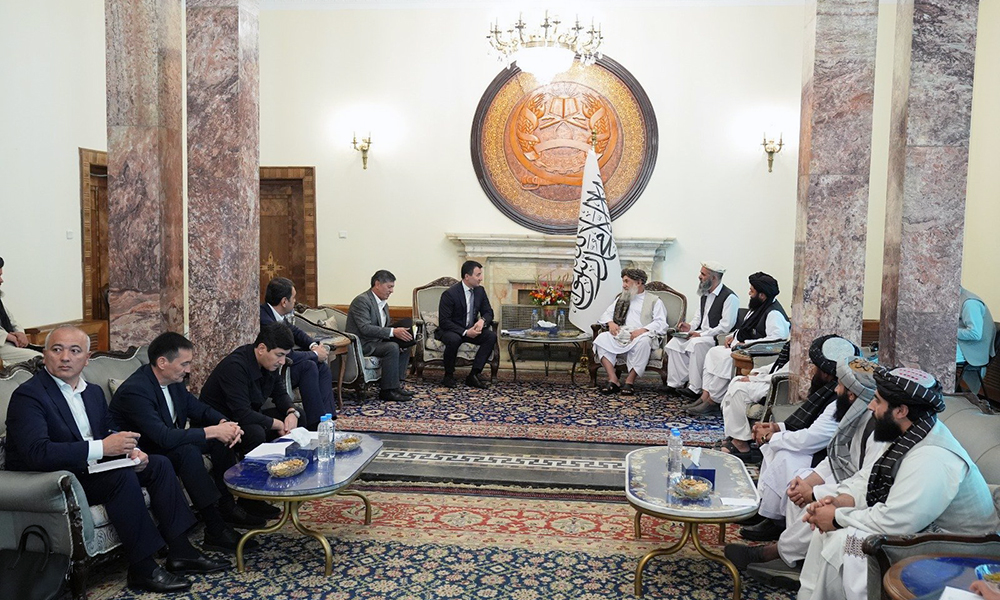
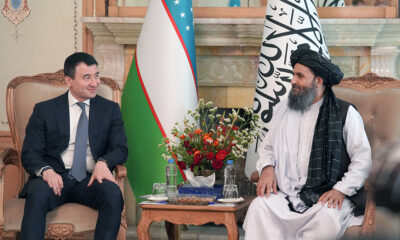
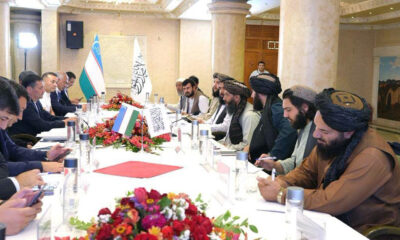
Afghanistan’s Prime Minister, Mullah Mohammad Hassan Akhund, met on Sunday at the Gulkhana Palace with Uzbekistan’s Deputy Prime Minister, Jamshid Khojayev, who arrived this weekend in Kabul leading a high-level delegation.
The meeting was also attended by Dr. Mullah Abdul Wasi, Chief of Staff of the Office of the Prime Minister of the Islamic Emirate of Afghanistan, Hedayatullah Badri, Minister of Mines and Petroleum, and Abdul Ghafar Bahr, Ambassador of the Islamic Emirate of Afghanistan to Uzbekistan.
At the outset of the meeting, Deputy Prime Minister Khojayev said the purpose of the visit by the high-level Uzbek delegation, comprising ministers, deputy ministers, business leaders, and investors, was to strengthen the economic and political relations between the two countries.
Referring to the cordial ties between Uzbekistan and Afghanistan, he said Afghanistan holds an important place in Uzbekistan’s foreign policy.
He added that, under the directives of President Shavkat Mirziyoyev, the primary objective of the visit is to begin the practical implementation of commitments made in the areas of investment and trade so that both countries can see tangible results.
Khojayev said Afghanistan’s total exports to Uzbekistan reached US$150 million last year. Since the beginning of the current year, exports have reached US$111 million, and the figure is expected to increase further by the end of the year.
He also stated that Uzbekistan has so far issued 5,000 visas to Afghan nationals, reflecting the continued expansion of friendship and economic relations between the two countries.
Prime Minister Mullah Mohammad Hassan Akhund welcomed Deputy Prime Minister Khojayev and the accompanying delegation, describing the visit as significant for strengthening bilateral relations between Afghanistan and Uzbekistan.
He said the visit of the high-level Uzbek delegation and the expansion of economic cooperation demonstrate Uzbekistan’s strong confidence in Afghanistan’s future.
At the conclusion of the meeting, Prime Minister Akhund assured the Uzbek Deputy Prime Minister that Afghanistan welcomes stronger relations with the friendly and brotherly country and remains fully committed to implementing the commitments that have been made.
Latest News
Badakhshan Governor, Army Chief reaffirm commitment to Afghanistan’s security
The Badakhshan governor also urged everyone to encourage opposition groups not to destabilize the country and to appreciate the current security situation.
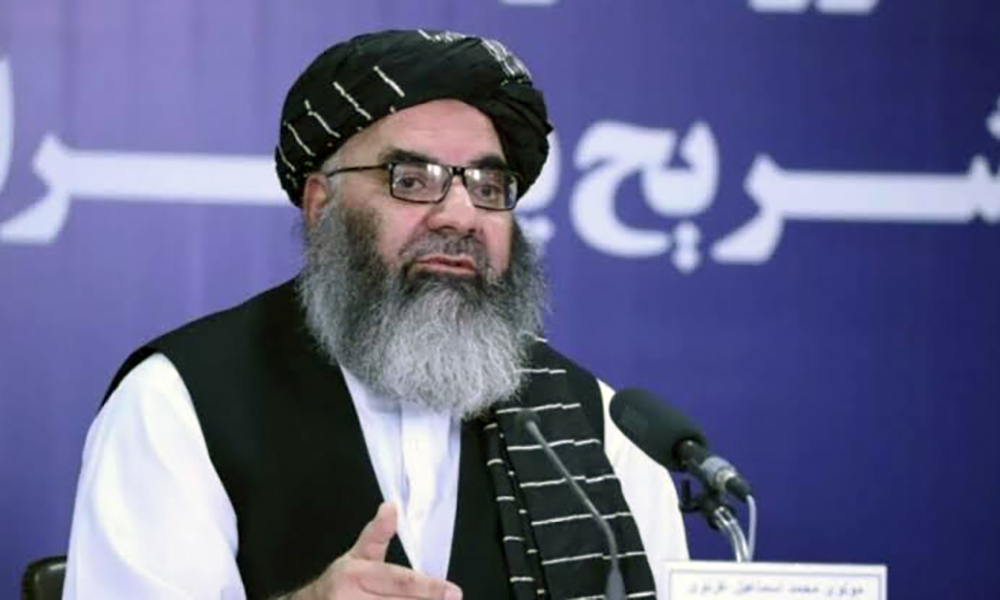
Badakhshan Governor Mohammad Ismail Ghaznavi said during a public gathering that no individual or group would be allowed to threaten Afghanistan’s security.
Ghaznavi called on opposition groups to stop their disruptive activities and refrain from threatening the security of the country’s citizens. He also addressed the opposition, saying: “What did you achieve during the past twenty years when NATO and U.S. forces were supporting you? We know well how to suppress and fight you, and your dream of taking control of the country may be buried with you.”
The Badakhshan governor also urged everyone to encourage opposition groups not to destabilize the country and to appreciate the current security situation. He said: “Our country needs reconstruction. How long should there be war? Anyone who has a problem should come forward; the doors of the Islamic Emirate are open to them.”
He concluded by saying there is no need for anyone to create disturbances against the Islamic system.
Meanwhile, Qari Fasihuddin Fitrat, Chief of Army Staff of the Ministry of Defense of the Islamic Emirate of Afghanistan, stressed during a visit to Zebak district of Badakhshan province that security forces will not allow any individual or group to disrupt Afghanistan’s security.
Fitrat, who traveled to Zebak to assess the security situation, said Pakistan had supported some opponents of the Islamic Emirate, but they were defeated by the resistance of the Islamic Emirate’s forces. Following the recent clash in the Topkhana–Chitral area, he announced that security forces are fully prepared to defend the country’s borders and warned that any attempt to create insecurity would be met with a decisive response.
According to sources, during the recent clash between security forces and an armed group attempting to enter Zebak from the Shah Salim area of Chitral, at least five people were killed, several others fled to Pakistan, and Commander Marouf, described as a key commander of the Freedom Front, was killed during the clash and the subsequent pursuit operation by security forces.


Tahawol: Trump halting major Iran escalation

Saar: Afghanistan-Uzbekistan economic ties

Afghan team arrives in England for training camp ahead of Ireland ODI series

Afghanistan can link South and Central Asia through data transit: Baradar

Afghanistan, Uzbekistan discuss expanding economic, trade and investment cooperation

India offers 1,000 online scholarships for Afghan students for 2026-27 academic year

Afghanistan eyes direct Basmati rice imports from India amid tensions with Pakistan

Cricket world pays tribute to Afghanistan fast bowler Shapoor Zadran

Turkey spent over $120 million to prepare airport for Qatar-donated U.S. presidential aircraft

Afghanistan, Uzbekistan set for friendly cricket clash in Khost
Tahawol: Trump halting major Iran escalation
Saar: Afghanistan-Uzbekistan economic ties

Tahawol: New developments ahead in the Middle East discussed

Saar: Rising tensions between Kabul and Islamabad discussed

Tawsia: Factors behind rising fuel prices in Afghanistan discussed
-
 Latest News4 days ago
Germany defends Afghan deportation policy after fatal Trier knife attack
-
 Sport4 days ago
FIFA updates world rankings; Spain climbs to No. 1, Afghanistan ranked 171st
-
 Latest News4 days ago
Afghanistan and Uzbekistan advance railway cooperation, discuss Trans-Afghan project
-
 World5 days ago
War in Iran has cost the US $37.5 billion so far, Pentagon says
-
 Latest News4 days ago
Amnesty International calls for probe into Pakistan airstrike on Kabul rehabilitation centre
-
 Business4 days ago
Pakistan’s trade deficit with neighbours surges to nearly $16 billion as exports to Afghanistan plunge
-

 Sport4 days ago
Rahmat Shah Zurmati appointed Afghanistan’s new Test and ODI captain
-
 Latest News2 days ago
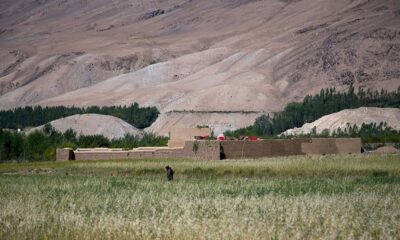
Five armed men killed while attempting to cross Durand Line into Badakhshan