
Latest News
China to launch high-stakes crewed mission to space

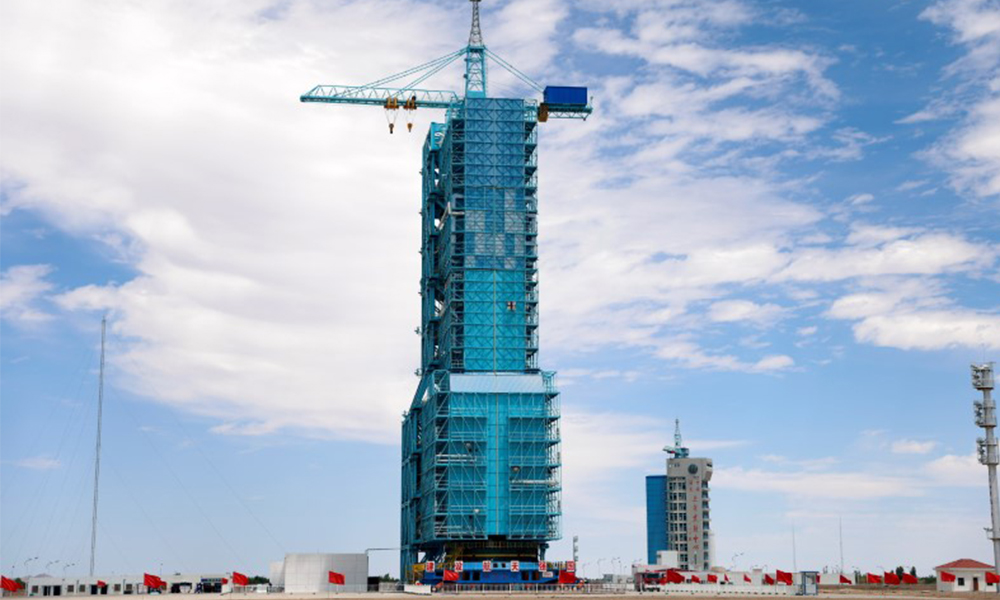
China will send three astronauts into orbit on Thursday in a high-stakes mission, the first of four crewed space flights to complete the country’s space station by the end of next year.
China will launch Nie Haisheng, Liu Boming and Tang Hongbo into orbit aboard the spacecraft Shenzhou-12 at 9:22 a.m. (0122 GMT) on June 17 from Jiuquan in northwestern Gansu province.
Nie, 56, a former air force pilot, will be the oldest Chinese astronaut to go to space.
Shenzhou-12, meaning “Divine Vessel”, is the third of 11 missions needed to build China’s space station. Construction began in April with the launch of Tianhe, the first and largest of three modules.
The Shenzhou-12 crew are to live on the Tianhe, which means “Harmony of the Heavens”, a cylinder 16.6 m (55 ft) long and 4.2 m (14 ft) in diameter.
The three-month stay for Nie, Liu and Tang will be the longest for any Chinese astronauts, and one focus will be seeing how the men handle their relatively long time in orbit.
“The (mission) is longer this time, and not only do we have to set up the core module – this ‘home’ in space – we’ve to carry out a series of pivotal technical tests,” Nie told reporters in Jiuquan.
“This mission is more arduous and the challenges are greater.”
Shenzhou-12 will be Nie’s third space outing, the second for Liu, 54, and the first for Tang, 45.
On Liu’s Shenzhou-7 mission in 2008, his first, he almost did not get to perform a space walk to plant the Chinese flag on the exterior of the spacecraft.
Liu, with the help of another astronaut, used a crowbar to pry open the hatch after it refused to budge.
“We experienced some dangerous situations and encountered some difficulties on that mission,” Liu said on Wednesday.
“The amount of time spent outside the cabin on this mission is much longer, and there will be many rounds of extra-vehicular activity. The mission has thus become extremely complex and tough.”
Chinese astronauts have had a comparatively low international profile.
U.S. legislation bars NASA from any cooperation with China, and Chinese astronauts have not been to the more than two-decade-old International Space Station (ISS), which has been visited by more than 240 men and women of various nationalities.
The ISS may be decommissioned in 2024 if the project does not receive new funding, and China could end up being the operator of the only space station in Earth’s orbit.
“After the completion of the Chinese space station, in the near future, we will see both Chinese and foreign astronauts jointly participate in the flight of the Chinese space station,” said Ji Qiming, assistant director at the China Manned Space Agency, told reporters in Jiuquan.
China’s space launches drew intense international attention last month after remnants of the rocket that carried the Tianhe module into space fell back to Earth with no official forecast of their expected landing location until literally the final minutes.
“We’re willing to carry out more extensive international exchanges and cooperation with other countries on the issue of debris from spacecraft and in space,” Ji said.
Backup astronauts for the mission on Thursday are Zhai Zhigang, 54, Wang Yaping, 41 and Ye Guangfu, 40.
China’s last crewed flight mission was in 2016 when two men – Chen Dong and Jing Haipeng – were sent via the Shenzhou-11 spacecraft to Tiangong-2, a prototype of the space station where they later stayed for about a month.












Kazakhstan’s Foreign Minister Mukhtar Tileuberdi has called for pragmatic and coordinated international engagement with Afghanistan, saying the country’s long-term stability is closely linked to the security and sustainable development of Central Asia.
Speaking during the general debate of the 81st session of the United Nations General Assembly in New York on Friday, Tileuberdi said humanitarian assistance to Afghanistan remains essential but alone cannot break the cycle of poverty, displacement and dependency.
He said Kazakhstan supports a “pragmatic, coordinated and step-by-step” approach to international engagement with Afghanistan, with the United Nations playing a central role.
Tileuberdi also said Kazakhstan is working with the UN to operationalize the United Nations Regional Centre for the Sustainable Development Goals for Central Asia and Afghanistan in Almaty.
He said the success of the centre should be measured by the results and assistance it delivers to the region.


Abu Muslim Farah defeat Khurasan Faryab 2-0 in ACL season six

Saar: Concerns over Pakistan’s political crisis discussed

Afghanistan Champions League: Omar Zawak Herat beat Toofan Herat 1-0

Blast in Pakistan’s Dera Ismail Khan kills 11, injures 30

Ariana Afghan Airlines increases Kabul-Delhi cargo flights

Saudi energy group signs major Afghanistan deals covering gas exploration and pipeline plans

Trump floats idea of renaming Atlantic or Pacific Ocean

US hits Egyptian bank branches with Iran sanctions as war marks six months

Nepal flood rescue mission enters critical phase as thousands remain missing

Iranian clubs to face Gulf opponents at neutral venues in Asian Champions League Elite
Saar: Concerns over Pakistan’s political crisis discussed

Exclusive interview with Abdul Latif Mansoor, Minister of MRRD

Tawsia: Overview of Afghanistan’s iron mines

Tahawol: Discussion on fresh Pakistani airstrikes on Afghanistan

Saar: Calls for international support for Afghanistan discussed
-

 World5 days ago
CNN, MS NOW and Politico sue Trump, challenging White House ban
-

 Latest News3 days ago
Ariana Afghan Airlines ranks seventh among 45 Central Asian airlines
-

 Latest News5 days ago
UN reiterates call for respect for international law after Kunar airstrikes
-

 Regional4 days ago
US and Iran hold first talks since June after Trump’s ‘annihilation’ threat
-

 Latest News3 days ago
Silk Road highway in Wakhan corridor now reaches the China border
-

 Latest News5 days ago
Afghan Official: Pakistan’s airstrikes will not go unanswered
-

 Regional3 days ago
Iran airlines cancel flights as US sanctions hit
-

 Sport5 days ago
Afghan boxing referee heads to China for international festival