
Latest News
Taliban shows willing-signs to get along with India

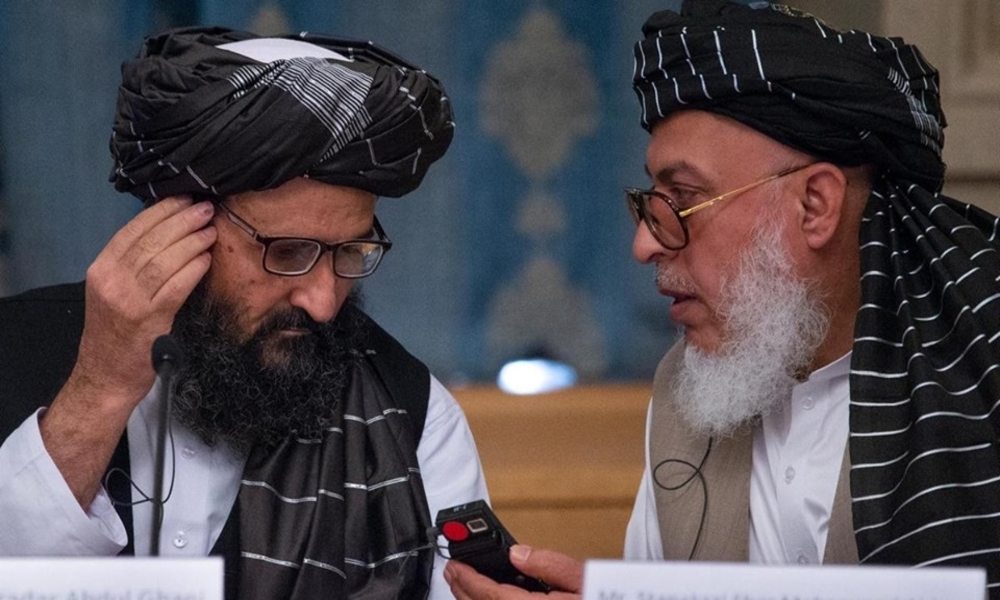
Shir Mohammad Abbas Stanikzai, a prominent member of the political office the Taliban in Qatar, told Ariana News that as soon as Delhi contributed positively to the Afghan peace process, the Taliban were ready to get along.
Since the start of the talks between the United States and the Taliban in 2019, many countries, including Russia, China, Pakistan, Iran, and some Central Asian countries, have approached the Taliban representatives, except for India.
The United States has recently poked India to participate in the process. The Taliban have also welcomed it, saying it is conditional of a positive move by the India side.
Responding to the question ‘if the Taliban were willing to talk to India as part of the US efforts’, the group’s prominent member Stanikzai said, “We have no problem with anyone who wants to take a positive step towards peace in Afghanistan. Whenever they want to take a positive step in this regard, we are ready to talk with them for peace.”
Zalmay Khalilzad, the US special representative for reconciliation in Afghanistan, has said India was an important element in Afghanistan’s peace process and would welcome its involvement in it
In the meantime, ThePrint, an Indian digital news platform, has written that it was not expected that the Narendra Modi administration would change its position and be directly part of Afghanistan’s peace talks with the Taliban unless it derives from pressure by the United States.
It has quoted senior Indian officials as saying that New Delhi was willing to speak out if the Taliban recognized the democratic government – the Afghan government – and that the United States was now forcing India to take part in the Afghan peace talks.
An Afghan free journalist, Sami Yousufzai, who is mostly following the peace process and its events, believes that India is deeply concerned about the Taliban’s return to the Afghan political system.
“It is a fact that during the Taliban regime, thousands of Kashmiri jihadist fighters were active in Afghanistan.” He has said noting that when the United States sought a guarantee from the Taliban that there would be no more room for al-Qaeda or other groups that pose a threat to the United States and the West, India also wanted to receive a commitment from the Taliban as such.
On the other hand, according to Yousufzai, Zalmay Khalilzad has tried to share India’s concerns with the Taliban, which seems to be fruitful as a relationship seems to have taken birth between the Taliban and India.
The progress in the Afghan peace talks has shown that Pakistan has influence over the Taliban and is a key player in the process.
India, on the other hand, had no place in the process but has now made it clear that at the other end of the process – the Afghan government – it has a strong position in relation to the Ghani-led government.
Ahmad Saeedi, a former diplomat at the Afghan embassy in Pakistan, said that following the US-Taliban agreement, [India] was deeply concerned thinking that all the provisions of the agreement were in Pakistan’s interest; therefore, Zalmay Khalilzad has been trying to seek India’s satisfaction to step into negotiations with the Taliban.
So far, India has not yet announced its will for direct talks with the Taliban; however, a point to be noted is that after meeting with Indian officials, Zalmay Khalilzad traveled to Pakistan and met with Qamar Bajwa, Pakistani army’s chief of staff, to seek Islamabad’s support in speeding up starting the Intra-Afghan talks, reducing violence, and overall, to help take the Afghan peace process to next level.
Khalilzad travels to Qatar to meet with Taliban political representatives, following up on his agenda: the acceleration of government-Taliban prisoner releases, the immediate start of Intra-Afghan talks, the reduction of violence, the humanitarian ceasefire, and last but not the least, India’s participation in the peace process.






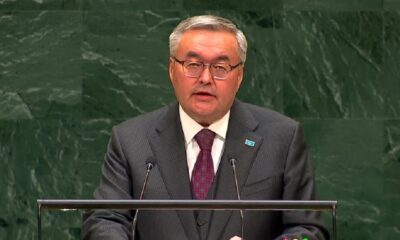




Kazakhstan’s Foreign Minister Mukhtar Tileuberdi has called for pragmatic and coordinated international engagement with Afghanistan, saying the country’s long-term stability is closely linked to the security and sustainable development of Central Asia.
Speaking during the general debate of the 81st session of the United Nations General Assembly in New York on Friday, Tileuberdi said humanitarian assistance to Afghanistan remains essential but alone cannot break the cycle of poverty, displacement and dependency.
He said Kazakhstan supports a “pragmatic, coordinated and step-by-step” approach to international engagement with Afghanistan, with the United Nations playing a central role.
Tileuberdi also said Kazakhstan is working with the UN to operationalize the United Nations Regional Centre for the Sustainable Development Goals for Central Asia and Afghanistan in Almaty.
He said the success of the centre should be measured by the results and assistance it delivers to the region.


Afghanistan Champions League: Omar Zawak Herat beat Toofan Herat 1-0

Blast in Pakistan’s Dera Ismail Khan kills 11, injures 30

Ariana Afghan Airlines increases Kabul-Delhi cargo flights

Khalilzad questions Pakistan’s commitment to Afghan welfare

India, UN envoy discuss Afghanistan’s humanitarian needs

Saudi energy group signs major Afghanistan deals covering gas exploration and pipeline plans

Trump floats idea of renaming Atlantic or Pacific Ocean

US hits Egyptian bank branches with Iran sanctions as war marks six months

Nepal flood rescue mission enters critical phase as thousands remain missing

Iranian clubs to face Gulf opponents at neutral venues in Asian Champions League Elite

Exclusive interview with Abdul Latif Mansoor, Minister of MRRD

Tawsia: Overview of Afghanistan’s iron mines

Tahawol: Discussion on fresh Pakistani airstrikes on Afghanistan

Saar: Calls for international support for Afghanistan discussed

Tahawol: Opening of the 81st UN General Assembly Session
-

 World4 days ago
CNN, MS NOW and Politico sue Trump, challenging White House ban
-

 Latest News3 days ago
Ariana Afghan Airlines ranks seventh among 45 Central Asian airlines
-
 Latest News5 days ago
Khalilzad condemns Pakistan airstrikes, says current strategy is not working
-

 Latest News4 days ago
UN reiterates call for respect for international law after Kunar airstrikes
-

 Regional3 days ago
US and Iran hold first talks since June after Trump’s ‘annihilation’ threat
-

 Latest News3 days ago
Silk Road highway in Wakhan corridor now reaches the China border
-

 Latest News4 days ago
Afghan Official: Pakistan’s airstrikes will not go unanswered
-

 Sport4 days ago
Afghan boxing referee heads to China for international festival