
Latest News
As Trump downplays COVID ahead of elections, US infections continue to climb

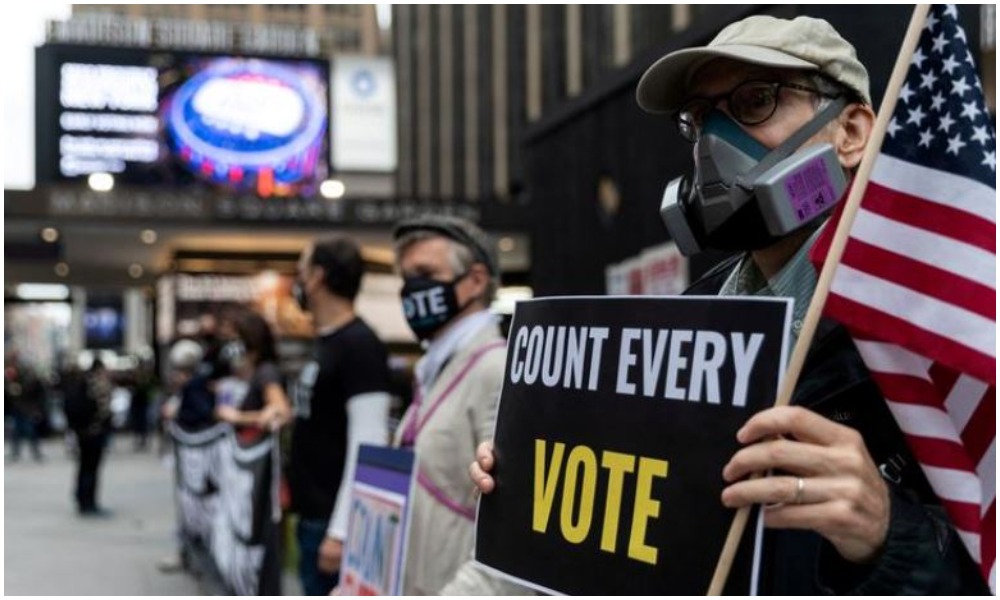
With US elections just one day away, coronavirus cases continued to climb in America at a staggering rate while Midwestern states reported record numbers of hospitalizations.
On Saturday, almost 87,000 new cases were reported, with 909 deaths, according to a Reuters tally.
President Donald Trump, the Republican seeking re-election against Democratic challenger Joe Biden has continued to downplay the virus and accused Democrats of overblowing the pandemic that has killed more 230,000 Americans, more than any other country, Reuters reported.
Biden and fellow Democrats have stated Trump is a poor leader who failed to contain COVID-19 in the United States, which also leads the world in the daily average number of new cases.
This comes after Trump falsely accused doctors of profiting from COVID-19 deaths – a statement that drew harsh criticism from the governor of Wisconsin.
“We have a president that believes that the doctors are at fault, they’re messing with the numbers and he believes that it’s over. It ain’t over,” Democratic Governor Tony Evers told CNN’s “State of the Union” on Sunday.
“We have hospitalizations going through the roof,” he said. “We absolutely need somebody that understands that this is an issue, it’s a thing. People are dying.”
Biden campaign adviser Anita Dunn meanwhile came out in defense of doctors after Trump’s attack, saying many hospital workers have not not had adequate protective gear for a long time.
“These people have been risking their lives since the beginning of this crisis,” she said on ABC’s “This Week.”
Reuters reported that Trump’s comments referred to reports on doctors’ billing practices, Trump campaign adviser Jason Miller said on the same program, without elaborating.
Scott Gottlieb, a former Food and Drug Administration commissioner appointed by Trump, told CBS’ “Face the Nation” it was “troubling” to suggest doctors were manipulating data to get higher reimbursements as the country enters a difficult phase.
“Things are getting worse around the country,” and more aggressive actions will be needed to fight the virus’ spread, he said, with December likely to be the toughest month.
Ohio is another state where the infection rate is climbing.
Republican Governor Mike DeWine said: “This thing is really, really spreading in Ohio.”
Speaking to CNN he attributed the increase to more social gatherings, people not wearing masks and letting their guard down.
Meanwhile, Stanford University economists estimated that Trump’s campaign rallies have resulted in 30,000 additional confirmed cases of COVID-19, and likely led to more than 700 deaths overall, according to a paper posted over the weekend.
Infectious disease experts have long suspected that Trump’s campaign rallies might be so-called “superspreader events” but scientists have not been able to confirm this partly due to a lack of contact tracing.
Trump has meanwhile repeatedly disdained masks, even after outbreaks affected his own family and a number of White House staffers, Reuters reports.
In contrast, Biden has stuck to federal health guidelines that discourage large, crowded gatherings during his campaign events and he has called Trump’s handling of the virus negligent and irresponsible.












Kazakhstan’s Foreign Minister Mukhtar Tileuberdi has called for pragmatic and coordinated international engagement with Afghanistan, saying the country’s long-term stability is closely linked to the security and sustainable development of Central Asia.
Speaking during the general debate of the 81st session of the United Nations General Assembly in New York on Friday, Tileuberdi said humanitarian assistance to Afghanistan remains essential but alone cannot break the cycle of poverty, displacement and dependency.
He said Kazakhstan supports a “pragmatic, coordinated and step-by-step” approach to international engagement with Afghanistan, with the United Nations playing a central role.
Tileuberdi also said Kazakhstan is working with the UN to operationalize the United Nations Regional Centre for the Sustainable Development Goals for Central Asia and Afghanistan in Almaty.
He said the success of the centre should be measured by the results and assistance it delivers to the region.


Abu Muslim Farah defeat Khurasan Faryab 2-0 in ACL season six

Saar: Concerns over Pakistan’s political crisis discussed

Afghanistan Champions League: Omar Zawak Herat beat Toofan Herat 1-0

Blast in Pakistan’s Dera Ismail Khan kills 11, injures 30

Ariana Afghan Airlines increases Kabul-Delhi cargo flights

Saudi energy group signs major Afghanistan deals covering gas exploration and pipeline plans

Trump floats idea of renaming Atlantic or Pacific Ocean

US hits Egyptian bank branches with Iran sanctions as war marks six months

Nepal flood rescue mission enters critical phase as thousands remain missing

Iranian clubs to face Gulf opponents at neutral venues in Asian Champions League Elite
Saar: Concerns over Pakistan’s political crisis discussed

Exclusive interview with Abdul Latif Mansoor, Minister of MRRD

Tawsia: Overview of Afghanistan’s iron mines

Tahawol: Discussion on fresh Pakistani airstrikes on Afghanistan

Saar: Calls for international support for Afghanistan discussed
-

 World5 days ago
CNN, MS NOW and Politico sue Trump, challenging White House ban
-

 Latest News3 days ago
Ariana Afghan Airlines ranks seventh among 45 Central Asian airlines
-

 Latest News5 days ago
UN reiterates call for respect for international law after Kunar airstrikes
-

 Regional4 days ago
US and Iran hold first talks since June after Trump’s ‘annihilation’ threat
-

 Latest News3 days ago
Silk Road highway in Wakhan corridor now reaches the China border
-

 Latest News5 days ago
Afghan Official: Pakistan’s airstrikes will not go unanswered
-

 Regional3 days ago
Iran airlines cancel flights as US sanctions hit
-

 Sport4 days ago
Afghan boxing referee heads to China for international festival