
Latest News
Rescuers find debris thought to be from missing Indonesian submarine

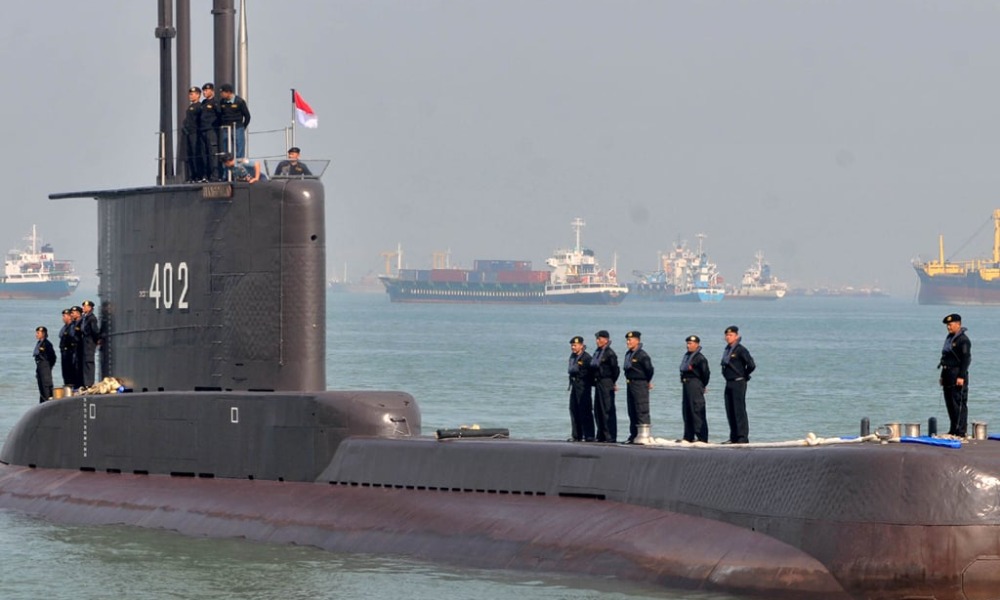
Search teams have recovered debris believed to be from an Indonesian submarine missing for days in the Bali Sea, defence officials said on Saturday, as hopes dwindled for the 53 crew who were expected to have run out of oxygen in the early hours, Reuters reported.
Indonesian Navy Chief of Staff Yudo Margono said the exact location of the 44-year-old submarine was unknown but its presence had been detected and the search would continue.
The KRI Nanggala-402 lost contact on Wednesday as it prepared to conduct a torpedo drill.
“We are still carrying out the search … the depth of the sea we have detected is at 850 metres which is very tricky and presents many difficulties,” he told reporters, adding that he expected the dive in depth taken by the vessel had led to cracks.
“We have found debris floating around the submarine’s last location,” Yudo said.
Rescuers have sent more than a dozen search helicopters and ships to the area where contact was lost, with the United States, Australia, Singapore, Malaysia, and India providing assistance.
According to Yudo, the submarine had only enough air to last until around dawn on Saturday if it had lost power, but that this could be stretched for five days if the vessel had retained electricity, Reuters reported.
But even that assessment on oxygen was optimistic, according to experts, because it assumed the submarine had not been crushed by water pressure.
“Now it’ll be up to the investigators to establish the chronology of events and determine the cause. At the same time, plans would have been made to assess the feasibility of retrieving the sub at such extreme depth,” said Collin Koh, Research Fellow at the Institute of Defence and Strategic Studies.
“It’s technically possible to do it, though I believe Indonesia will have to engage foreign assistance in this.”
Indonesia’s navy has said it is investigating whether the submarine lost power during a dive and could not carry out emergency procedures as it descended to a depth of 600-700 metres, well beyond its survivable limits.
Indonesian navy retired rear admiral Frans Wuwung, who had previously headed the submarine’s machinery room, told news channel MetroTV that he believed a blackout was likely and could have caused the crew to panic.
“A blackout means the vessel’s equipment cannot be moved,” said the admiral, who told reporters he had experienced a blackout on the same submarine in 1985.
One of the people on board was the commander of the Indonesian submarine fleet, Harry Setiawan.
Indonesia operates five submarines — two German-built Type 209s including Nanggala and three newer South Korean vessels.
It has been seeking to modernise its defence capabilities but some of its equipment is old and there have been fatal accidents in recent years.












Kazakhstan’s Foreign Minister Mukhtar Tileuberdi has called for pragmatic and coordinated international engagement with Afghanistan, saying the country’s long-term stability is closely linked to the security and sustainable development of Central Asia.
Speaking during the general debate of the 81st session of the United Nations General Assembly in New York on Friday, Tileuberdi said humanitarian assistance to Afghanistan remains essential but alone cannot break the cycle of poverty, displacement and dependency.
He said Kazakhstan supports a “pragmatic, coordinated and step-by-step” approach to international engagement with Afghanistan, with the United Nations playing a central role.
Tileuberdi also said Kazakhstan is working with the UN to operationalize the United Nations Regional Centre for the Sustainable Development Goals for Central Asia and Afghanistan in Almaty.
He said the success of the centre should be measured by the results and assistance it delivers to the region.


Abu Muslim Farah defeat Khurasan Faryab 2-0 in ACL season six

Saar: Concerns over Pakistan’s political crisis discussed

Afghanistan Champions League: Omar Zawak Herat beat Toofan Herat 1-0

Blast in Pakistan’s Dera Ismail Khan kills 11, injures 30

Ariana Afghan Airlines increases Kabul-Delhi cargo flights

Saudi energy group signs major Afghanistan deals covering gas exploration and pipeline plans

Trump floats idea of renaming Atlantic or Pacific Ocean

US hits Egyptian bank branches with Iran sanctions as war marks six months

Nepal flood rescue mission enters critical phase as thousands remain missing

Iranian clubs to face Gulf opponents at neutral venues in Asian Champions League Elite
Saar: Concerns over Pakistan’s political crisis discussed

Exclusive interview with Abdul Latif Mansoor, Minister of MRRD

Tawsia: Overview of Afghanistan’s iron mines

Tahawol: Discussion on fresh Pakistani airstrikes on Afghanistan

Saar: Calls for international support for Afghanistan discussed
-

 World5 days ago
CNN, MS NOW and Politico sue Trump, challenging White House ban
-

 Latest News3 days ago
Ariana Afghan Airlines ranks seventh among 45 Central Asian airlines
-

 Latest News5 days ago
UN reiterates call for respect for international law after Kunar airstrikes
-

 Regional4 days ago
US and Iran hold first talks since June after Trump’s ‘annihilation’ threat
-

 Latest News4 days ago
Silk Road highway in Wakhan corridor now reaches the China border
-

 Regional3 days ago
Iran airlines cancel flights as US sanctions hit
-

 Latest News5 days ago
Afghan Official: Pakistan’s airstrikes will not go unanswered
-

 Regional5 days ago
G7 foreign ministers call on Iran to stop arming Houthis